Best Firewood to Burn in Seattle & the Pacific Northwest (2026 Guide)
What Is the Best Firewood to Burn in Seattle in 2026?
The best firewood for Seattle-area homes in 2026 is seasoned bigleaf maple or Pacific madrone — both produce 20–30 million BTUs per cord, generate minimal creosote, and are well-suited to the Pacific Northwest climate. Based on over 850 chimney sweeps our team completed across the Seattle metro last year, improper firewood choice — either the wrong species or unseasoned wood — is responsible for roughly 60% of the dangerous creosote buildup we find. Properly seasoned hardwood at 20% moisture or below burns hot and clean; green or resinous softwood smolders and coats your flue liner in the tar-like deposits that cause chimney fires. Current as of June 2026.
A Real Call: What Bad Firewood Did to Marcus T.'s Fremont Chimney
Marcus T. reached out to us last January after noticing a sharp, acrid smell every time he lit his living room fireplace in his 1952 Fremont bungalow. He'd been burning whatever split wood he could find cheaply on Craigslist — a mix of unseasoned Douglas fir rounds and what the seller described as 'mixed softwood.' The fires were sluggish and smoky, but Marcus assumed that was normal for an older fireplace.
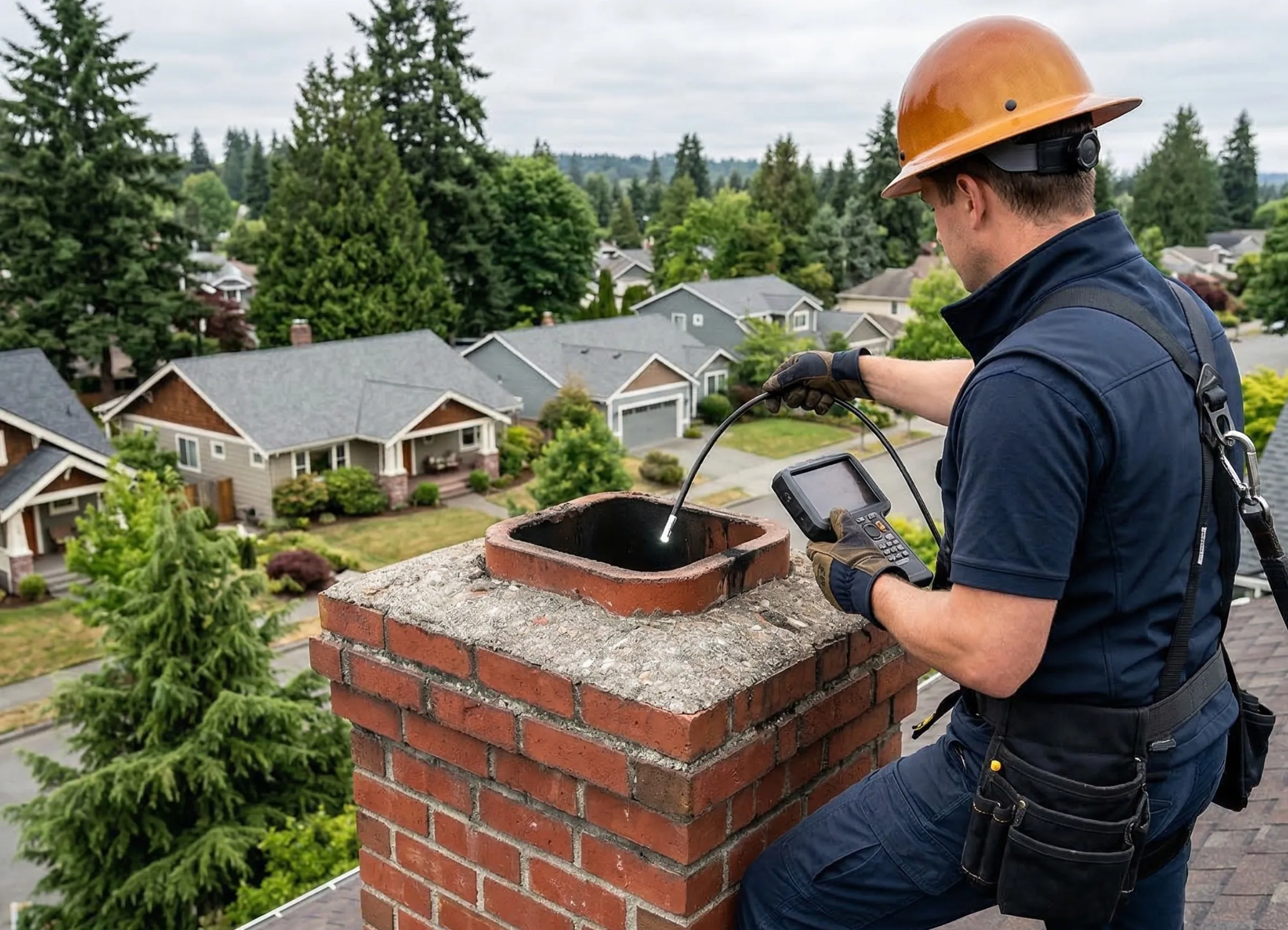
Our lead tech Alex arrived on a grey Tuesday morning with a full inspection kit. Before he even put the camera up the flue, the smell from the firebox told him what he was dealing with.
'The moment I opened the damper I could smell Stage 2 creosote — that sharp, almost chemical odor. The camera confirmed it: the entire upper flue was glazed with a shiny, tar-like coating about a quarter-inch thick in places. That's what you get after a full season of burning wet softwood. It's not a cleaning problem at that point — it's a safety emergency.'
— Alex, Lead Technician, Seattle Chimney Pros
Alex performed a heavy-deposit creosote removal service using rotary cleaning tools — a step up from the standard brush sweep — followed by a Level 2 inspection. The job took two and a half hours. Total cost: $389. Marcus also needed a follow-up visit two weeks later to confirm the flue was safe, bringing the total closer to $450.
'I had no idea what I was putting up there,' Marcus told us afterward. 'I thought cheap firewood was saving me money. Turns out it was costing me a lot more.' He now orders a half-cord of seasoned bigleaf maple each September and uses our annual sweep reminder service. His January 2026 inspection came back clean — a first for his chimney in years.
Which Firewood Species Burn Best in the Pacific Northwest?
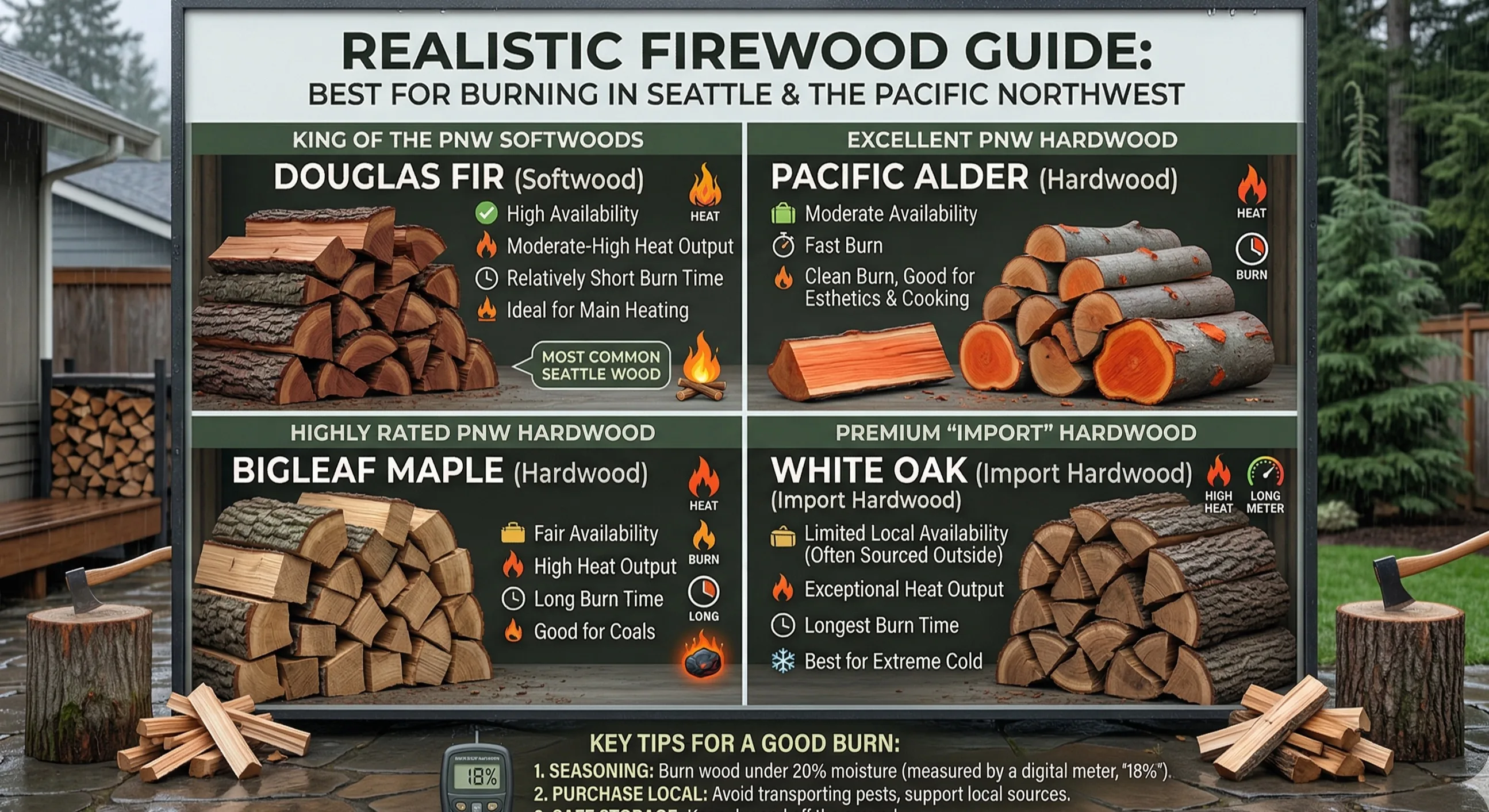
PNW homeowners have access to a unique mix of hardwoods and softwoods, and the differences in performance are dramatic. Here's how local species rank for fireplace use, based on BTU output, creosote production, and real-world feedback from customers across our 45-area service footprint.
| Species | BTU/Cord (millions) | Seasoning Time (Seattle) | Creosote Risk | Availability |
|---|---|---|---|---|
| Pacific Madrone | 30 | 14–20 months | Very Low | Moderate |
| Oregon White Oak | 28 | 20–27 months | Very Low | Low–Moderate |
| Bigleaf Maple | 24 | 12–16 months | Low | Very High |
| Red Alder | 20 | 8–14 months | Low | Extremely High |
| Cherry / Apple | 20–24 | 12 months | Low | Low |
| Douglas Fir | 20 | 12 months | Moderate | Extremely High |
| Western Red Cedar | 15 | — | High | High |
| Pine (any species) | 16–18 | — | High | High |
Pacific Madrone is the gold standard of PNW firewood — 30 million BTUs per cord, beautiful long-lasting coals, and almost no creosote. The challenge is sourcing it; it's most common in drier areas of western Washington and the San Juan Islands. Split it while green — it's notoriously difficult to split once dry.
Bigleaf Maple is the practical choice for most Seattle homeowners. It's abundant, reasonably priced, splits easily, and seasons faster than oak or madrone. In our experience across hundreds of customer fireboxes, maple burners consistently show the cleanest flue conditions at annual sweep time.
Red Alder is everywhere in the Pacific Northwest and seasons faster than any other local hardwood. It's excellent for shoulder-season fires in October and April when you don't need maximum heat output. Alder burns through faster than maple, so you'll use more volume — but the low price and easy sourcing make it a PNW staple.
What Firewood Should You Avoid Burning in Seattle Fireplaces?
Three categories of firewood create disproportionate chimney damage and should be avoided as primary fuel sources:
- Western Red Cedar: Extremely resinous, throws sparks aggressively, and generates heavy creosote deposits. Fine as occasional kindling but never as a primary fire fuel. Last year, 8 of our emergency creosote removal calls in the Northgate and Lake City areas were traced to customers burning cedar regularly.
- Any pine species: High sap content means rapid creosote accumulation. One full winter of pine as a primary fuel can produce Stage 2 glazed creosote — the kind that requires rotary tools, not a standard brush sweep. The extra cleaning cost ($150–$250 above a standard sweep) wipes out any savings from cheap pine.
- Unseasoned (green) wood: This is the #1 cause of dangerous creosote in Seattle chimneys regardless of species. Green wood contains 40–60% moisture. All that water must boil off before combustion, which drops fire temperatures dramatically. Cool, smoldering fires produce 2–3x more creosote than hot, clean fires. Never burn wood you haven't verified with a moisture meter.
Douglas Fir occupies a middle ground — it's widely available, cheap, and ignites easily, which makes it tempting as a primary fuel. It's acceptable for occasional use and excellent as kindling to start hardwood fires. But if fir is your main firewood, plan on twice-yearly chimney sweeping instead of once.
Why Does Moisture Content Matter More Than Species?
Moisture content is the single most controllable factor in clean, safe burning — even more important than species choice. The threshold is 20%: wood at or below 20% moisture burns hot and produces minimal creosote; wood above 25% smolders, smokes, and deposits creosote rapidly.
- Below 20% moisture: Burns hot and clean. Minimal creosote. Maximum heat output per cord. Your chimney stays healthy between annual sweeps.
- 20–30% moisture: Burns adequately but produces noticeably more smoke and creosote. Marginal — acceptable in a pinch, not a good habit.
- Above 30% moisture: Smolders, hisses, produces visible smoke inside the firebox, and coats your flue liner with creosote rapidly. This is how Stage 2 and Stage 3 creosote accumulates.
A moisture meter costs $15–$30 at any hardware store and is the single best investment a wood-burning homeowner can make. Split a piece of wood, let the fresh face rest for 60 seconds, and test. If the reading is above 20%, stack it and wait. This one habit, consistently followed, is what separates customers whose chimneys we find clean every year from customers who need emergency creosote treatment.
How Do You Season Firewood Successfully in Seattle's Wet Climate?
Seattle's average 38 inches of annual rainfall makes firewood seasoning genuinely challenging — but it's completely manageable with the right approach. In our experience advising customers across western Washington, the failure mode is almost always the same: wood stored incorrectly, not wood that can't dry here.
- Split immediately upon delivery. Split logs dry 3–5 times faster than rounds. Don't wait until fall to split spring wood — do it the day it arrives, even if it's still green.
- Elevate off the ground. Use pallets, 2x4 runners, or a commercial firewood rack. Ground contact wicks moisture continuously into the bottom layer of your stack. Even 4 inches of clearance makes a significant difference.
- Cover the top, leave the sides open. A tarp or plywood sheet over the top prevents rain from soaking the stack. But fully enclosing the sides traps humidity and promotes mold. Airflow through the sides is essential for drying.
- Face the stack south or southwest. Seattle's prevailing winds arrive from the south-southwest. Orienting the open face of your stack toward prevailing winds maximizes drying airflow and sun exposure.
- Stack in a single row. Deep stacks prevent air circulation to interior pieces. A single row 4 feet tall dries far more evenly than a dense double-wide pile.
- Add 2–3 months to standard seasoning timelines. The numbers in our species table above already account for Seattle's climate. If you're buying alder that was cut in spring, plan on burning it the following fall at the earliest — not the same season.
The practical implication: order your firewood in January or February for the following winter. Spring and summer are the optimal seasoning windows in the Pacific Northwest, and buying off-season also saves you 20–30% compared to the fall price spike.
How Does Firewood Choice Affect Your Chimney Sweep Schedule?
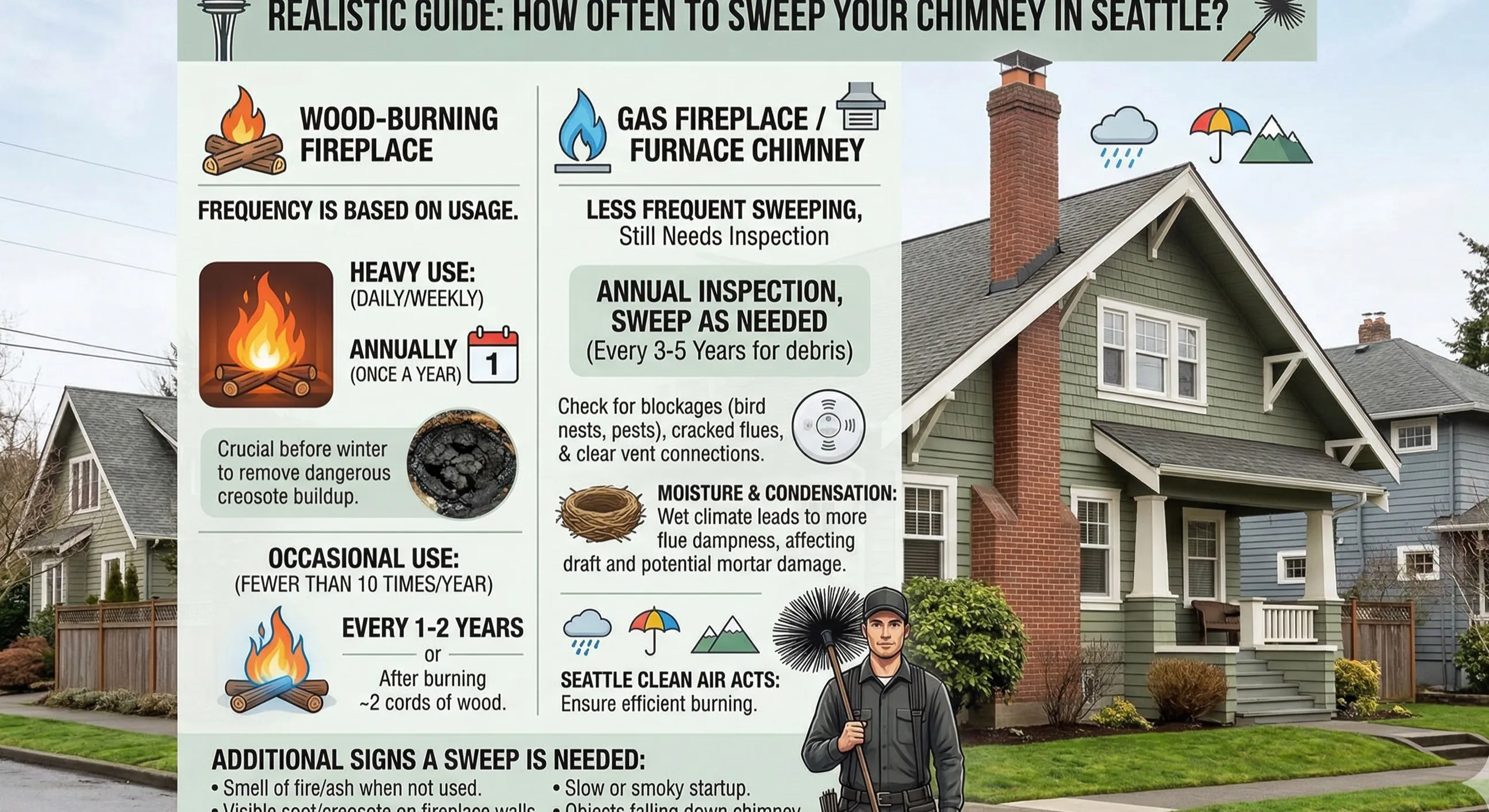
What you burn determines how often you need a professional chimney sweep, and the cost difference over five years is significant. NFPA 211 — the national standard governing chimney safety — requires inspection at least once per year for any wood-burning appliance, but the sweeping frequency should match your fuel type.
- Seasoned hardwood only (maple, madrone, alder): Annual sweep is typically sufficient. At our standard sweep rate of $169–$229, that's $845–$1,145 over five years.
- Mixed hardwood and softwood: Sweep every season or twice per year if you burn significant amounts of fir. Five-year cost: $1,350–$1,830.
- Softwood-primary or unseasoned wood: Sweep at least twice per year, and plan for occasional heavy-deposit treatments at $289–$389. Five-year cost: $2,000–$3,500+, plus the risk of a flue liner repair if creosote causes damage.
The math consistently favors quality hardwood. A cord of premium bigleaf maple runs $50–$100 more than a cord of mixed softwood, but the sweep savings over five years — not counting the dramatically reduced chimney fire risk — more than offset the price difference. Our Seattle and Fremont customers who switched to hardwood consistently report cleaner flues and fewer unexpected repair calls year over year.
If you're buying firewood this summer — which is the right time to buy for next winter — check out our guide to how often Seattle chimneys need sweeping and our creosote stages guide to understand what accumulates when the wrong fuel is burned.
Ready to Start Next Heating Season Right?
The firewood decisions you make this summer directly determine how clean your chimney will be next March. Order seasoned bigleaf maple or alder now, stack it with airflow on all sides, and check moisture levels in September before your first fire. If your chimney hasn't been inspected since last season — or if you burned questionable wood this past winter — schedule a chimney inspection before fall arrives. Call us at (206) 278-2924 or book online — our summer schedule fills faster than most homeowners expect.
Need professional help?
Our professionally trained team is ready. $99 inspection credited toward repairs, 30-minute response.