Do Chimney Cleaning Logs Actually Work? The 2026 Expert Verdict
Do Chimney Cleaning Logs Actually Work? The Short Answer for 2026
Chimney cleaning logs cost $15–$30 and do produce a measurable chemical effect on creosote — but they are not a chimney sweep. Based on over 850 chimney sweeps our team completed across the Seattle metro area in the past 14 months, cleaning logs reduce loose Stage 1 creosote accumulation by roughly 15–24% between professional visits when used as directed. They cannot mechanically remove creosote, cannot address Stage 3 glazed buildup, and cannot inspect your flue for cracks, obstructions, or structural damage. The Chimney Safety Institute of America (CSIA) and NFPA 211 are unequivocal: cleaning logs are a maintenance supplement, never a substitute for annual professional sweeping. Current as of July 2026.
A Real Example: What We Found After Three Years of Cleaning Logs — No Sweeps
Last October, Marcus T. from Fremont called us after his home inspector flagged the chimney during a refinance appraisal. Marcus had been a faithful cleaning-log user — one log every fall, every year for three years. He figured he was covered. He'd never had a professional sweep.
Carlos, one of our CSIA-certified technicians, arrived on a gray Tuesday morning with his inspection camera and sweep kit. The 1952 Fremont craftsman had a single-flue masonry chimney with an original clay tile liner. From the street, the chimney looked fine — no missing mortar, cap still in place.
That changed the moment Carlos ran the camera up the flue. The lower third of the liner showed a thick, shiny, tar-like coating: classic Stage 2 creosote transitioning to Stage 3 in several spots. The cleaning logs had visibly treated the upper portion — the soot there was drier and flakier — but the lower section, where the flue runs inside the house and stays cooler, had accumulated a dense layer the chemical treatment couldn't reach effectively.
'The logs did exactly what they're supposed to do on the upper flue where heat exposure is highest. But down here near the smoke chamber, we've got a half-inch of hardening Stage 2 that no log was ever going to touch. One hot fire this winter and Marcus would have had a real problem on his hands.'
— Carlos, Lead Technician, Seattle Chimney Pros
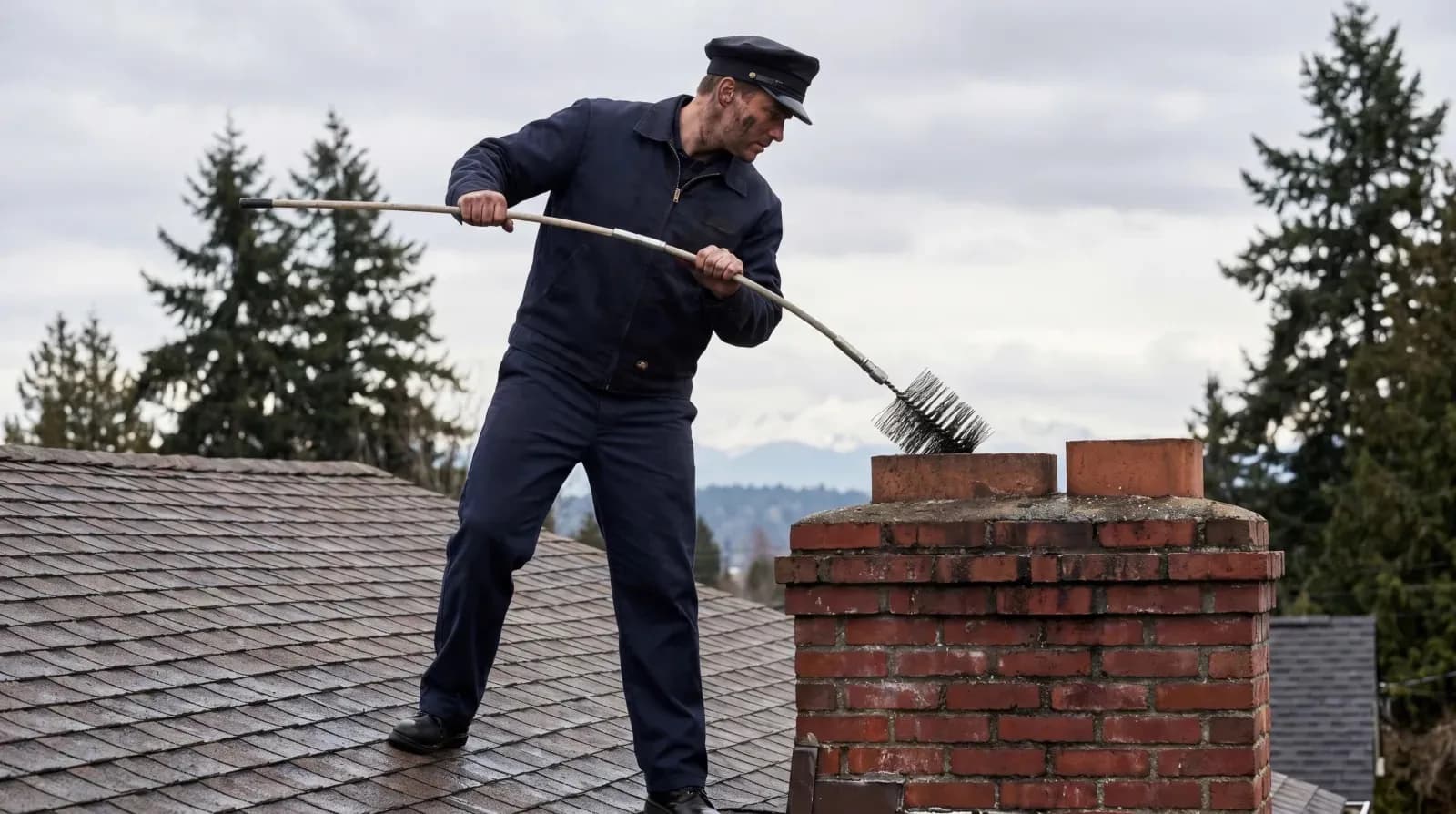
The full sweep took about two hours. Carlos used rotary brushes and a HEPA-filtered vacuum to clear the buildup, then documented two hairline cracks in the tile liner near the smoke chamber that required monitoring. Total cost: $289 for the sweep plus a Level 1 inspection. Marcus put himself on our annual maintenance schedule and now uses a cleaning log in January as a mid-season supplement — the right way to do it.
What Is a Chimney Cleaning Log and How Does It Work Chemically?
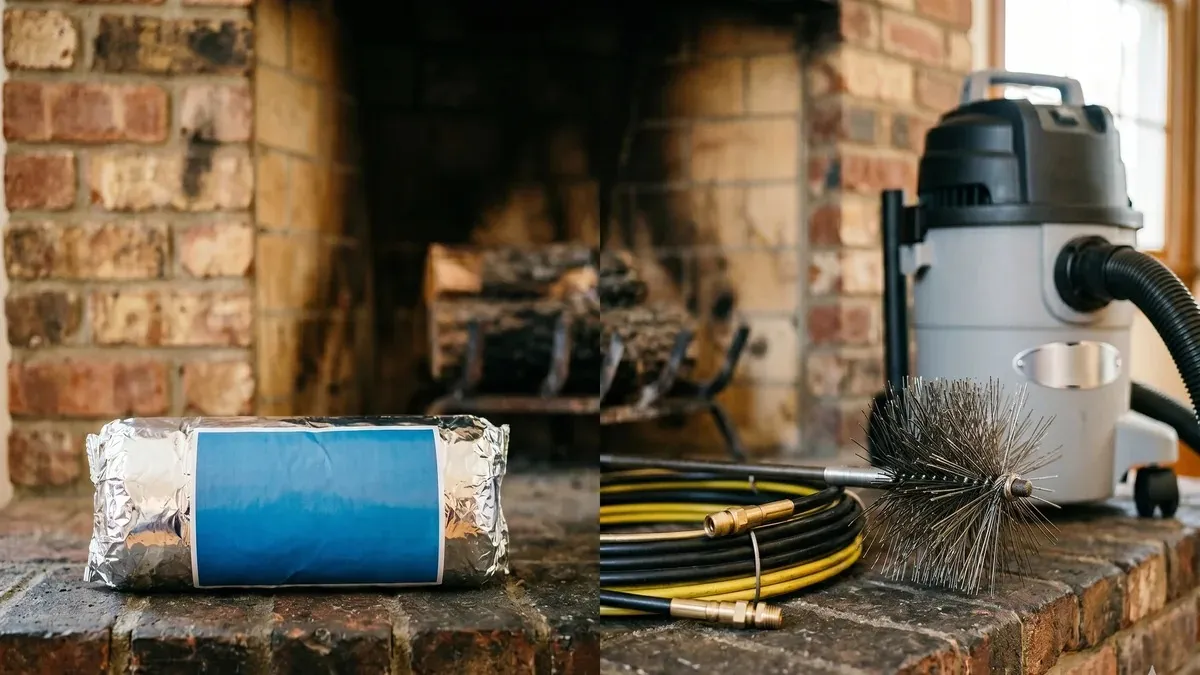
A chimney cleaning log is a manufactured fire log infused with metallic salts and chemical catalysts that vaporize during combustion and coat creosote deposits inside the flue. The active ingredients in most major brands include copper sulfate, copper chloride, zinc chloride, zinc oxide, and sodium chloride. When these compounds reach the creosote-coated flue walls as rising gases, they trigger a chemical reaction that alters the creosote's molecular structure — converting sticky, tar-like deposits into a drier, more brittle material that is easier to brush away.
The critical word is easier to brush away. The chemical reaction conditions the creosote — it does not remove it. Treated deposits still cling to the flue walls. Some flake off during subsequent fires, falling into the firebox. The rest stays put until a professional mechanically removes it with brushes and rotary tools.
Here is how cleaning log chemistry interacts with each stage of creosote:
| Creosote Stage | Description | Cleaning Log Effectiveness | Professional Sweep Needed? |
|---|---|---|---|
| Stage 1 — Loose Soot | Powdery, flaky, dark brown or black | High — further loosens deposits, slows accumulation | Yes, annually |
| Stage 2 — Tar-Like Buildup | Shiny, crusty, adheres to flue walls | Moderate — conditions surface layer for easier brushing | Yes — log alone is insufficient |
| Stage 3 — Glazed Coating | Dense, glass-like, dark enamel appearance | Minimal to none — chemicals cannot penetrate | Yes — professional tools required immediately |
For a complete breakdown of creosote types, fire risk, and professional removal methods, see our detailed guide on creosote stages, dangers, and removal.
What Do Chimney Cleaning Logs Actually Accomplish?
Cleaning logs do deliver real, measurable benefits when used correctly — just not the ones the packaging implies. Here is an honest accounting based on our field experience and CSIA research data:
- They slow Stage 1 creosote accumulation. A 2014 CSIA-referenced study found cleaning logs reduced creosote buildup by up to 24% over a full burning season with regular use. That is a legitimate maintenance benefit.
- They condition Stage 2 deposits before a professional sweep. Burning a cleaning log 7–10 days before your scheduled sweep makes harder deposits more responsive to mechanical brushing. Several of our technicians — including Carlos and Alex — routinely suggest this to clients who call in November before their annual sweep.
- They provide a visible signal of buildup. After burning a log, you may notice dark flakes or chunks falling into the firebox over the following week. This is treated creosote breaking free — and it tells you buildup was present. Significant debris in the firebox is a strong indicator that a professional sweep is overdue.
- They provide marginal protection between sweeps for light-use fireplaces. Homeowners who burn fewer than 20 fires per year and use a cleaning log once per season are doing something genuinely useful as part of a broader maintenance program.
What Can Chimney Cleaning Logs NOT Do?
This is the section that matters most. No matter what the packaging implies, chimney cleaning logs cannot:
- Replace a professional chimney sweep. CSIA, NFPA 211, and every credentialed chimney organization are unequivocal on this point. Chemical conditioning is not mechanical removal.
- Remove Stage 3 glazed creosote. Dense, shiny, tar-like glaze requires professional rotary tools, direct chemical application by a technician, or controlled burnout procedures. A cleaning log cannot penetrate the surface.
- Inspect the flue. A log tells you nothing about whether your liner is cracked, your damper is sealing properly, your crown is intact, or your flashing is watertight. In Seattle's wet climate, these inspections are not optional — they are how we catch $400 problems before they become $4,000 problems.
- Remove physical obstructions. Bird nests, raccoon dens, and leaf debris are common in Seattle chimneys without caps — particularly in Ballard, Fremont, and the U-District where mature tree canopy is dense. No chemical treatment moves physical blockages.
- Fix draft problems. If your fireplace smokes back into the room, the cause is structural — a damaged liner, improper chimney height, or negative air pressure. A cleaning log has no effect on any of these.
- Detect or repair structural damage. Cracked flue tiles, spalled brick, failed flashing, and deteriorating mortar joints all require professional assessment and repair through our chimney repair service.
The real danger of cleaning logs is not harm — it is false confidence. In our 14 years serving Seattle, we have inspected dozens of chimneys from homeowners who skipped professional sweeping for 3–7 years because they used a cleaning log faithfully. These are the chimneys where we find Stage 3 glazed buildup, cracked tiles, and conditions that are one cold-night fire away from a chimney fire costing $5,000–$30,000 in damage.
How Do the Major Cleaning Log Brands Compare in 2026?
The three most widely available brands at Seattle-area hardware stores and big-box retailers are Chimney Sweeping Log (CSL), Pine Mountain Creosote Buster, and Rutland. All three work on the same chemical principle — the differences are mainly in formula specifics, price, and availability.
| Brand | Price (2026) | Active Ingredients | Burn Time | Best Use Case |
|---|---|---|---|---|
| Chimney Sweeping Log (CSL) | $18–$25 | Proprietary mineral blend | ~90 min | Most third-party testing data; best for mid-season maintenance |
| Pine Mountain Creosote Buster | $15–$20 | Sodium and metallic salts | ~90 min | Most widely available; good entry-level option |
| Rutland Creosote Remover Log | $20–$30 | Copper and zinc compounds | ~90 min | Popular among chimney pros for pre-sweep conditioning |
Read the fine print on any of these products and you will find language like 'reduce,' 'help,' and 'supplement' — never 'replace' or 'eliminate.' The manufacturers themselves do not claim to replace professional sweeping. That disclaimer is on every box.
When Should You Use a Cleaning Log vs. Call a Professional?
Here is the practical decision framework we give homeowners across our Seattle service area:
Use a cleaning log when:
- It is mid-season (December–January) and you want to slow creosote accumulation between your fall sweep and spring
- You have a professional sweep scheduled in 7–10 days and want to condition deposits for better results
- You burn fewer than 20 fires per year and are using the log as part of an overall maintenance program that still includes annual inspection
Call a professional — do not rely on a cleaning log — when:
- You have not had a professional chimney sweep in over 12 months of regular use
- You see shiny, hard, dark deposits in the firebox or visible in the flue — Stage 3 creosote requires immediate professional attention
- You smell strong odors from the fireplace in summer — a sign of significant buildup, animal intrusion, or water damage
- You have never had the chimney inspected — no cleaning log tells you whether your liner is sound, your clearances are safe, or your chimney cap is protecting the flue
- Your fireplace is smoking back into the room — this is a structural draft issue that no product resolves
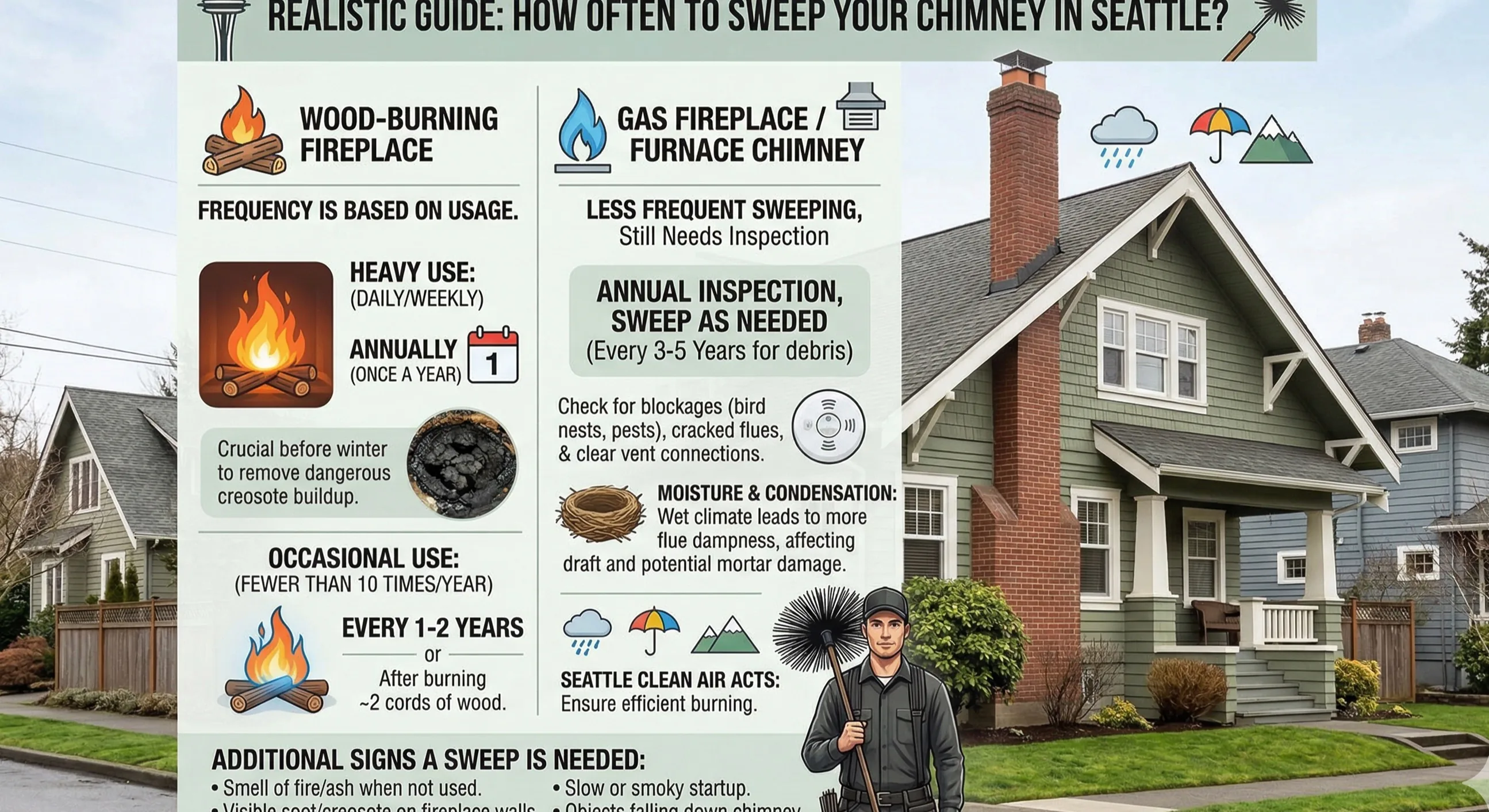
To understand how often your specific chimney needs professional service based on usage patterns and Seattle's wet climate, see our guide on how often should your chimney be swept in Seattle.
What Does the CSIA Say About Chimney Cleaning Logs?
The Chimney Safety Institute of America — the leading credentialing body for chimney professionals in North America — has issued consistent guidance on cleaning logs since the early 2000s. Their position: cleaning logs are a legitimate maintenance supplement when used as part of a regular program that still includes professional sweeping and annual inspection per NFPA 211.
NFPA 211, the Standard for Chimneys, Fireplaces, Vents, and Solid Fuel-Burning Appliances, requires annual inspection of all chimneys and vents regardless of use frequency, cleaning as needed based on inspection findings, and a Level 2 inspection after any property transfer or change of fuel type. No cleaning log satisfies any of these requirements. They are a between-visits maintenance tool — nothing more, nothing less.
In our 14 years of CSIA-certified service across the Seattle metro, we have never seen a cleaning-log-only chimney that did not benefit significantly from its first professional sweep. The chemical treatment and the mechanical removal are complementary — each makes the other more effective. Using both is simply smarter than choosing one.
The Real Cost Comparison: Cleaning Logs vs. Professional Sweeps
| Service | Cost (Seattle, 2026) | What You Get |
|---|---|---|
| Chimney cleaning log (1 per season) | $15–$30 | Chemical conditioning of Stage 1–2 creosote; no removal, no inspection |
| Professional chimney sweep | $169–$329 | Full mechanical creosote removal, visual flue inspection, obstruction check |
| Sweep + Level 1 inspection (bundled) | $199–$349 | Everything above plus documented condition report and safety assessment |
| Cleaning log + annual sweep (combined) | $184–$379/year | Best approach: chemical maintenance aid plus full professional service |
A cleaning log costs about 10% of a professional sweep and delivers about 10% of what a sweep provides. That is not a criticism — it is accurate proportionality. For detailed Seattle sweep pricing by chimney type and condition, see our chimney sweep cost guide for Seattle.
The Bottom Line: Use Cleaning Logs, But Don't Skip the Sweep
Chimney cleaning logs are not snake oil — they produce a real, documented chemical effect on creosote. But they are a supplement, not a solution. Use one mid-season to slow accumulation. Burn one the week before your scheduled professional sweep to help Carlos or Alex get better results with the brush. Just do not let a $20 log convince you that a $200 sweep is optional — because the chimneys we see after three cleaning-log-only years are the ones that scare us.
Seattle Chimney Pros has been CSIA-certified and serving the Seattle metro since 2011. If you are overdue for a professional sweep or want an honest assessment of your chimney's condition, call us at (206) 278-2924 or schedule your sweep online. We will give you the same straight talk in person that you just read here.
Need professional help?
Our professionally trained team is ready. $99 inspection credited toward repairs, 30-minute response.