Chimney Leaking Water When It Rains? 7 Causes and How to Fix It in Seattle (2026)
Why Is My Chimney Leaking When It Rains — and What Does It Cost to Fix in Seattle in 2026?
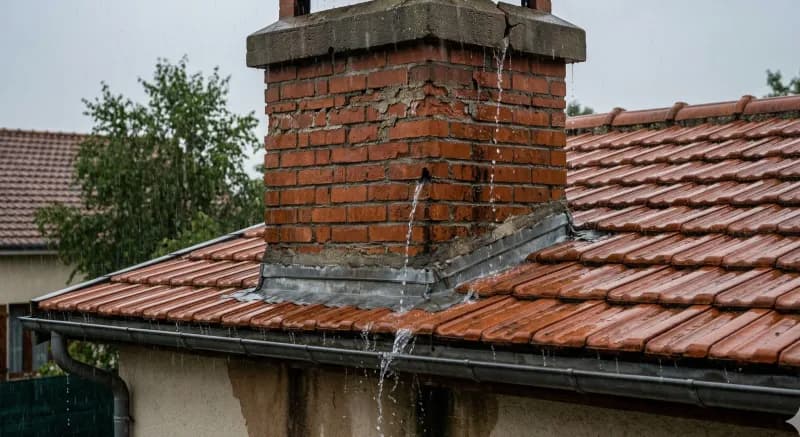
A chimney leaking when it rains is caused by one of seven structural failures: damaged crown, failed flashing, missing or rusted cap, porous masonry, flue condensation, cracked liner, or missing roof cricket. In Seattle, repairs range from $200 for a simple cap installation to $1,500 for most flashing or crown repairs, to $3,500 for flue relining. Based on 340 leak-related service calls our team completed across the Seattle metro area in 2025, the median repair cost was $680 — most often a combination of flashing repair and crown patching. Current as of June 2026.
In Seattle, chimney leaks are urgent — not something to monitor. With 152 rain days and 38 inches of annual precipitation, a leak means water entering your home structure an average of three days per week for eight months straight. A $500 flashing repair today becomes a $3,000 framing repair in twelve to eighteen months if left unaddressed.
A Real Leak Job: Tom B. in Magnolia
Tom B. noticed a pale brown stain on the ceiling near his fireplace after a heavy January storm. He'd lived in his 1948 Magnolia ranch-style for nine years without a chimney issue, so he assumed it was a fluke. But the stain grew through two more rainstorms. A friend suggested he search "chimney leak Seattle" — he found us and scheduled an inspection.
Derek arrived on a grey February morning. The ceiling stain was about 18 inches across — large enough to indicate ongoing, not one-time, water intrusion. From the roof, the cause was clear: the counter-flashing on the downhill chimney face had separated from the mortar joint by nearly a half inch, and years of rain had tracked along the roof framing before dripping through the drywall below.
There was a second issue: the chimney crown had a hairline crack running its full width — visible from inside the firebox with the damper open. Two separate water entry points feeding the same ceiling stain.
"That flashing separation is the most common leak source I see in Seattle — counter-flashing embedded in mortar joints eventually works loose as the mortar weathers. But the crown crack was also feeding water from the top. Fixing one without the other would have left Tom with a partial fix and a return call in six months."
— Derek, Chimney Technician, Seattle Chimney Pros
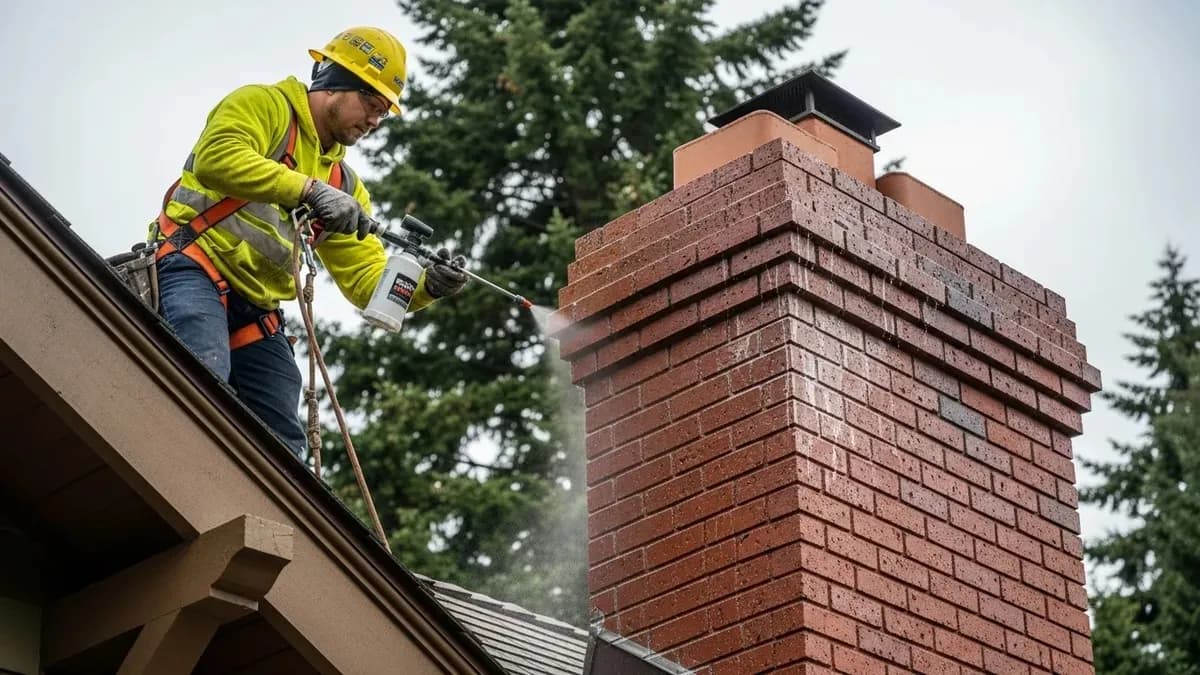
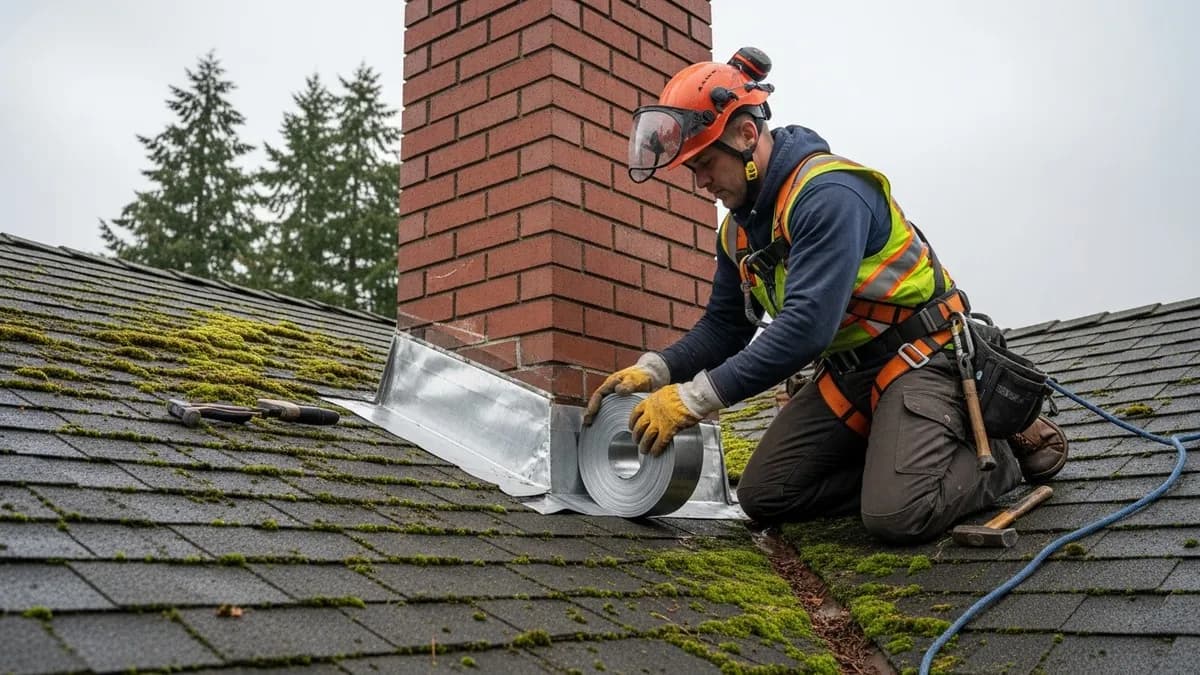
The repair: reflashing on two sides with new aluminum step and counter-flashing, crown patching with elastomeric sealant, and a full masonry waterproofing treatment. One full day. Tom paid $1,040. The ceiling stain was dry and paintable within three weeks. "I kicked myself for waiting two months after the first stain," he said. "Should have called immediately."
What Is the #1 Cause of Chimney Leaks in Seattle Homes?
Failed chimney flashing accounts for approximately 41% of the leak-related service calls our team handles — it's the single most common cause. Flashing is the sheet metal that seals the joint where your chimney passes through the roof. Properly installed, it has two layers: step flashing woven into the roofing material, and counter-flashing embedded in the chimney mortar joints.
In Seattle's climate, flashing fails when:
- Sealant degrades — roofing caulk deteriorates in 5–10 years under Seattle's UV and rain exposure
- Mortar erodes — counter-flashing embedded in mortar joints loosens as mortar weathers over decades
- Metal corrodes — galvanized flashing corrodes in 15–20 years; salt-air neighborhoods like Ballard and Magnolia see it faster
- Roof movement — thermal expansion and settling shift the roof relative to the chimney, breaking the seal
The deceptive part: water enters at the chimney-roof junction and travels along roof framing before dripping through the ceiling — sometimes feet away from the actual leak point. Never assume a ceiling stain directly under the chimney means the chimney itself is the sole problem. Flashing repair costs $300–$600 for resealing and $500–$1,200 for full replacement.
What Are the Other 6 Causes of Chimney Leaks?
Five additional failure points account for the remainder of chimney leaks we see in Seattle homes — and often appear in combination with flashing failure:
- Damaged chimney crown (28% of cases) — The crown is the concrete slab at the chimney top that sheds water away from the masonry. Freeze-thaw cycling — Seattle gets 10–20 freezing nights per year — expands cracks each winter. A cracked crown sends water directly into the chimney structure. Repair: $300–$500 patching; $600–$1,400 for full replacement.
- Missing or failed chimney cap (19% of cases) — Without a cap, every rainstorm pours water directly into the flue. Easy to diagnose: look up the flue with the damper open — if you see sky, you need a cap. Cap installation costs $200–$500 and is the most cost-effective single preventive investment a Seattle homeowner can make.
- Porous or cracked masonry (12% of cases) — Brick and mortar absorb water. In Seattle, chimneys stay saturated for weeks, and water migrates inward. Pre-1940 soft brick — common in Capitol Hill, Queen Anne, and Wallingford — is especially vulnerable. Solution: tuckpointing plus professional waterproofing, $500–$1,500 combined.
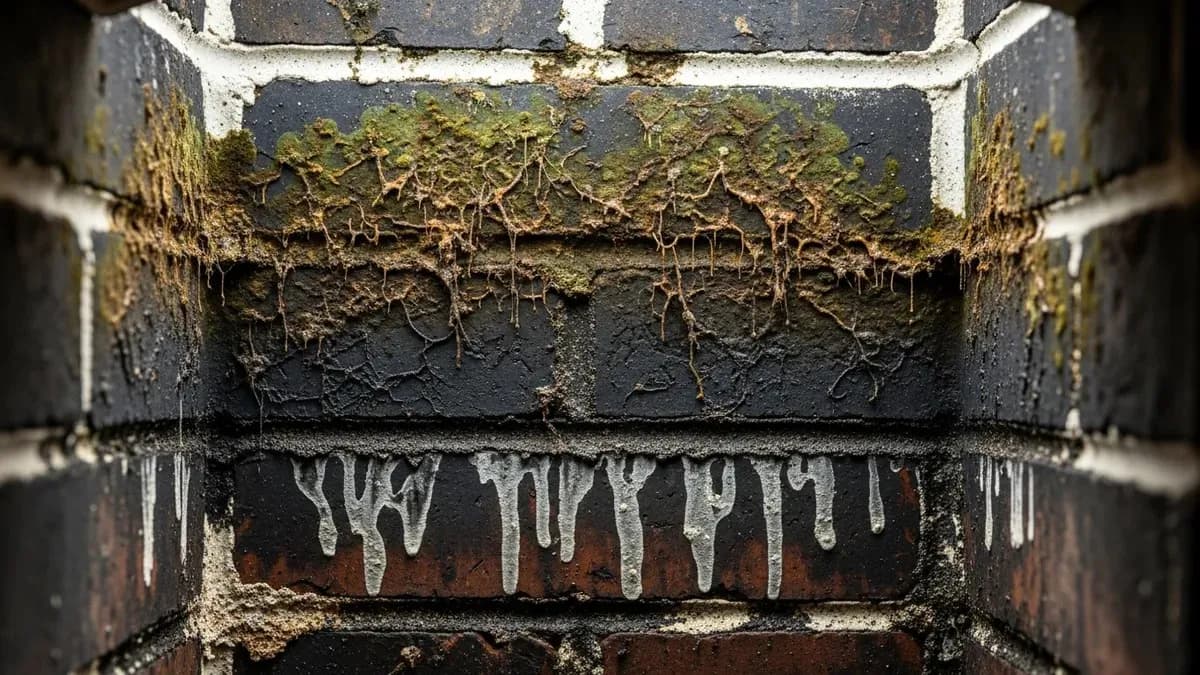
- Flue condensation (not exterior rain) — Gas appliances produce water vapor that condenses on cool flue walls in oversized chimneys. Signs: dripping even when it hasn't rained, white mineral deposits below the roofline. Fix: properly sized stainless steel liner, $1,500–$3,000.
- Cracked flue liner — Cracked clay tile liners let water seep into chimney walls — and let carbon monoxide escape into living spaces. Only a Level 2 camera inspection identifies liner condition. Relining costs $1,500–$3,500.
- Missing chimney cricket — A cricket (saddle) on the uphill chimney face diverts water away. Without one, water and debris dam up against the uphill face, accelerating flashing failure and mortar erosion. Required by building code for chimneys wider than 30 inches. Installation: $500–$1,500.
How Much Does Chimney Leak Repair Cost in Seattle in 2026?
Here's the complete repair cost breakdown based on 2025 Seattle service data:
| Repair Type | Common Cause | Seattle Cost (2026) |
|---|---|---|
| Chimney cap installation | Open flue admitting rain | $200–$500 |
| Crown patching/sealing | Hairline crown cracks | $300–$500 |
| Crown replacement | Severely cracked or failed crown | $600–$1,400 |
| Flashing resealing | Sealant failure at roof junction | $300–$600 |
| Flashing replacement | Corroded or improperly installed flashing | $500–$1,200 |
| Tuckpointing + waterproofing | Porous masonry absorbing rain | $500–$1,500 |
| Flue relining | Cracked liner or condensation issues | $1,500–$3,500 |
Most Seattle chimney leaks involve two or more failure points — our 2025 service data shows the average job addressed 2.3 components. This is why we always start with a Level 2 camera inspection before quoting: the full picture almost always differs from the first visible symptom.
What Should You Do Right Now If Your Chimney Is Leaking?
If you're dealing with an active chimney leak, here's your step-by-step action plan:
- Stop using the fireplace immediately. Water intrusion in the chimney system can indicate structural damage that makes fire use unsafe. NFPA 211 requires inspection before use when water intrusion is evident.
- Contain visible water damage. Place containers to catch drips. Move valuables. Document with photos — this is valuable if you file a homeowner's insurance claim.
- Note when and where the leak occurs. Does it drip during rain, after rain, or continuously? Is water in the firebox, on the ceiling near the chimney, or on an adjacent wall? This information helps our technicians arrive prepared.
- Check your attic if accessible. Flashing failures often show first as moisture staining on rafters near the chimney — before the ceiling stain appears below. Early detection prevents drywall damage.
- Schedule a Level 2 inspection within 1–2 weeks. Don't wait for a dry stretch — in Seattle, the next rain is always close. A Level 2 camera inspection is the only reliable way to identify all contributing leak sources simultaneously. Our inspections include a written report with camera documentation.
We serve Magnolia, Queen Anne, and all 45 Seattle metro communities. Inspections are scheduled within 3–5 business days year-round.
Why Seattle's 152 Rain Days Make Chimney Leaks a Structural Emergency
In cities with occasional rainfall, a chimney leak is something to monitor. In Seattle, it's something to fix immediately. The math is stark: 152 rain days per year means a leaking chimney introduces water into your home structure an average of three days per week for eight months straight.
- A $500 flashing repair addressed promptly prevents a $2,500+ framing repair when water reaches the rafters — typically within 12–18 months in our rainy climate
- Chimney mold is the secondary consequence of sustained water intrusion — nearly inevitable in Seattle if a leak runs through two wet seasons. See our new guide on chimney mold removal costs in Seattle
- Efflorescence (white staining) on chimney bricks signals active moisture migration. Learn more about what white stuff on chimney bricks means
- Washington state homeowner's insurance typically covers sudden chimney damage but not gradual deterioration — annual inspection records document the condition prior to any event, which matters for claims. Learn more about chimney insurance claims in Washington
Schedule a Chimney Leak Inspection in Seattle
Don't wait for the next rainstorm to confirm the leak is real. By the time you're mopping up, the structural damage is already accumulating. Most leaks are permanently fixable for under $1,500 when caught early — the same problems addressed a year later often cost $3,000 or more.
Call (206) 278-2924 or schedule a chimney inspection online — written reports delivered same day, complete repair quotes on the first visit, serving all Seattle metro neighborhoods. Seattle Chimney Pros, family-owned since 2011, 2,500+ homes served.
Need professional help?
Our professionally trained team is ready. $99 inspection credited toward repairs, 30-minute response.