Chimney Waterproofing Cost in Seattle 2026: What Homeowners Actually Pay
What Does Chimney Waterproofing Cost in Seattle in 2026?
Professional chimney waterproofing in Seattle costs between $280 and $800 in 2026, depending on chimney height, masonry condition, roof access, and whether crown sealing or cleaning is bundled in. Based on more than 340 waterproofing jobs our team completed across the Seattle metro area over the past 14 months, the most common service — waterproofing plus crown seal on a standard single-flue chimney — runs $320–$550. Homes in Capitol Hill, Queen Anne, and Madrona with tall two-story chimneys on steep-pitched roofs typically land in the $500–$800 range due to extended ladder setups and higher product volumes needed for older, more porous brick. Seattle rates run 15–25% above the national average of $150–$350, reflecting local labor costs and the complexity of working on Pacific Northwest craftsman and Victorian housing stock. Current as of July 2026.
Case Study: What We Found on a Ravenna Craftsman With 20 Years of No Waterproofing
Last May, Marcus T. from Ravenna called us after noticing white powdery streaks running down two sides of his chimney. His 1932 craftsman had been a rental property for six years before he bought it, and there was no documentation of any chimney maintenance — let alone waterproofing — in that time. A neighbor who'd seen our truck on the next block suggested he give us a call.
Alex arrived on a clear Tuesday morning — exactly the kind of dry-window day that's ideal for waterproofing assessments. From the driveway he could already see the efflorescence Marcus had described, plus a hairline crack running diagonally across the upper course of bricks just below the crown. On the roof, the picture got worse fast.
'The crown had three separate cracks I could fit a finger into, and the mortar joints on the north-facing side were recessed almost a full half-inch in places,' Alex told Marcus during the walkthrough. 'That north face never gets direct sun in Seattle, so it stays damp for days after rain. Twenty years of freeze-thaw without any sealant — that's exactly what you'd expect.'
'That diagonal crack and the recessed mortar aren't cosmetic — water is pooling at the crown, wicking into those joints, and expanding every time it freezes. If we waterproof over this without repointing those joints first, we're just sealing the damage in rather than stopping it.'
— Alex, Lead Technician, Seattle Chimney Pros
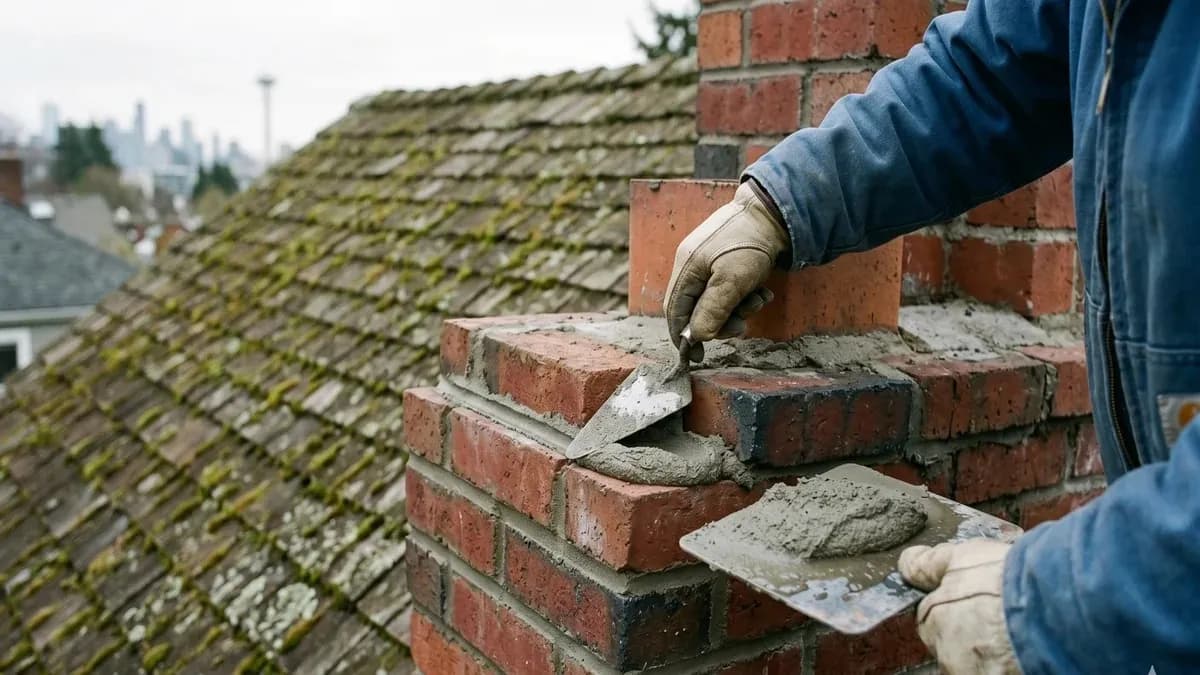
The repair sequence took two visits. On the first, Alex repointed the deteriorated mortar joints on the north and west faces and patched the crown cracks with a flexible crown sealant, then let everything cure for five days. On the second visit, he cleaned the efflorescence with a pH-neutral masonry cleaner, masked the windows and surrounding roofline, and applied two saturation coats of ChimneySaver Water Repellent — professional-grade solvent-based formula, which penetrates deeper into older porous brick than the water-based version.
Total cost for Marcus: $410 for the spot repointing and crown repair, plus $395 for the waterproofing service — $805 combined. Not cheap, but as Alex pointed out during the walkthrough, full tuckpointing of that chimney — which would have been necessary in another 3–4 years without intervention — would have run $1,400–$1,900. Marcus is now on our biennial inspection list, with the next waterproofing reapplication estimated for 2033.
How Does Seattle's Climate Make Waterproofing More Critical Than Almost Anywhere Else?
Seattle averages 38 inches of rainfall spread across approximately 152 rain days per year — one of the wettest major metros in the continental U.S. That persistent moisture exposure, combined with Pacific Northwest freeze-thaw cycles that can run from October through March, creates a relentlessly harsh environment for chimney masonry.
Unglazed brick and mortar are naturally porous — they absorb moisture like a sponge. In mild climates, that absorbed water simply evaporates without causing damage. In Seattle, it doesn't get the chance. When temperatures drop below freezing, water trapped inside brick and mortar expands by roughly 9% as it turns to ice. That expansion stress fractures mortar joints, pops off brick face layers (spalling), and progressively weakens the entire masonry structure from the inside out.
In our experience across more than 2,500 Seattle-area homes, we've inspected chimneys where what appeared structurally sound from the ground had mortar joints so eroded at the top that sections could be pulled free by hand. The damage was happening invisibly, one freeze-thaw cycle at a time, because the masonry had never been sealed. North-facing chimney faces — which never receive direct sun in Seattle's low-angle winter light — are consistently the worst-affected. Neighborhoods with heavy tree canopy like Madrona, Leschi, and parts of Ballard add biological growth risk on top of the baseline moisture problem.
Quality waterproofing uses vapor-permeable penetrating sealants — not film-forming coatings. This distinction matters enormously: a correctly specified silane/siloxane product makes masonry water-repellent at the material level while still allowing interior water vapor to escape. Chimneys produce condensation from the flue side during use, and trapping that moisture inside sealed masonry would cause a different category of damage. A professionally waterproofed chimney in Seattle can extend masonry service life by 15–25 years and dramatically reduces the frequency of chimney repair costs across the life of the structure.
What Does the Waterproofing Process Actually Include?
Understanding what professional chimney waterproofing involves explains why costs vary as much as they do — and why the cheapest quote is rarely the best choice for Seattle's climate.
Products used by CSIA-certified technicians: Professional-grade silane/siloxane penetrating sealants — not surface coatings, latex paints, or consumer spray products. The most widely specified product in the industry is ChimneySaver Water Repellent (Saver Systems), which penetrates up to ¼ inch into masonry, is 100% vapor permeable, and carries a manufacturer-backed 10-year warranty when professionally applied. We use solvent-based ChimneySaver for older Seattle brick (pre-1950), which achieves deeper penetration into more porous historic masonry, and the water-based formulation for denser modern brick.
What you should avoid: Film-forming products like Thompson's Water Seal, silicone sprays, or latex masonry paints marketed as 'waterproofing.' These trap moisture inside brick rather than allowing vapor to escape, causing the surface spalling they're supposed to prevent. We regularly document Seattle chimneys damaged by incorrectly specified consumer products applied as a DIY fix.
- Condition assessment: The technician inspects all masonry surfaces, mortar joints, the crown, and flashing for existing damage. Cracks, deteriorated joints, and spalled faces must be repaired before sealant is applied — waterproofing over damage seals the damage in rather than stopping it.
- Cleaning: Efflorescence, moss, algae, dirt, and any previous coating residue are removed before application. Product adhesion and penetration depth depend on clean, open-pore surfaces. We use low-pressure methods on older Seattle brick — never high-pressure washing, which can erode already-soft mortar joints.
- Masking and protection: Windows, roof surfaces, landscaping, and painted trim are masked before sealant application. Penetrating sealants permanently stain many surfaces if contact occurs.
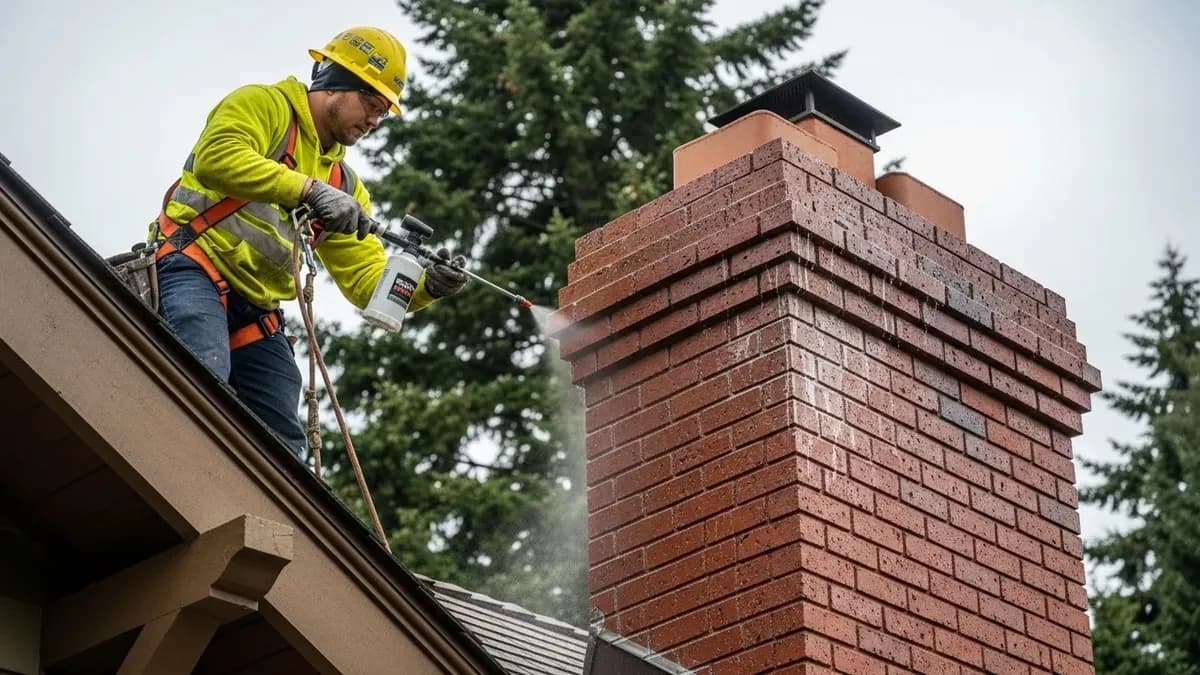
- Saturation application: Product is applied by pump sprayer and brush until the masonry reaches saturation — it can absorb no more. This typically requires two coats with a short interval between them. Surface-wetting only, which most DIY applicators achieve, provides significantly less protection than full saturation penetration.
- Crown sealing: The chimney crown is treated with a separate flexible crown sealant during the waterproofing visit. Crowns crack from thermal cycling and are a primary water entry point in Seattle chimneys.
Seattle Chimney Waterproofing: 2026 Price Breakdown by Service
The following pricing reflects 2026 market rates across the Seattle metro area including King, Pierce, and Snohomish counties.
| Service | Seattle 2026 Range | Notes |
|---|---|---|
| Waterproofing only (standard chimney) | $280–$420 | Pre-cleaned masonry, single-story or low-slope roof, sound mortar joints |
| Waterproofing + crown seal | $320–$550 | Most common service combination; sealant plus flexible crown treatment |
| Waterproofing + cleaning + crown seal | $380–$680 | Full prep including efflorescence or moss removal, then sealant and crown |
| Large or tall chimney (2+ stories) | $520–$800+ | Multi-flue chimneys, steep-pitched roofs requiring extended ladder work, historic commercial masonry |
| Waterproofing + spot repointing | $480–$800 | Minor tuckpointing of deteriorated joints before sealant; full repointing billed separately |
| National average (reference only) | $150–$350 | Seattle rates 15–25% above national benchmark |
These ranges represent service costs only. If pre-existing damage — significant spalling, cracked crowns, failed flashing, or deteriorated mortar joints — is found during the condition assessment, repair costs are additional and quoted separately before any work begins. For comparison, a full chimney tuckpointing project in Seattle runs $600–$2,500 depending on extent, and full masonry restoration costs $3,000–$15,000+. A $320–$550 waterproofing service every 7–10 years is among the best returns on maintenance investment available to Seattle homeowners with masonry chimneys.
What Drives Your Chimney Waterproofing Cost Up or Down?
Several factors push estimates above or below the typical range. Understanding them helps you evaluate quotes accurately.
Factors that increase cost:
- Chimney height and roof pitch: Seattle's craftsman and Victorian housing stock features steeper roof pitches and taller chimneys than national average residential construction. Every additional foot above the roofline adds access complexity. Chimneys requiring scaffolding rather than standard ladder access add $100–$300 to any service.
- Multiple flues: Larger homes often have two- or three-flue chimneys serving multiple fireplaces or a furnace. More masonry surface area means more product and labor time.
- Pre-existing damage: Sound masonry waterproofs efficiently. Masonry requiring spot repointing, crown repair, or spall patching before sealant application adds cost — but skipping those repairs to save money creates a false economy. Waterproofing over damage doesn't protect the damage.
- Severe biological growth: Chimneys with heavy moss, algae, or lichen colonization — common in shaded Seattle microclimates in neighborhoods like Madrona, Leschi, and parts of Ballard — require more preparation time and sometimes chemical pre-treatment. See our guide on chimney moss removal in Seattle for what biological growth removal costs separately.
- Age and porosity of brick: Pre-1940 Seattle brick — common in Capitol Hill, Queen Anne, First Hill, and Beacon Hill — is softer and more porous than modern brick, requiring more product to achieve saturation penetration.
Factors that reduce cost:
- Combining services: Scheduling waterproofing during the same visit as a chimney inspection or sweep reduces total cost compared to separate service calls, since mobilization and setup are shared.
- Chimney already in good condition: Sound mortar joints, an intact crown, and clean masonry keep the job toward the lower end of the range. No prep time means efficient application.
- Accessible roof: Low-slope roofs and single-story homes with standard chimney heights are the most cost-effective to service — common in Ballard, Beacon Hill, and South Seattle.
How Is Waterproofing Different From Chimney Flashing Repair?
Chimney waterproofing and flashing repair address different water intrusion pathways. Both are necessary for a fully water-tight chimney system, and neither substitutes for the other.
Waterproofing addresses water absorption through the masonry itself — brick faces, mortar joints, and the chimney crown. Rain that hits the exterior masonry surface is repelled before it can be absorbed into the material. Waterproofing does not seal the joint where the chimney passes through the roof, and it does not address internal condensation or flue liner integrity.
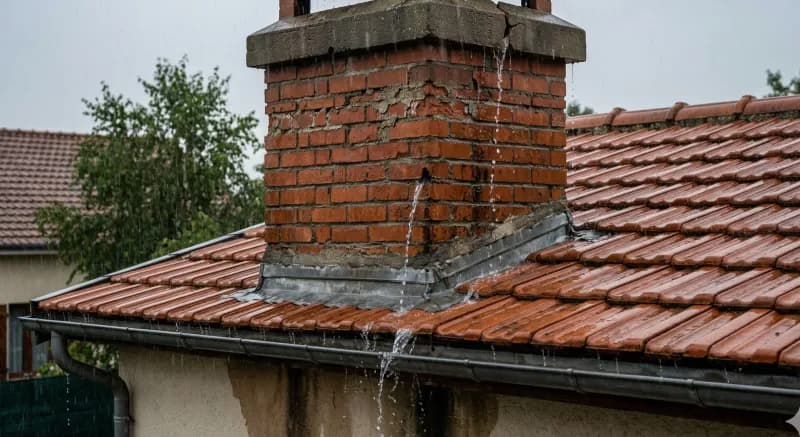
Flashing is the metal system (typically lead, aluminum, or stainless steel) that seals the joint between the chimney and the roof surface at the penetration point. Failed flashing is one of the most common causes of chimney-related water damage in Seattle homes — and it's a completely separate repair from waterproofing. A chimney can have perfectly applied waterproofing and still leak heavily if the flashing has failed.
If your chimney is actively leaking water into the firebox or attic, do not assume waterproofing will solve it. Our guide to why chimneys leak water when it rains walks through the diagnostic process for identifying exactly where water is entering. Our chimney flashing repair cost guide covers flashing-specific pricing separately.
What Are the Signs Your Seattle Chimney Needs Waterproofing Now?
Based on more than 340 waterproofing assessments we completed across the Seattle metro in the past 14 months, these are the most consistently documented warning indicators:
- White staining (efflorescence) on brick: Those white powdery deposits are mineral salts carried out of the masonry by water moving through it. Efflorescence is a direct indicator of active moisture migration — the same water movement that causes freeze-thaw damage when temperatures drop. Our article on white stuff on chimney bricks explains the chemistry in detail.
- Spalling brick faces: Thin layers of brick face popping or flaking off the surface — often found as debris on the roof or at the chimney base — indicate active freeze-thaw damage already in progress. Waterproofing stops further spalling but cannot restore already-damaged brick faces.
- Deteriorating mortar joints: Joints that are recessed, crumbling, or soft to the touch have lost their integrity. Moisture is the primary cause in Seattle's climate. Joints need repointing before waterproofing can be applied effectively.
- Masonry stays dark after rain: If your chimney visibly darkens and remains dark for extended periods after rain — rather than drying quickly — the masonry is absorbing and retaining moisture at a rate that means near-continuous exposure during Seattle's multi-day rain events.
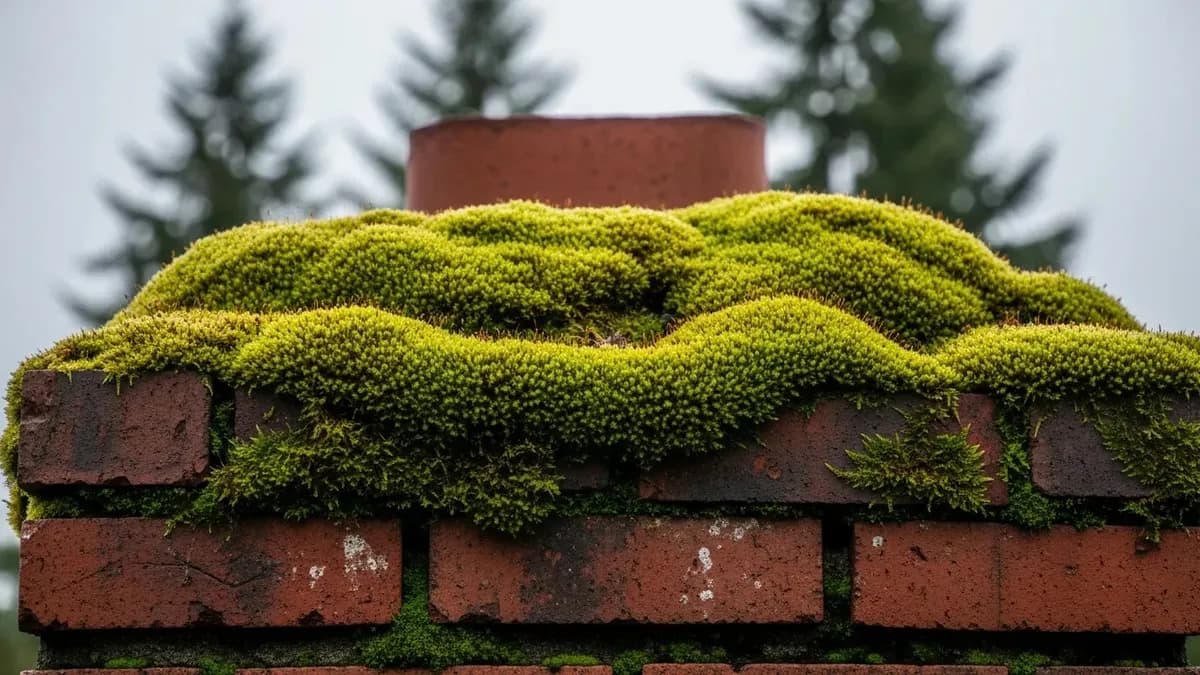
- Moss, algae, or lichen growth: Biological growth on chimney masonry indicates persistent moisture retention. Moss root filaments penetrate mortar joints, and biological matter retains water against the masonry surface for extended periods. Treat biological growth first, then waterproof.
- No prior waterproofing history: If your home is more than 15 years old and you have no documentation of chimney waterproofing, the masonry has almost certainly never been treated. In Seattle, 10–15 years of untreated exposure to 152 annual rain days is enough to cause measurable deterioration in most brick types.
Should You Waterproof Your Own Chimney or Hire a Pro?
Consumer-grade waterproofing products are available at hardware stores, and some Seattle homeowners attempt DIY application. Here is an honest assessment of where DIY falls short and where it can be appropriate.
Where DIY falls short:
- Product specification: Consumer products — Thompson's Water Seal, various silicone sprays — are typically film-forming products, not vapor-permeable penetrating sealants. Applying a film-forming product to a chimney traps interior moisture inside the masonry, causing the spalling damage you're trying to prevent. This is the single most common and costly DIY mistake we document.
- Saturation application: Professional application requires applying product until the masonry can absorb no more. Achieving this from the ground or on a ladder on all four chimney faces — including the back — is effectively impossible for most homeowners without professional spray equipment.
- Pre-treatment assessment: Sealant applied to cracked mortar joints, a failing crown, or existing biological growth locks those problems in rather than solving them. Most homeowners cannot perform a complete masonry condition assessment from the ground.
- Roof safety: Safe access to Seattle's steep-pitched roofs requires professional-grade fall protection. The cost savings of DIY waterproofing do not justify the risk of a roof fall.
Where DIY can be appropriate: Homeowners with single-story homes, flat or low-slope roofs, and genuinely safe access to a chimney in confirmed good condition can DIY with a correctly specified vapor-permeable product — specifically a professional-grade silane/siloxane sealant, not a consumer spray. Budget $60–$150 for product and apply two full saturation coats. For most Seattle homeowners with two-story craftsman profiles and chimneys well above the roofline, professional application is the practical choice for both safety and quality reasons.
How Often Does Chimney Waterproofing Need to Be Reapplied in Seattle?
Professional-grade silane/siloxane waterproofing has a service life of 7–10 years in Seattle's climate when applied at full saturation penetration by a qualified technician. ChimneySaver carries a manufacturer-backed 10-year warranty when applied by certified contractors. Consumer-grade products have shorter effective service lives of 3–5 years and provide less protection due to lower penetration depth.
Factors affecting reapplication frequency in the Pacific Northwest include UV exposure (Seattle's lower UV intensity compared to southern climates extends product life slightly), physical abrasion from pressure washing, and masonry condition at the time of application. The simplest approach: schedule a chimney inspection every 2–3 years and have the technician assess the waterproofing condition as part of that visit. A simple water-bead test — spraying water on the masonry surface and observing whether it beads off or absorbs — quickly reveals whether the sealant is still effective. When the masonry absorbs water instead of beading it, reapplication is due regardless of how many years have passed since the last treatment.
Ready to Protect Your Chimney Before Seattle's Next Rainy Season?
July is an excellent time to schedule chimney waterproofing in Seattle — masonry needs to be dry before sealant can penetrate properly, and summer's dry windows provide ideal application conditions. Scheduling now also means your chimney is fully protected before fall and winter rain returns. Our team uses professional-grade vapor-permeable sealants applied at saturation depth, with a full condition assessment before any product goes on, and a written estimate that separates repair costs from waterproofing costs before work begins. To schedule an assessment for your Seattle-area chimney, call (253) 429-8006 or request a free estimate online. We serve 45 communities across King, Pierce, and Snohomish counties, Monday through Saturday.
Need professional help?
Our professionally trained team is ready. Free estimate, 30-minute response.