Chimney Tuckpointing Cost in Seattle 2026: What You'll Actually Pay
How Much Does Chimney Tuckpointing Cost in Seattle in 2026?
Chimney tuckpointing in Seattle costs between $500 and $2,500 in 2026, depending on how many mortar joints need replacement, the chimney's height and roof accessibility, and whether the home requires historic lime mortar. Based on 340 tuckpointing jobs our crews completed across the Seattle metro area last year, the average homeowner pays $1,350 for a partial repair covering one or two weather-exposed faces. Full four-face tuckpointing on a standard single-flue chimney typically runs $1,500–$2,500. Homes in older neighborhoods like Capitol Hill, Wallingford, and Queen Anne — where pre-1940 soft brick requires matched lime mortar — average $2,200–$3,500 due to specialty materials and extra prep time. Current as of July 2026.
A Real Job: Marcus T. in Fremont
Marcus T. had owned his 1928 Fremont bungalow for six years before he noticed something alarming: a rust-colored stain spreading across the living room wall, directly behind the chimney. He assumed it was a roof leak. A neighbor down the street — who'd had us out the previous fall — saw him poking around on the front porch and pointed him our way.
When Carlos arrived for the inspection on a drizzly Tuesday morning in May, he could see the problem before he even got on the roof. Three courses of bricks near the roofline had mortar joints so degraded you could poke a finger into them. On the rooftop, the full picture was worse: the entire south and west faces of the chimney — the two sides that take the brunt of Puget Sound weather — had mortar joints that had receded a full inch or more in places. Moss had colonized every soft joint it could find, holding constant moisture against the brick.
Carlos photographed every problem area and walked Marcus through the findings on his phone screen at the bottom of the ladder.
'The south face is what's feeding that interior stain. Water is running straight through those open joints, wicking into the brick, and finding the path of least resistance into your wall cavity. The good news is the bricks themselves are still solid — we caught this before the freeze-thaw damage got into the brick faces. Tuckpointing now saves you a much more expensive repair later.'
— Carlos, Technician, Seattle Chimney Pros
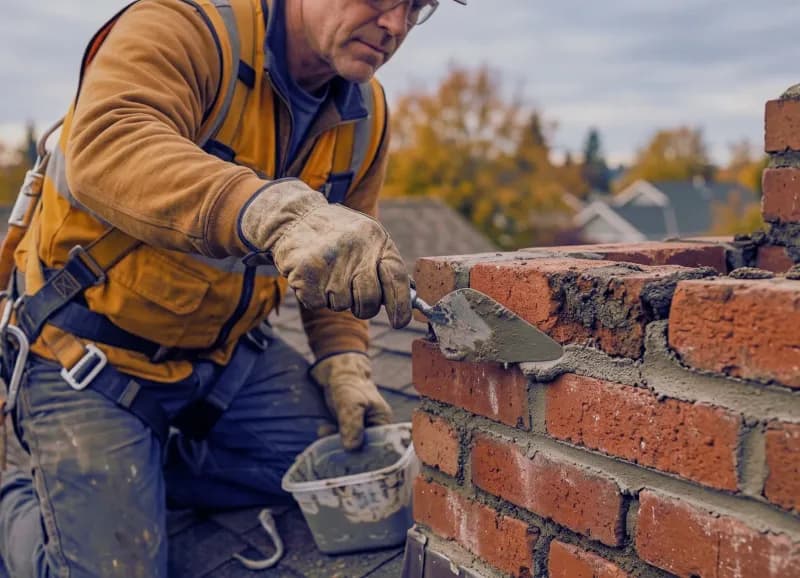
The job covered the full south and west faces — roughly 60 linear feet of joints ground out, cleaned, and repacked with Type N mortar matched to the original gray tone. Moss was treated and mechanically removed before any mortar was applied. The work took Carlos and a helper one full day. Total cost: $1,550, which Marcus said was less than he'd braced himself for. The interior stain dried out completely within three weeks. He added annual inspections to his home maintenance calendar and is scheduled for a chimney waterproofing application this coming September.
What Is Chimney Tuckpointing — and Why Do Seattle Chimneys Need It More Than Most?
Tuckpointing is the process of removing deteriorated mortar from the joints between chimney bricks and replacing it with fresh, properly bonded mortar. It is the single most effective way to stop water intrusion through the masonry structure before it damages bricks, framing, or interior walls.
The Puget Sound region averages 152 rain days and 37 inches of precipitation per year. Water saturates exposed mortar joints, then overnight temperatures drop just below freezing 20–40 times each winter. Every freeze-thaw cycle expands water trapped in the joints by roughly 9%, prying microscopic cracks wider until the mortar crumbles and falls away. Add year-round moss and lichen — which root into soft mortar and hold moisture against it constantly — and you have conditions that accelerate joint failure faster than almost any other climate in the continental U.S.
In our experience across more than 1,400 masonry chimney inspections in the Seattle metro area, deteriorated mortar joints are the number-one cause of chimney water damage. Bricks are expensive to replace; mortar is relatively inexpensive. Tuckpointing exists precisely to sacrifice the mortar so the bricks survive. Catching it early is everything.
How Do You Know If Your Chimney Needs Tuckpointing?
Mortar deterioration follows a predictable progression in Seattle's climate. These are the signs our crews see most often:
- Crumbling or sandy mortar — if you can scrape mortar out with a fingernail or a key, it has lost its binding strength and is no longer protecting the bricks from water.
- Visible gaps between bricks — missing mortar gives water a direct path into the chimney structure. In Seattle's rain, interior damage can follow within a single wet season.
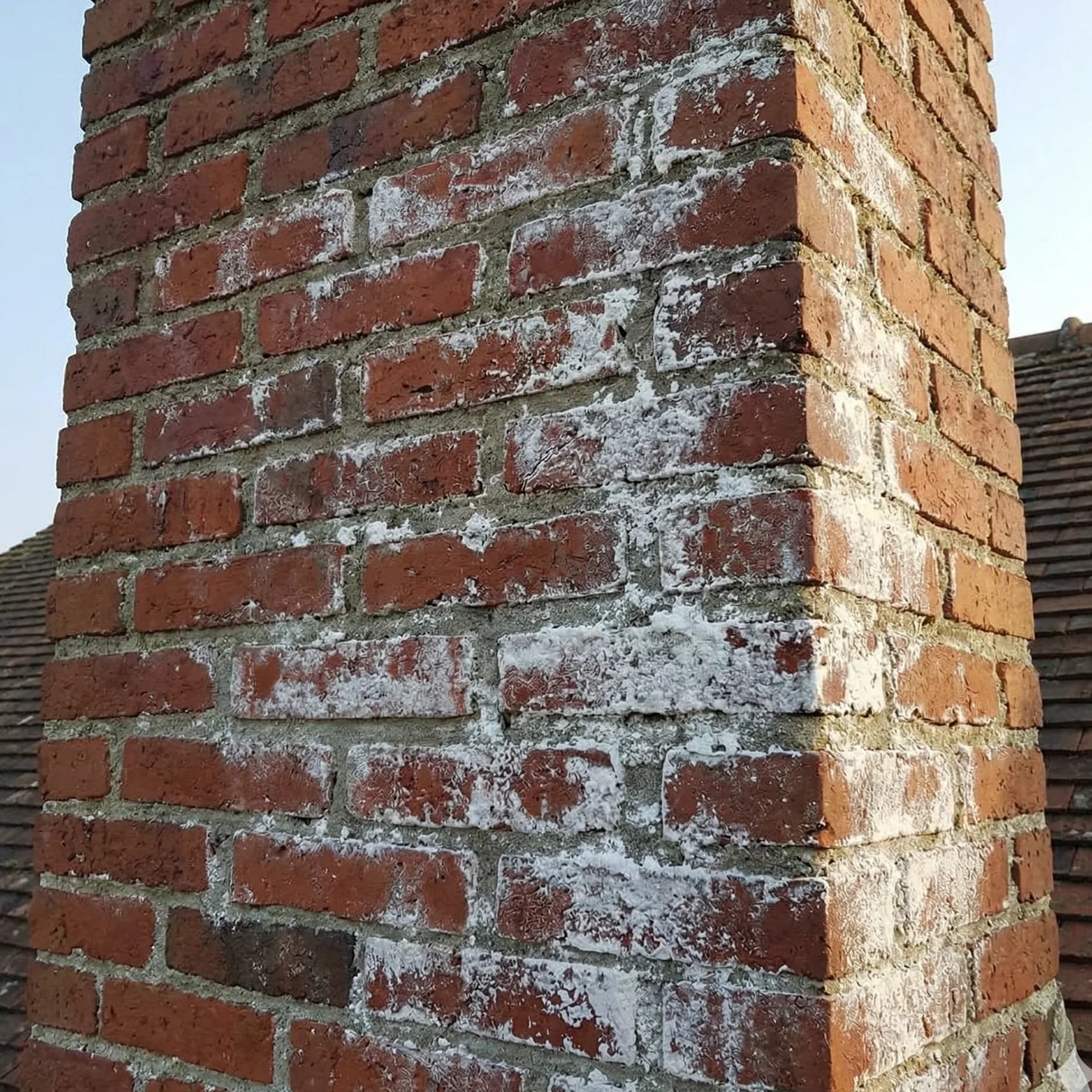
- White staining (efflorescence) — mineral salt deposits blooming on the brick surface mean water is migrating through the masonry. See our full guide to efflorescence on chimney bricks for what it signals.
- Moss or plant growth rooted in the joints — biological growth holds moisture against mortar 24 hours a day, dramatically speeding deterioration.
- Spalling bricks — brick faces popping off or flaking mean water has already penetrated past the mortar and is freezing inside the brick itself. Tuckpointing is overdue at this stage.
- Water stains on interior walls near the fireplace — failed mortar joints are one of the top three entry points for chimney leaks in Western Washington.
- Mortar dust or fragments in the firebox — falling mortar pieces indicate that interior joints are failing. A chimney inspection will confirm the extent of the damage.
If you spot two or more of these signs, schedule an inspection before the next rainy stretch. Catching deterioration at the mortar stage costs $500–$2,500 to fix. Waiting until bricks need replacing can push that number to $5,000–$15,000 or higher for a partial rebuild.
What Does Chimney Tuckpointing Cost in Seattle? (2026 Price Breakdown)
Pricing is driven by the scope of joint replacement needed, chimney height, roof pitch and access difficulty, and whether specialty mortar is required. Here are current ranges from our 2026 job data:
| Scope of Work | Typical Cost (Seattle 2026) | Notes |
|---|---|---|
| Spot tuckpointing (under 10 sq ft) | $500–$1,000 | A few isolated joints on one face; minimal setup |
| Partial tuckpointing (one or two faces) | $1,000–$1,800 | Weather-exposed south and west sides most common |
| Full chimney tuckpointing (all four faces) | $1,500–$2,500 | Complete mortar replacement on standard-height chimney |
| Historic lime mortar tuckpointing | $2,000–$3,500 | Pre-1940 homes; requires Type O or custom lime mortar |
| Tall chimney or difficult access surcharge | +$500–$1,500 | Multi-story, steep pitch, hillside lot, scaffolding needed |
All prices include labor, materials, roof access setup, moss treatment where needed, and cleanup. Most standard tuckpointing jobs take one to two days. For a firm written quote on your specific chimney, request an estimate online — we inspect from the rooftop and deliver a written quote the same day.
Why Does Tuckpointing Cost More in Seattle Than National Averages?
National home-improvement sites quote chimney tuckpointing at $300–$1,500. That range consistently misleads Pacific Northwest homeowners. Here is why Seattle pricing runs higher:
Deeper deterioration at the time of discovery. By the time a Seattle homeowner notices bad mortar, moisture has usually driven deterioration deeper than it would in a drier climate. Joints frequently need to be ground out a full inch or more — sometimes to full depth — versus the shallow raking that suffices in Arizona or the Midwest. Deeper grinding means more labor hours and more mortar material.
Mandatory moss removal prep. Biological growth must be fully removed and joints treated with a biocide before new mortar can bond properly. On the majority of Seattle chimneys we tuckpoint, moss removal adds one to two hours of prep work that contractors in drier climates never encounter.
Older housing stock with specialty mortar requirements. Neighborhoods like Queen Anne, Capitol Hill, Ballard, and Wallingford have dense concentrations of pre-1940 chimneys built with soft brick and lime mortar. Matching that mortar correctly requires sourcing Type O or natural hydraulic lime — specialty materials that cost two to three times more than standard Type N bags. See our guide to chimney care for historic Seattle homes for the full picture.
Harder roof access. Steep-pitch roofs (8/12 to 12/12), cedar shingle surfaces that cannot be walked directly, and hillside properties on tight lots all require additional safety rigging — roof jacks, harnesses, sometimes scaffolding or a boom lift. Every one of those adds to mobilization cost in a way that flat-roof or walk-on markets never see.
What Does the Tuckpointing Process Actually Look Like?
Understanding the correct process helps you evaluate contractor quotes and identify shortcuts. Here is what a proper Seattle tuckpointing job looks like from start to finish:
- Rooftop inspection and documentation. The technician inspects every face from the roof, photographs failed joints, tests mortar hardness, assesses brick condition, and determines the original mortar type. Any quotes given without a rooftop inspection are guesswork.
- Moss and debris removal. Biological growth is treated with a biocide and mechanically removed with a stiff brush. Loose mortar fragments are blown or brushed out of all joints to be repaired. Skipping this step causes new mortar to fail prematurely.
- Joint grinding or raking. Deteriorated mortar is removed to a minimum depth of 3/4 inch using an angle grinder with a thin diamond blade or a mortar raking tool. Joints with deep deterioration are ground to full depth. The channel must be clean and uniform for new mortar to bond properly.
- Wetting the joints. Dry brick pulls moisture out of fresh mortar too quickly, preventing proper curing. Joints and surrounding brick are misted until damp — not soaking — before mortar is applied. On Seattle's typical overcast days this is rarely a problem, but it matters during July and August.
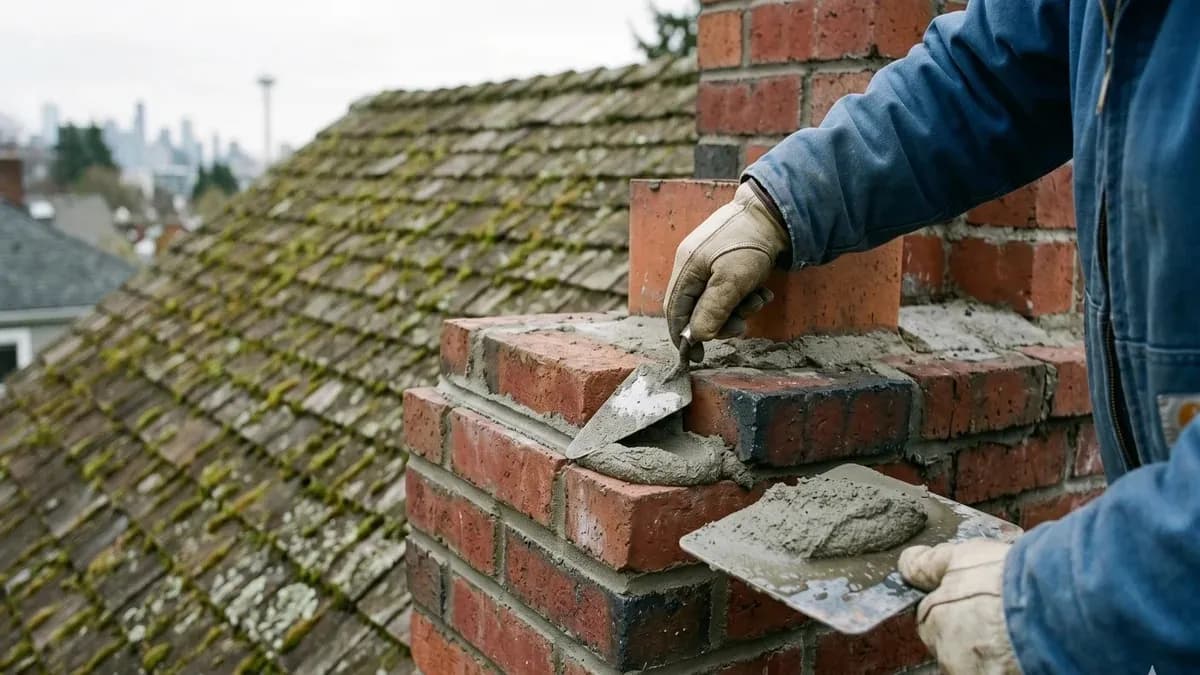
- Mortar application. Fresh mortar is pressed firmly into joints in layers using a pointing trowel and a hawk. Each layer is tooled to the correct joint profile — concave is most common and most effective at shedding Seattle's rain.
- Tooling and surface finishing. Once mortar reaches thumbprint firmness (typically 20–30 minutes), joints are compressed with a jointing iron to create a smooth, water-shedding surface. Excess mortar is brushed off the brick faces before it fully hardens.
- Curing and optional waterproofing. New mortar requires 24–48 hours without heavy rain. After full cure (seven days minimum), a breathable siloxane waterproofing sealant can be applied to extend the life of both the new joints and the surrounding brick. This is strongly recommended in Seattle's climate.
Which Mortar Type Is Right for Your Seattle Chimney?
Using the wrong mortar type is one of the most damaging mistakes in chimney tuckpointing. The core rule: mortar must always be softer than the brick it surrounds. If the mortar is harder than the brick, it traps moisture inside the masonry, and freeze-thaw cycles blow the brick faces off — a costly condition called spalling. Here is how the main types compare:
| Mortar Type | Compressive Strength | Best Application | Seattle Notes |
|---|---|---|---|
| Type N | 750 PSI | Most post-1940 chimneys | Industry standard for above-grade masonry; good flexibility under thermal movement |
| Type S | 1,800 PSI | High-wind or seismic applications | Sometimes specified in WA for earthquake resistance; only appropriate on hard modern brick |
| Type O | 350 PSI | Pre-1920 soft historic brick | Softer than the brick — mortar cracks before brick; correct approach for preservation |
| Natural Hydraulic Lime (NHL) | 200–500 PSI | Historic restoration and landmark structures | Breathable, self-healing micro-cracks, period-accurate; requires specialist skill to apply correctly |
A qualified chimney repair contractor will test or research the original mortar composition before mixing anything. If your contractor cannot tell you which mortar type they plan to use and why, that is a red flag worth acting on.
DIY vs. Professional Tuckpointing: The Honest Breakdown
Tuckpointing is one of those repairs where the skill gap between amateur and professional work is large and the cost of getting it wrong is significant.
When DIY might be appropriate:
- A single-story home with a safe, low-pitch roof and easy ladder access
- Only a handful of isolated joints need attention — not a full face
- Standard Portland cement mortar (not lime mortar) is confirmed correct for your chimney
- You have genuine masonry experience and own or can rent proper grinding and pointing tools
When you should hire a professional:
- The chimney is on a two-story or taller home, a steep roof, or a hillside lot
- Multiple faces or the full chimney needs work
- The home was built before 1940 — lime mortar matching requires expertise and specialty materials
- Any bricks are also spalled, cracked, or missing alongside the mortar failure
- You want warrantied work and contractor insurance coverage
The most common outcome of failed DIY tuckpointing we see in the field: mortar that was applied too shallow, used the wrong mix ratio, or applied over incompletely cleaned joints. It looks fine for one or two seasons, then starts popping out in chunks. At that point, a professional has to grind out your new mortar before they can apply theirs — effectively paying twice for the same repair. For most Seattle homeowners, professional tuckpointing is the lower-risk investment. Learn about our full chimney repair services.
What to Do Right Now If You Suspect Mortar Deterioration
If you noticed this article because something about your chimney looks off, here is a practical action plan before you call anyone:
- Inspect the firebox from inside. Look up with a flashlight for mortar fragments or daylight showing through joints where it shouldn't. Falling mortar debris in the firebox is a reliable sign of active deterioration.
- Walk the perimeter of the chimney exterior. At ground level, look for white mineral staining on the bricks, visible gaps in the joints, or loose mortar pieces at the base of the chimney. These are visible indicators that don't require a ladder.
- Check interior walls adjacent to the chimney. Water staining, soft drywall, or a musty smell near the chimney chase often traces back to failed mortar joints letting rain in at the roofline.
- Do NOT light a fire until an inspection is completed. Active water infiltration through deteriorated joints can be accelerated by heating cycles, and structural compromise in the masonry — however small — poses a safety risk during use.
- Schedule a rooftop inspection. Only an on-roof assessment with photos will tell you the true extent of joint failure, whether bricks are also affected, and what mortar type is correct for your chimney. Call us at (206) 278-2924 or request your estimate online.
Making Your Tuckpointing Last: Post-Repair Maintenance in Seattle
Fresh tuckpointing is an investment of $500–$2,500. Here is how to protect it in the Pacific Northwest's demanding climate:
- Wait seven days before applying waterproofing sealant. Let the mortar cure fully. A breathable siloxane-based product is ideal — it blocks liquid water while allowing moisture vapor to escape, preventing the trapped-moisture spalling problem.
- Remove moss annually. A soft brush treatment each spring, or zinc strips installed along the roofline near the chimney, prevents moss from re-rooting into the fresh joints before they fully harden.
- Never pressure-wash a chimney. High-pressure water erodes mortar — including new mortar — and can crack brick. A low-pressure rinse and soft brush are the correct approach for any cleaning.
- Schedule annual inspections. Catching a single failed joint early costs $100–$200 to touch up. Waiting until an entire face has deteriorated costs $1,000 or more. In our experience, homeowners who schedule annual inspections extend the life of their tuckpointing by 30–50% compared to those who wait until visible problems appear.
- Maintain the chimney crown and cap. A cracked crown channels water directly down the mortar joints below it. A missing cap lets rain pour onto the chimney structure from directly above. Both issues undo tuckpointing work faster than anything else. See our chimney repair cost guide for crown and cap pricing.
With proper maintenance, professional tuckpointing in the Pacific Northwest should last 25–30 years on sheltered faces and 15–20 years on exposed south and west faces. Skipping maintenance in Seattle's climate cuts those timelines roughly in half.
Seattle Chimney Pros has been tuckpointing chimneys across the metro since 2011 — from 1905 Capitol Hill craftsmen to new Bellevue construction. Our CSIA-certified team inspects from the rooftop, photographs every joint, and delivers a written quote the same day. Call (206) 278-2924 or book your $99 inspection online — we serve all 45 areas across the Seattle metro.
Need professional help?
Our professionally trained team is ready. $99 inspection credited toward repairs, 30-minute response.