How Often Should You Clean Your Dryer Vent in Seattle? (2026 Guide)
How Often Should You Clean a Dryer Vent in Seattle?
In Seattle, dryer vents should be professionally cleaned at least once per year — and every 6 months for households with heavy usage, pets, or long vent runs. Based on over 600 dryer vent cleanings our team has completed across the Seattle metro area, the average home accumulates dangerous lint levels within 10-14 months. Standard professional cleaning costs $100-$175 in 2026, with roof-exit or extended-run vents running $150-$225. Seattle's average relative humidity of 73-83% year-round causes wet lint to compact 20-30% faster than the same vent would clog in a dry climate — making annual cleaning here more urgent than the national baseline suggests. Current as of July 2026.
A Real Dryer Vent Call: Marcus T. in Greenwood
Marcus T. had lived in his 1952 Greenwood rambler for six years and never once thought about his dryer vent. Last October, his wife pointed out that a full load of towels was taking nearly two full cycles to dry. He assumed the dryer was aging out. A neighbor who'd just had her chimney swept by our crew mentioned we also clean dryer vents — Marcus called the same afternoon.
Carlos arrived the next morning and pulled the dryer away from the wall. The transition duct — the short flexible piece connecting the dryer to the wall — was a ribbed vinyl tube, kinked at a 90-degree angle where someone had pushed the dryer too close to the wall. Behind it, the rigid duct running through the crawlspace and out the side of the house was packed with what Carlos described as 'gray papier-mache' — wet, compacted lint layered against every joint and elbow in the 32-foot run.
'This vent hadn't been cleaned in years, possibly ever,' Carlos noted during the inspection. 'The vinyl transition piece was also a fire code violation — ribbed vinyl traps lint and melts at low temperatures. We replaced it with smooth aluminum on the spot.'
'That compacted, wet lint you're seeing is exactly what Seattle's humidity does — it doesn't blow out on its own. One more season and this duct would have been completely sealed. At that point you're either burning out the dryer motor or, worse, the heat has nowhere to go.'
— Carlos, Senior Technician, Seattle Chimney Pros
The full cleaning took 55 minutes: rotary brush through the entire 32-foot run, high-pressure air flush, transition duct replacement, and an airflow verification with the dryer running. Total cost: $178, which included the new aluminum transition duct. That evening, Marcus's towels dried in a single 45-minute cycle. He booked a standing annual appointment for the following October.
How Often Does a Seattle Dryer Vent Actually Need Cleaning?
The NFPA, the Consumer Product Safety Commission, and every major dryer manufacturer recommend cleaning at least once per year — but Seattle's climate warrants a more nuanced answer based on your specific setup.
| Household Profile | Recommended Interval | Why |
|---|---|---|
| 1-2 person household, short straight vent, no pets | Every 12-18 months | Low lint volume; simple duct geometry |
| Family of 3-4, standard vent run, no pets | Every 12 months | NFPA baseline; appropriate for most Seattle homes |
| Family of 4+, heavy towel/bedding use | Every 6-9 months | High lint volume accelerates buildup |
| Any household with 1+ pets | Every 6 months | Pet hair dramatically increases lint load |
| Vent run over 25 ft or 3+ elbows | Every 6-9 months | More surface area for wet lint to stick |
| Roof-exit vent (vertical run) | Every 6 months | Vertical runs trap lint at every elbow; harder to clear |
Seattle's 73-83% average annual relative humidity is the key variable that makes our vents clog faster than those in drier climates. Warm dryer exhaust condenses against cooler duct walls, and that moisture turns dry, light lint into a wet, sticky paste that accumulates against duct walls, joint seams, and elbows. In our experience across hundreds of Seattle-area cleanings, vents here reach dangerous restriction levels 20-30% sooner than the same configuration would in a climate like Spokane or Phoenix.
If your dryer vent hasn't been cleaned in the last 12 months, it's overdue regardless of which category above you fall into.
What Are the Warning Signs of a Clogged Dryer Vent?
Don't wait for a scheduled cleaning if any of these signs appear — a restricted vent gets worse with every load you run.
- Clothes take more than one cycle to dry. A load that used to finish in 45 minutes now needs 75-90 minutes. This is the most common and clearest early sign of restricted airflow.
- The dryer feels excessively hot to the touch. Some warmth on the exterior is normal. A surface you can't hold your hand against is a warning — heat is backing up because it can't exhaust.
- The laundry room feels hot and humid while the dryer runs. Exhaust air is escaping into the room instead of exiting through the vent.
- You smell something burning during a cycle. Lint is highly flammable. If you detect a burning smell, stop the dryer immediately, unplug it, and do not operate it again until the vent is inspected.
- Lint is visible around the exterior vent hood. Lint clinging to the outside flap or accumulating on the wall around the vent exit means the duct is shedding buildup — a sign of heavy interior accumulation.
- The exterior vent flap won't fully open during operation. Step outside while the dryer is running and check. You should feel strong, warm airflow and see the flap fully open. If it barely moves, the duct is significantly blocked.
- Your dried laundry smells musty. In Seattle's climate, mold can grow inside the damp lint buildup and be blown onto your clothing with every cycle. Our technicians find mold in roughly 1 in 5 Seattle dryer vents they inspect.
If you're experiencing any combination of these symptoms, call (206) 278-2924 — a dryer vent fire is one of the most preventable home emergencies, and it's not something to defer.
What Happens During a Professional Dryer Vent Cleaning in Seattle?
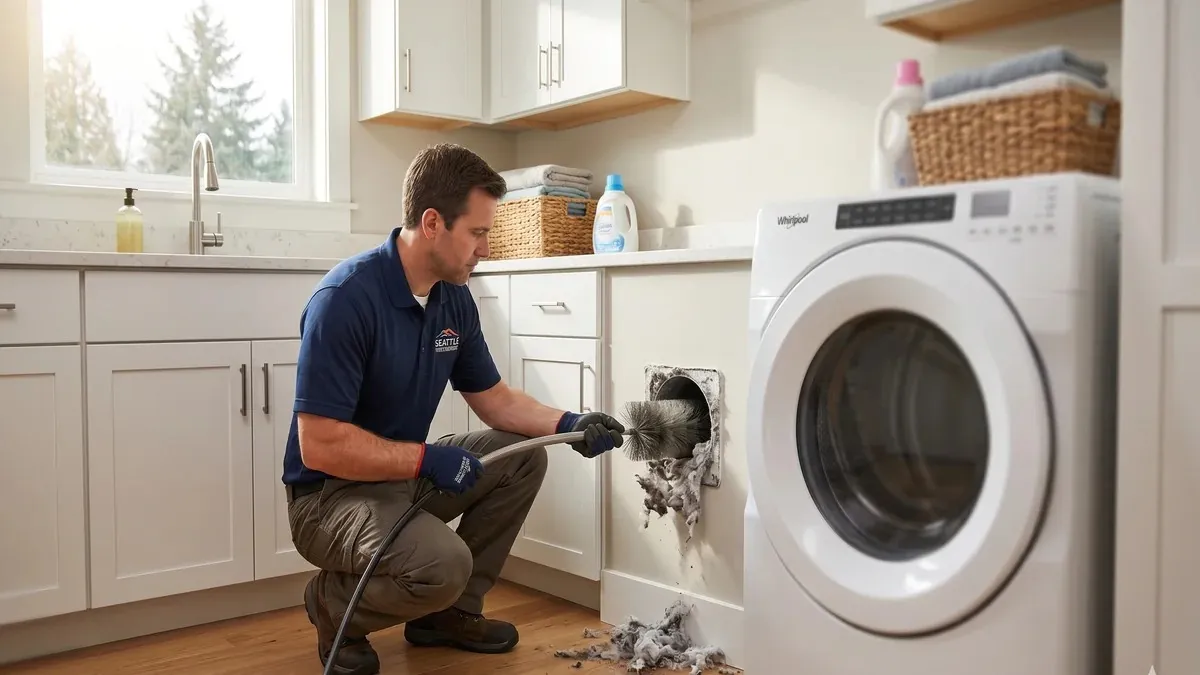
A professional cleaning takes 30-60 minutes in most Seattle homes. Here's the exact process our technicians follow:
- Inspection and disconnect. We pull the dryer from the wall, disconnect the transition duct, and inspect both the dryer connection point and the exterior vent hood for damage, pest intrusion, or incorrect materials (ribbed vinyl instead of smooth aluminum).
- Rotary brush cleaning. A professional-grade rotary brush on flexible drive rods is run through the full length of the duct from the dryer-side opening. The rotating head dislodges compacted lint from duct walls, elbows, and joint seams. For Seattle homes, this step alone often pulls out dense gray wads of wet, compressed lint that consumer-grade kits cannot budge.
- High-pressure air flush. After brushing, we use a high-pressure air tool to blast all dislodged debris out through the exterior exit — clearing any material that settled around elbows after brushing.
- Transition duct inspection and replacement if needed. We inspect the short flexible section between the dryer and the wall. If it's ribbed vinyl (a fire hazard), crushed, kinked, or deteriorating, we replace it with a smooth aluminum transition duct on the spot. This is one of the most common deficiencies we find in older Seattle-area homes.
- Airflow verification. We reconnect everything and run the dryer, then check the exterior exit for strong, steady airflow and a fully open vent flap. We also observe the dryer's exhaust temperature to confirm it's within normal operating range.
- Written findings report. We document what we found, how much buildup was present, whether any repairs were needed, and when we recommend the next cleaning based on your vent configuration and household usage.
What Does Dryer Vent Cleaning Cost in Seattle in 2026?
Dryer vent cleaning is one of the most affordable home fire-safety services available — typically less than what you'd spend on two visits to a laundromat.
| Service | Cost Range (2026) | Notes |
|---|---|---|
| Standard cleaning (up to 25 ft, side-wall exit) | $100 – $150 | Most common setup in Seattle single-family homes |
| Extended run (25-50 ft, multiple elbows) | $150 – $200 | Common in larger homes or laundry rooms far from exterior wall |
| Roof-exit vent cleaning | $150 – $225 | Requires roof access; common in 1940s-1960s Seattle homes |
| Transition duct replacement (aluminum) | $25 – $75 | Needed when existing duct is vinyl, kinked, or crushed |
| Bird nest or pest removal from vent hood | $75 – $150 additional | Starlings nest in dryer vent hoods across Seattle neighborhoods |
| Chimney sweep + dryer vent bundle | $250 – $400 | Combines annual services; saves $50-$75 vs. booking separately |
Most Seattle homeowners pay $100-$175 for a standard dryer vent cleaning. We offer a chimney sweep + dryer vent bundle that combines your annual chimney sweep and dryer vent cleaning in a single visit — since the tools and expertise overlap directly, bundling saves you a second service call and reduces the combined cost. Call (206) 278-2924 or request a quote online.
Should You DIY or Hire a Pro for Dryer Vent Cleaning in Seattle?
Consumer dryer vent cleaning kits ($20-$40 at Home Depot) work adequately in specific circumstances — but those circumstances are rarer in Seattle than most guides suggest.
DIY can work if:
- Your vent run is under 10 feet with no elbows
- The vent exits through the side wall at or near ground level, giving you easy access to both ends
- You cleaned it within the past year and are doing light maintenance
- Your transition duct is already smooth aluminum in good condition
Hire a professional if:
- Your vent run is longer than 15 feet or has more than one elbow
- The vent exits through the roof (requires working top-down from the roof with specialized tools)
- You've never cleaned it, or it's been more than 18 months — heavy, wet-compacted Seattle lint won't respond to a consumer brush kit
- You smell mold or mildew from the dryer — DIY brushes don't sanitize the duct walls
- Your transition duct is ribbed vinyl (a fire hazard requiring replacement)
- The duct runs through walls, floors, or the crawlspace where you can't inspect it visually
The Seattle humidity factor is the deciding variable here. In a dry climate, a consumer kit pushing dry lint through a short run is effective. In Seattle, where wet lint compacts like construction material against every surface it touches, professional rotary brush equipment and high-pressure air flushing is the only reliable way to fully clear a vent that's been building up through a Pacific Northwest winter. A $130 professional cleaning that actually works beats a $30 kit that leaves 60% of the blockage in place — and the remaining blockage keeps trapping heat with every load you run.
How Seattle's Climate Creates a Mold Risk Inside Dryer Vents
This is the section most national dryer vent guides skip entirely — and it's the reason Seattle homeowners need to think about dryer vent maintenance differently than someone in Denver or Dallas.
When your dryer runs, it pushes 140-180°F air through the vent duct. In a Seattle winter, the exterior-facing sections of that duct may be sitting in 38-45°F ambient air. The temperature differential — up to 140 degrees across a few inches of duct wall — causes condensation inside the duct every single cycle, the same way a cold glass sweats on a warm day.
That condensation creates a three-stage problem unique to high-humidity climates:
- Lint adhesion. Dry lint in an Arizona vent drifts through the duct and exits outside. Wet lint in a Seattle vent sticks to the damp duct walls, accumulating at every joint seam, elbow, and rough surface.
- Compaction. Cycle after cycle, more wet lint layers on top of the existing buildup. Over months, it compresses into a dense, paste-like mass that feels more like pressed cardboard than fluffy lint. A shop vacuum won't touch it. A consumer brush kit barely dents it.
- Mold colonization. Organic material (lint is mostly clothing fibers) plus persistent moisture plus darkness equals an ideal mold habitat. Our technicians find visible mold in approximately 1 in 5 Seattle dryer vents they clean — with higher rates in neighborhoods closer to the waterfront like Magnolia, West Seattle, and Burien. When mold is present, every dryer cycle blows spores directly into your laundry room.
If your clean laundry smells musty, or you notice dark discoloration around the dryer vent connection at the back of the machine, mold inside the duct is a likely cause. Professional rotary brush cleaning removes the lint and disrupts the mold colony; restoring full airflow ensures the duct dries out between cycles, preventing recurrence. This is also why we recommend scheduling your annual dryer vent cleaning in early fall — before the rainy season increases condensation rates and before heavy winter usage packs lint in further. For more on how moisture and combustion hazards connect in Seattle homes, see our guide on carbon monoxide warning signs from chimney and exhaust systems.
Why Does a Chimney Company Clean Dryer Vents — and Why Does It Matter?
The connection between chimney service and dryer vent cleaning is more than convenience — the skills, tools, and safety mission are nearly identical.
Both chimneys and dryer vents are exhaust systems that move combustion byproducts or heat out of your home. Both accumulate combustible buildup (creosote in a chimney, lint in a dryer vent). Both can cause house fires or carbon monoxide exposure when blocked. Both require rotary brush equipment and airflow analysis to service properly. Our technicians who sweep chimneys are trained to CSIA and NFPA 211 standards — the same physics of draft, restriction, and combustion apply directly to dryer vent diagnosis.
The carbon monoxide angle is especially important for Seattle homes with natural gas dryers (common in homes with PSE gas service). A clogged dryer vent on a gas dryer can cause CO from the burner to back up into the laundry room rather than exhausting outside — the same mechanism as a blocked chimney flue on a gas fireplace. If you have a gas dryer, working CO detectors near the laundry area are non-negotiable. Our chimney inspection service includes checking for CO-related exhaust hazards, and we evaluate both systems when you book a bundle visit.
Bundling your annual chimney sweep with dryer vent cleaning typically saves $50-$75 versus booking separately, and consolidates two critical fire-safety tasks into a single 90-120 minute appointment. Our teams serving West Seattle, Greenwood, and across the metro are equipped for both services on every truck. For a full picture of annual home fire-safety maintenance, see our complete guide to preventing chimney fires and our fall chimney maintenance checklist.
Schedule Your Dryer Vent Cleaning in Seattle Today
Seattle Chimney Pros has completed over 600 dryer vent cleanings across the Seattle metro since 2011 — alongside thousands of chimney inspections and sweeps. Our dryer vent service takes 30-60 minutes, costs $100-$175 for most homes, and eliminates one of the most common and preventable causes of house fires. Whether you're in Greenwood, Ballard, Bellevue, or Renton, same-week scheduling is usually available. Call (206) 278-2924 or book your dryer vent cleaning online — and ask about our chimney sweep + dryer vent bundle to handle both annual safety tasks in one visit.
Need professional help?
Our professionally trained team is ready. $99 inspection credited toward repairs, 30-minute response.