Wood-to-Gas Fireplace Conversion Cost in Seattle (2026 Guide)
How Much Does a Wood-to-Gas Fireplace Conversion Cost in Seattle?
A wood-to-gas fireplace conversion in Seattle costs between $1,200 and $8,000 in 2026, depending on the conversion type and whether a new gas line is required. Based on 180+ conversions our crew completed across the Seattle metro area last year, the average homeowner pays $4,800 for a direct-vent gas insert with an existing gas line nearby. Gas log sets land lower — typically $1,500–$2,800 installed. Homes requiring a new gas line run from the basement or meter add $500–$2,000 to any project total. All prices below reflect current installed rates including labor, permit fees, and basic trim finishing. Current as of July 2026.
Real Conversion Story: Marcus T. in Fremont
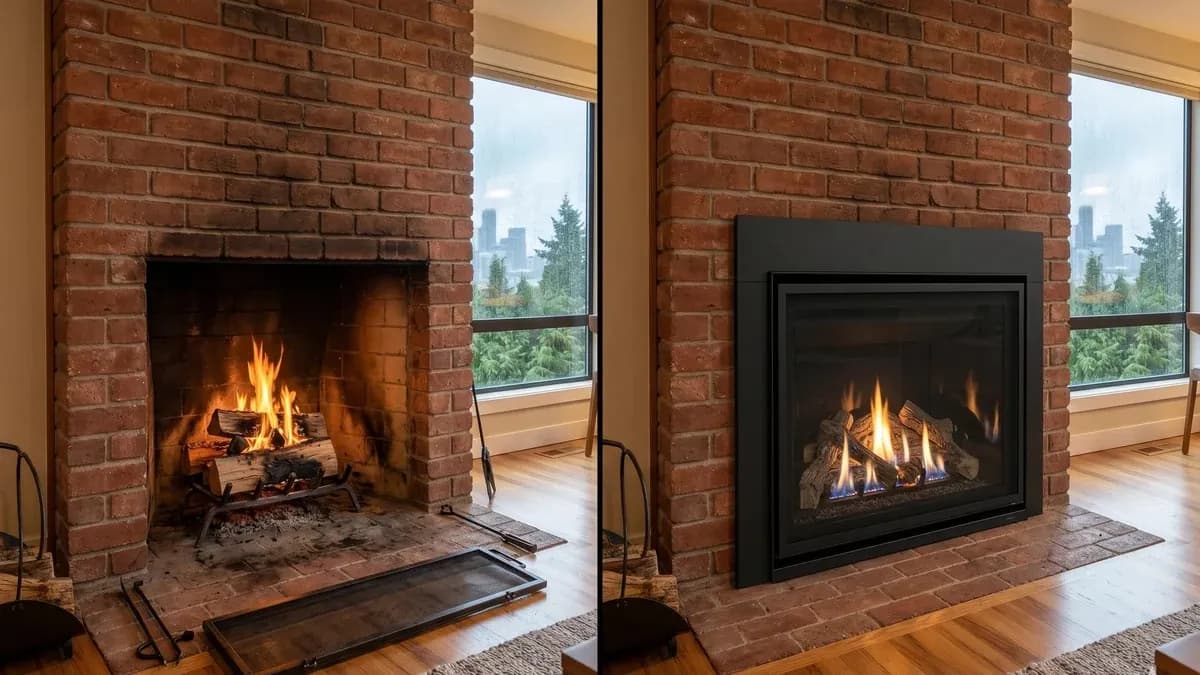
Marcus T. had owned his 1928 Fremont Craftsman for six years before he finally called us last September. The fireplace — a classic brick box with a clay-tile flue — had been used maybe twice since he moved in. Splitting and storing firewood in a narrow Seattle side yard wasn't practical, and two burn bans the previous winter had left him staring at a cold grate on the nights he'd most wanted a fire.
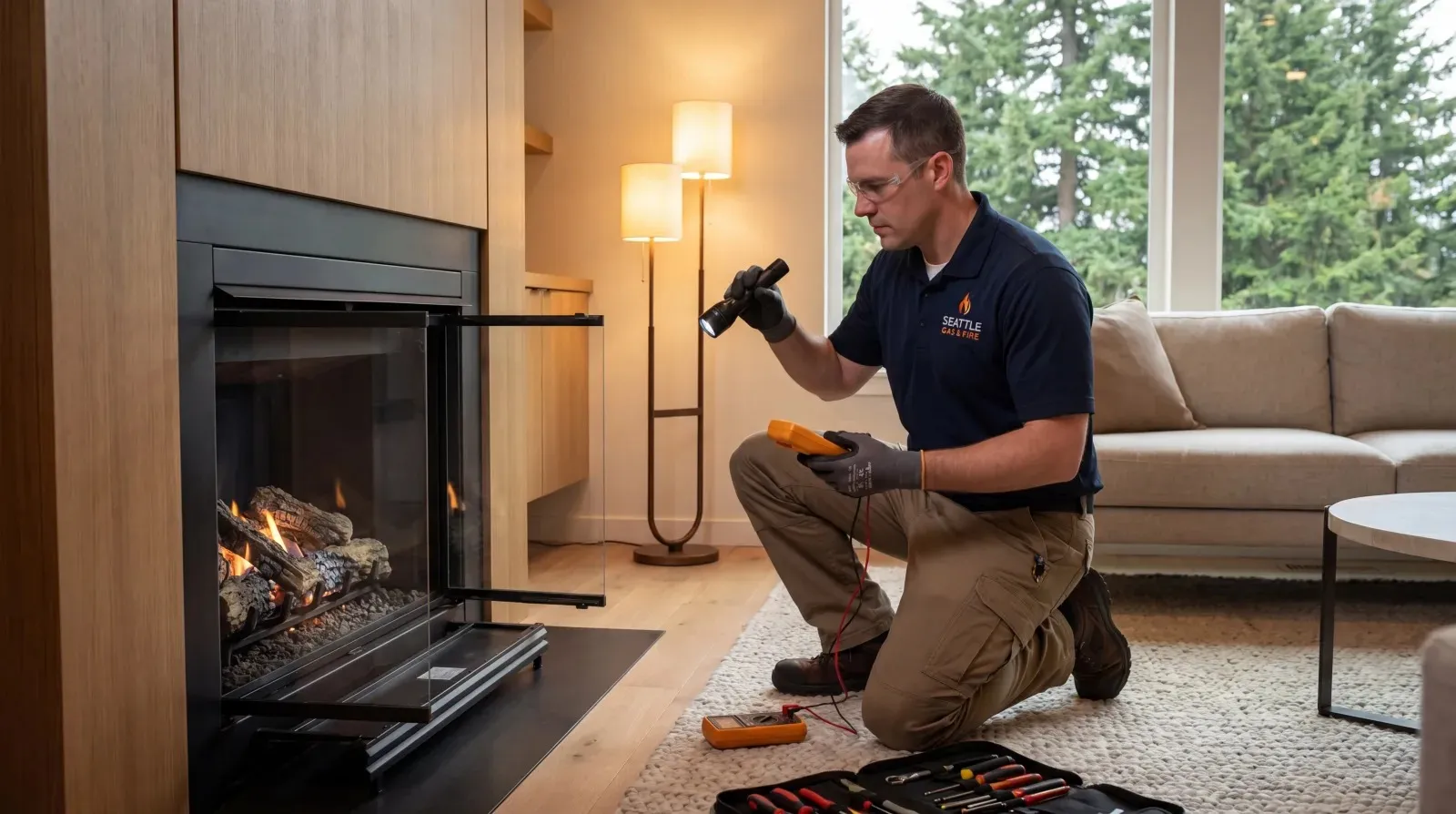
His neighbor mentioned seeing our truck on nearby Phinney Avenue, so Marcus looked us up and booked an in-home consultation. Carlos arrived the next Tuesday with a tape measure, a flue camera, and a gas pressure gauge.
The firebox measured 36 inches wide — a good candidate for a mid-large insert. The clay flue was intact (no cracks on camera), and there was already a gas stub in the adjacent dining room wall from an old wall heater that had been removed years earlier. That stub changed everything: instead of running new pipe from the basement, Carlos could tap off the existing line for a short branch run — roughly 8 feet through the wall.
'That dining room stub saved Marcus about $1,200 in gas line work right there. A lot of these older Fremont and Wallingford homes have abandoned gas stubs from converted wall heaters — it's always the first thing I check before we talk about pipe routing.'
— Carlos, Lead Technician, Seattle Chimney Pros
Marcus chose a Regency Liberty LRI6E — 38,000 BTU, a large ceramic log set, and a clean glass system that stays clear even in humid conditions. Installation took about six hours: liner down the flue, insert slid into the firebox, gas line connected by our licensed gas fitter, blower wired to a new outlet behind the surround. Total project cost: $5,100, including permits, the coaxial liner, installation labor, and a custom black surround trim kit that matched his original brick.
'I used it four times in the first week,' Marcus told us when we followed up in October. 'It's warmer in the living room than it's been since I bought the place.' He's now on our annual gas fireplace maintenance schedule — a quick cleaning and pressure check every fall to keep the unit running cleanly.
What Are the Three Types of Wood-to-Gas Conversions?
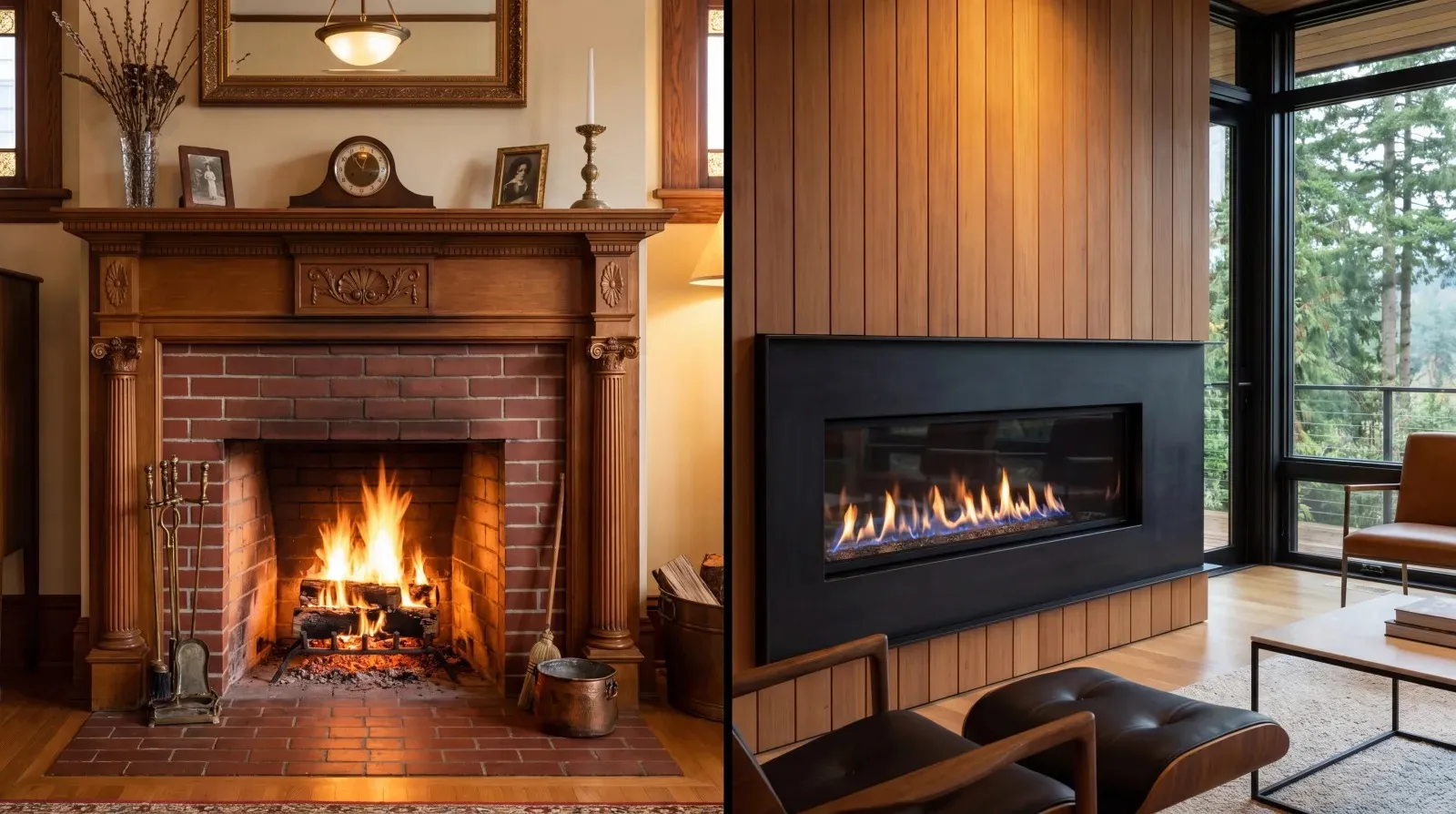
Not every conversion is the same. The right option depends on your firebox size, your existing gas infrastructure, how much heat you want, and your budget. Here's how the three main approaches compare:
| Conversion Type | Total Installed Cost | Heat Output | Best For |
|---|---|---|---|
| Gas log set (vented or ventless) | $1,200–$2,800 | 10,000–30,000 BTU | Ambiance on a budget; existing gas line nearby |
| Direct-vent gas insert | $3,500–$8,000 | 25,000–42,000 BTU | Primary supplemental heat; most Seattle homes |
| Built-in / full remodel | $5,000–$12,000+ | 20,000–60,000 BTU | Damaged firebox; contemporary linear flame look |
Gas log sets drop ceramic or refractory logs onto a burner that connects to a gas line. The logs sit inside your existing firebox with the damper open (vented) or partially closed (ventless). Simple and affordable, but lower heat output and less efficiency than an insert.
Direct-vent gas inserts are sealed combustion units that slide into your existing masonry firebox. A coaxial liner runs up the existing chimney — the inner pipe exhausts combustion gases out, the outer pipe draws fresh air in. No indoor air is used for combustion. This is the most popular Seattle conversion type because it delivers serious heat (25,000–42,000 BTU), works during burn bans, and eliminates drafting and moisture issues.
Built-in units replace the entire firebox — the right call when the existing masonry is damaged beyond repair or a homeowner wants a modern linear flame. This is also the path for through-wall direct-vent terminations in homes where the chimney is being fully decommissioned. For a deeper look at inserts versus full replacements, see our insert vs. new fireplace guide.
What Does Each Component of a Gas Conversion Cost?
Here is a full itemized breakdown of what each piece of a typical Seattle conversion costs in 2026, based on our current installed rates:
| Component | Cost Range | Notes |
|---|---|---|
| Gas log set (vented) | $800–$1,800 | Logs + burner + valve, installed |
| Gas log set (ventless/vent-free) | $1,000–$2,500 | Includes ODS safety pilot; check local codes |
| Direct-vent insert (unit only) | $2,000–$4,500 | Napoleon, Regency, Valor, Mendota |
| Insert installation labor | $800–$1,500 | Fitting, sealing, electrical hookup, testing |
| Coaxial vent liner (for insert) | $500–$1,200 | Length depends on chimney height |
| New gas line run (if needed) | $500–$2,000 | Distance from existing line to firebox |
| Gas line connection (existing nearby) | $200–$500 | Tap off existing line within 10 feet |
| Electrical outlet (for blower/ignition) | $150–$400 | Required for most inserts |
| Surround / trim kit | $200–$800 | Covers gap between insert face and masonry |
| Permits (Seattle / King County) | $100–$350 | Mechanical/gas permit required by code |
Most Seattle homeowners converting to a direct-vent insert with an existing gas line in the room spend $4,000–$6,500 all-in. Add $500–$2,000 if a new gas line must be routed from the meter or basement.
How Do Gas Line Requirements Affect Conversion Cost?
The gas line is frequently the biggest pricing variable in a conversion. Three scenarios cover most Seattle homes:
- Existing stub within 10 feet: Common in pre-1960 homes in Fremont, Wallingford, Green Lake, and Greenwood where gas wall heaters were once standard. A licensed gas fitter taps off the existing line and branches to the firebox. Cost: $200–$500. This is the best-case scenario and the one Marcus T. benefited from above.
- New line from basement or crawlspace: If the nearest gas line is below the living room floor, a plumber runs a dedicated branch, sized for the insert's BTU load plus system load. Cost: $500–$1,200 depending on routing complexity and whether walls are finished or open.
- New line from exterior meter: In homes where gas is only at the perimeter (or in older Magnolia and Beacon Hill properties with undersized meters), a longer run is needed. Cost: $1,000–$2,000. In rare cases, Puget Sound Energy must upgrade the meter — PSE does this at no cost, but it can add 2–4 weeks to the timeline.
All gas work in Washington State must be performed by a licensed contractor and pass a pressure test inspection. We coordinate the licensed gas fitter, permit, and inspection as part of every project — you won't need to manage separate trades.
Which Venting Type Is Best for Seattle Homes?
Venting determines safety, efficiency, and whether the unit can operate during burn bans. Seattle's damp climate adds one more variable: moisture. Here is how each option stacks up:
- Direct vent (coaxial liner): Our top recommendation for Seattle. A pipe-within-a-pipe runs up the existing chimney — inner pipe exhausts out, outer pipe draws fresh combustion air in. The firebox is 100% sealed from your living space. No indoor air quality impact, no drafting problems, works during all burn ban stages, 70–85% efficiency. Slightly higher install cost but the right choice for most Seattle homes, especially tight, well-insulated construction built after 2000.
- B-vent (natural draft): A single metal liner up the existing chimney draws combustion air from the room. Lower install cost, decent flame appearance, but less efficient (50–65%) and can cause negative-pressure issues in tighter homes. Best for older, draftier homes on a tighter budget.
- Vent-free (ventless): No chimney or liner needed — combustion byproducts exhaust directly into the room. Near-100% efficiency, but these units add significant moisture to indoor air. In Seattle's already-humid climate, this routinely causes condensation on windows and, in poorly ventilated rooms, mold. We generally do not recommend vent-free units in Seattle homes. Some King County jurisdictions also restrict them by local ordinance.
For a full comparison of how gas and wood options perform across efficiency, cost, and burn ban compliance, read our gas vs. wood fireplace Seattle guide.
What Permits and Inspections Are Required in Washington State?
A wood-to-gas conversion is not a DIY or permit-free project under Washington State law. Here is what is required:
- Mechanical/gas permit: Required by the City of Seattle, Bellevue, Tacoma, and all King and Pierce County jurisdictions for any new gas appliance or gas line work. Cost: $100–$350.
- Electrical permit: Required when new wiring is run for the blower or ignition system. Cost: $75–$150.
- Building permit: Only required if structural modifications are made (new chase, through-wall penetration for a direct-vent terminal). Rare for standard insert conversions.
After installation, a city or county inspector verifies: gas line pressure test at proper PSI with no leaks, proper vent termination clearances from windows and air intakes, appliance listing (UL, CSA, or ANSI certified) and installation per manufacturer specifications, and a carbon monoxide detector in the room — required by Washington State law (RCW 19.27.530) for all homes with gas appliances. Once your gas appliance passes inspection, you are permanently exempt from Puget Sound Clean Air Agency burn bans. Wood-burning fireplaces, wood stoves, and pellet stoves are restricted under Stage 1 and Stage 2 bans; gas appliances are not. We handle all permitting and schedule all inspections as part of every conversion — no permit office visits required on your end.
What Should You Do If You Want to Convert Your Fireplace to Gas?
If you are ready to move forward — or just want to understand your options before committing — here are the concrete steps to take right now:
- Check whether you already have a gas line nearby. Look for a capped stub on a wall near the fireplace, in an adjacent room, or along the baseboard. Many Seattle Craftsman and Tudor homes have orphaned gas stubs from old wall heaters. If you find one, your conversion cost just dropped by $500–$1,200.
- Measure your firebox opening. Width, height, and depth determine which insert models will fit. Standard openings run 32–42 inches wide. Write these numbers down before any consultation — it speeds the process considerably.
- Decide between ambiance and heat. If you want a flickering visual and occasional warmth, a gas log set works. If you want to meaningfully heat your living room on a cold January night, you need a direct-vent insert with 30,000+ BTU output.
- Request an in-home consultation. We measure the firebox, run the flue camera, check gas line proximity, and provide a written itemized quote within 24 hours. No obligation, no pressure.
- Schedule before September. Insert lead times from Seattle-area distributors run 1–3 weeks for in-stock models. By October, installation slots fill fast and some models go on backorder. Starting in July or August guarantees you have heat by the first cold snap.
Visit our gas fireplace services page to see what a full conversion includes, or browse our chimney inspection service if you want to assess your existing flue condition before deciding. We also serve homeowners across Queen Anne, Capitol Hill, Bellevue, and all 45 Seattle-area communities.
Is a Wood-to-Gas Fireplace Conversion Worth It in Seattle?
After 180+ conversions across King and Pierce counties in the past year alone, the answer we hear most often from homeowners is: 'I wish I'd done this sooner.' The combination of burn ban exemption, zero firewood hassle, reliable heat output, and lower long-term maintenance cost makes the math work for most Seattle households. A direct-vent insert at $4,800 installed pays back in avoided wood costs, reduced chimney sweeping, and the simple fact that you'll actually use the fireplace — typically 50–80 nights a season instead of the 3–5 wood fires most homeowners managed before converting.
Call us at (206) 278-2924 or request an in-home consultation online. We'll assess your firebox, check your gas line situation, and give you a written itemized quote within 24 hours — no surprises, no separate contractors to coordinate.
Need professional help?
Our professionally trained team is ready. $99 inspection credited toward repairs, 30-minute response.