Chimney Inspection When Buying a House in Washington State (2026 Guide)
What Every Washington Home Buyer Needs to Know About Chimney Inspections in 2026
A Level II chimney inspection before buying a home in Washington State costs $249–$399 and routinely uncovers repair needs ranging from $500 to over $12,000 — issues that standard home inspectors almost never catch. Based on the real estate chimney inspections our team completed across the Seattle metro area in 2025, 61% revealed at least one defect the general home inspection had missed entirely. Washington State does not legally require a chimney inspection at property transfer, but NFPA 211 — the national fire protection standard — explicitly calls for a Level II inspection whenever a home changes ownership. Skipping it is one of the most expensive mistakes a buyer can make. Current as of June 2026.
A $249 Inspection That Saved a Kirkland Buyer $11,400
Marcus T. had been searching for a home in Kirkland for seven months when he finally found a 1978 split-level with a wood-burning fireplace in the family room. The general home inspector noted the chimney was 'functional with normal wear for age' and flagged nothing as urgent. His real estate agent had worked with us before and strongly recommended a Level II inspection before Marcus removed his contingency.
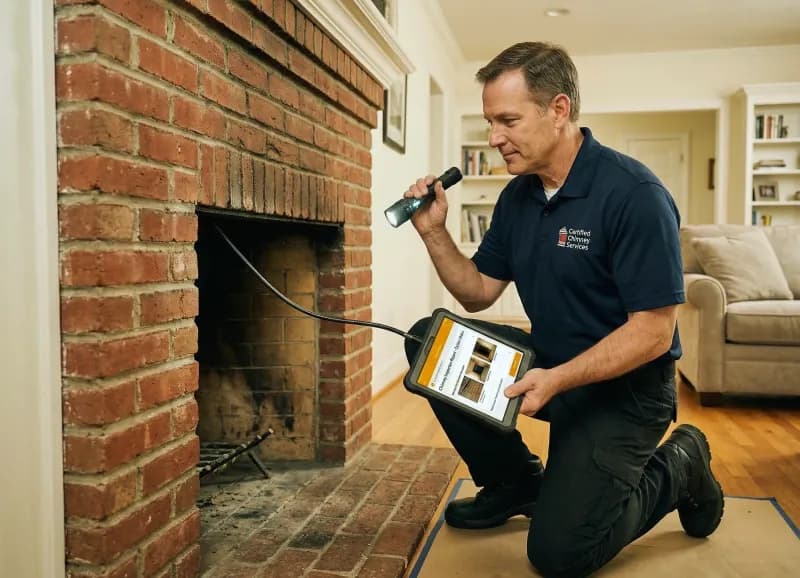
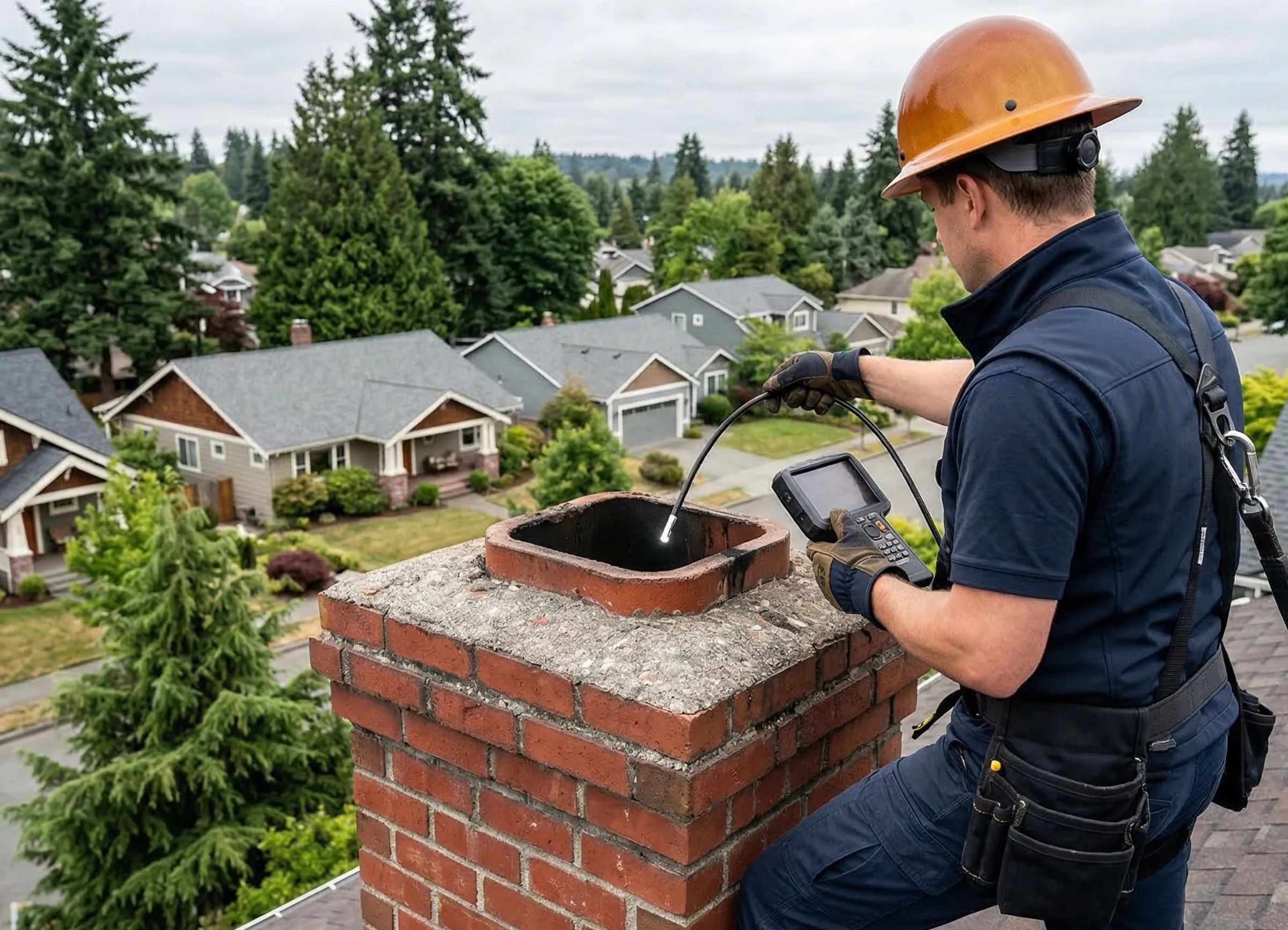
Derek arrived the morning after the general inspection. From the driveway, the chimney looked unremarkable — a standard brick stack, no obvious lean, no visible crumbling. But when Derek fed the HD flue camera up the firebox, the picture changed immediately. The original clay tile liner, which had never been replaced, had multiple longitudinal cracks running nearly the full height of the flue. At one section just above the smoke chamber, a tile had shifted completely, leaving a gap where combustion gases — including carbon monoxide — could migrate directly into the wood-framed chase surrounding the chimney.
'This is the kind of thing that doesn't show up until you're cooking a hot fire in January,' Derek told Marcus as they reviewed the camera footage together on his tablet. 'You can see right here — that gap is maybe three-quarters of an inch, but that's enough for CO to work its way into the wall cavity and eventually into the living space. It's also a direct fire-transfer path to the framing.' The crown had also developed a deep transverse crack from a previous winter freeze, and the original 1978 flashing showed no counter-flashing at all — just surface-applied caulk that had long since failed.
'The liner alone needs a full stainless steel reline — that's $3,800 to $4,200 at this flue diameter and height. Add the crown replacement and proper step-flashing installation and you're looking at $5,400 to $6,800 all in. And honestly, none of this is cosmetic. The liner is a safety issue that needs to be addressed before the first fire.'
— Derek, Certified Chimney Technician, Seattle Chimney Pros
Marcus went back to the sellers with Derek's full written report — HD photos, camera video, and itemized cost estimates. The sellers, unwilling to lose the deal, agreed to a $11,400 price reduction to cover the chimney repairs plus a margin for coordination. Marcus closed on the house, had the chimney relined and repaired before fall, and lit his first fire in November knowing the system was sound. 'I almost skipped the chimney inspection to save the $299,' he told us afterward. 'That would have been the most expensive $299 I ever saved.'
Why Does a General Home Inspection Miss Chimney Problems?
Home inspectors are skilled generalists — they evaluate hundreds of components in a few hours. Chimney systems require specialized tools and training that fall outside the standard home inspection scope. Here's exactly what the general inspector cannot assess:
- Flue liner condition — The most dangerous chimney defect (cracked clay tiles, failed mortar joints, missing sections) is completely invisible without a flue camera. Home inspectors do not carry this equipment, and NFPA 211 does not require them to.
- Creosote accumulation stage — Stage 2 and Stage 3 creosote buildup is a chimney fire hazard that requires interior flue examination to identify. A ground-level visual check cannot determine creosote level.
- Clearance-to-combustibles violations — Building code requires specific clearances between the flue liner and wood framing. Violations are a fire risk that can only be verified by someone who knows what to look for and where to look.
- Hidden water damage — Moisture damage inside the chimney structure deteriorates the system from within. By the time it's visible from outside, the damage is already extensive and expensive.
- Seismic damage — Seattle sits in an active seismic zone. Internal structural displacement from past earthquakes is frequently invisible from outside but can compromise the entire chimney stack. Our Seattle earthquake chimney damage guide explains exactly what to watch for.
- Improper prior repairs — Homeowners and unlicensed contractors sometimes make cosmetic chimney 'fixes' that mask deeper problems or create new hazards. Spotting these requires chimney-specific expertise and hands-on examination.
What Is a Level II Chimney Inspection and Why Is It the Real Estate Standard?
NFPA 211 defines three levels of chimney inspection. Level II is the explicit standard for real estate transactions — it's not a recommendation, it's the published national fire safety guideline for any change of ownership.
| Inspection Level | What's Included | When Required | Typical Cost (Seattle) |
|---|---|---|---|
| Level I | Visual inspection of accessible portions; no camera, no roof access required | Annual maintenance on a system with no changes | $169–$229 |
| Level II | Full HD flue camera, roof access, attic/crawlspace check, clearance-to-combustibles verification, cross-section flue wall evaluation | Property transfer, after any seismic/storm event, fuel type change | $249–$399 |
| Level III | Everything in Level II plus removal of components to access concealed areas | Only when Level II findings indicate hidden hazards requiring further investigation | $500–$900+ |
Our Level II chimney inspection includes HD interior and exterior photo documentation, a written condition report with component-by-component ratings, code compliance notes referencing NFPA 211 and local Seattle building standards, itemized repair cost estimates, and a 48-hour report turnaround — well within standard contingency windows.
What Does Washington State Law Say About Chimney Disclosure?
Washington operates under RCW 64.06, which requires sellers to complete a Seller Disclosure Statement covering known material defects — including chimney issues. But there are important nuances every buyer needs to understand:
- Sellers only disclose what they know. Many chimney problems — particularly flue liner cracks, internal water damage, and clearance violations — are invisible to homeowners. A seller can honestly mark 'unknown' on the disclosure form for problems they've never had inspected.
- Washington does not require a seller-ordered chimney inspection. Unlike some states, Washington has no statute mandating chimney inspection before property transfer. The disclosure requirement only covers known defects.
- 'As-is' sales still require disclosure. An as-is sale means the seller won't make repairs — it does not permit concealment of known defects. The disclosure form must still be completed honestly.
- Your inspection contingency is your protection window. Standard Washington purchase agreements include an inspection contingency period, typically 7–10 business days. This is your window to commission a Level II chimney inspection. Do not waive this contingency on any home with a fireplace or wood stove.
What Red Flags Should You Watch for When Touring Homes?
Before you even schedule an inspection, train your eye to spot these warning signs during showings:
- White mineral staining on brick (efflorescence) — Indicates chronic moisture cycling through the masonry. Common in Seattle's climate but always worth investigating further. See our detailed efflorescence guide for what it means.
- Visible mortar crumbling from street level — If deterioration is obvious from the driveway, the problem is already significant. Expect tuckpointing costs at minimum.
- Chimney cap missing or heavily rusted — A missing cap guarantees moisture intrusion into the flue and likely animal nesting. Rusted caps indicate years of deferred maintenance.
- Chimney leaning or separating from the house — Structural failure. Do not overlook this. It requires immediate professional assessment before any offer.
- Fresh masonry patches or mismatched brick — Could be a quality repair or a cosmetic cover-up. Only a camera inspection reveals which.
- Water stains on ceiling near the chimney chase — Active or recent water intrusion. The flashing, crown, or liner is compromised.
- Pre-1945 construction with original chimney — These chimneys predate modern liner requirements. Many have unlined flues, deteriorated clay tiles, or masonry that's never been seismically evaluated.
How Do Chimney Inspection Findings Affect Your Purchase Negotiation?
A professional chimney inspection report is one of the strongest negotiation tools a buyer can bring to the table. Here's how findings typically play out in Washington real estate transactions:
| Finding Category | Typical Repair Range | Typical Negotiation Outcome |
|---|---|---|
| Minor (cap, caulk, minor tuckpointing) | $200–$900 | Seller credit or completion before closing; usually accommodated |
| Moderate (crown replacement, flashing, waterproofing) | $900–$3,500 | Price reduction or escrow holdback for buyer-managed repairs |
| Major (full reline, significant masonry rebuild) | $3,500–$9,000 | Significant price reduction; sometimes renegotiates entire offer structure |
| Critical (structural failure, severe code violations) | $9,000–$20,000+ | Major price renegotiation, seller-funded repair, or buyer walks under contingency |
Based on 2025 real estate inspections we completed across King, Pierce, and Snohomish counties, chimney repair items appear in the top five negotiation issues in home sales involving fireplaces. Buyers who arrive at the negotiation table with a professional report — HD photos, camera video footage, and itemized cost estimates — have significantly stronger leverage than those relying solely on a general home inspection note that says 'recommend chimney evaluation.'
What Are the Steps to Get a Chimney Inspection During a Home Purchase?
Here is exactly how to work a Level II chimney inspection into your Washington home purchase timeline without risking your contingency period:
- Tell your buyer's agent at the first showing. If you're seriously interested in a property with a fireplace, let your agent know immediately that you want a Level II chimney inspection included in your due diligence. Experienced Seattle-area agents will build this into the inspection scheduling window without hesitation.
- Schedule within 24 hours of accepted offer. Inspection contingency windows in competitive Seattle markets are often 7–10 days. Call us the same day your offer is accepted — we can usually schedule within 1–3 business days and deliver the written report within 48 hours of the visit.
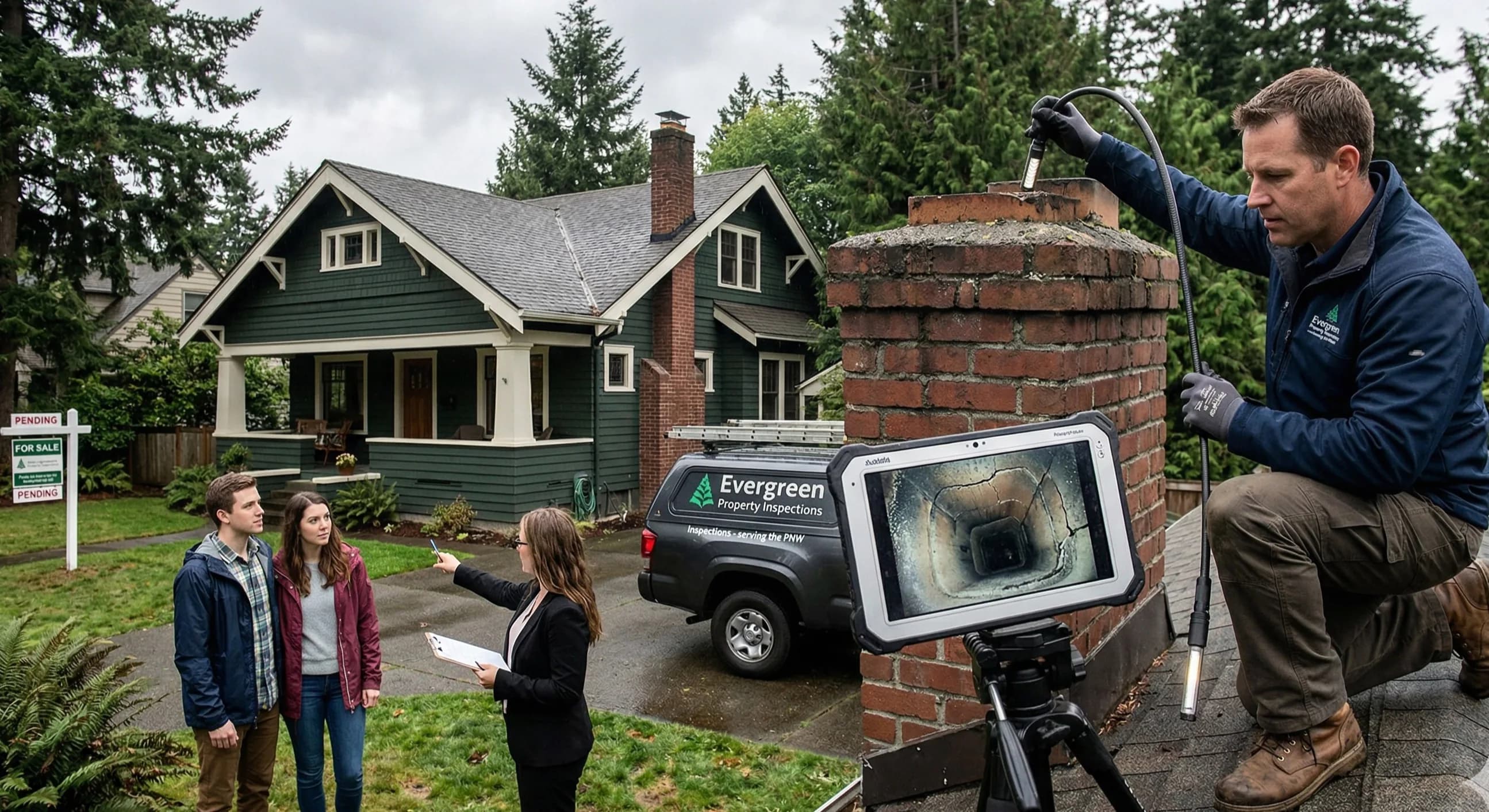
- Attend the inspection if possible. Our technicians walk buyers through every finding in real time using the camera feed and on-site photos. This firsthand knowledge is far more persuasive in negotiations than a report you read after the fact.
- Use the report's cost estimates directly in your request. Our reports include specific repair cost ranges for every deficiency. Your agent can present these as documented, professional estimates — not guesses — when requesting a credit or price reduction.
- Prioritize safety-critical findings. Our reports classify every item as safety-critical, recommended, or cosmetic. Safety-critical findings (cracked liner, clearance violations, structural issues) carry the most weight in negotiations and should be resolved before any fire is lit.
For homes with gas fireplaces or gas inserts, also ask about a gas fireplace inspection — the venting and burner assembly require a separate evaluation from the chimney structure itself.
Ready to Inspect Before You Close?
A $249–$399 Level II chimney inspection is the single highest-ROI step you can take during a Washington home purchase. Our CSIA-certified technicians serve the entire Seattle metro area — from Kirkland and Bellevue to West Seattle and Tacoma — with 48-hour report turnaround and itemized cost documentation built for real estate negotiations. Call us at (206) 278-2924 or schedule your Level II inspection online — we'll work around your contingency timeline.
Need professional help?
Our professionally trained team is ready. $99 inspection credited toward repairs, 30-minute response.