How to Make Your Fireplace More Efficient in Seattle (2026 Guide)
How Much More Efficient Can You Make a Fireplace in Seattle?
A standard open masonry fireplace in Seattle operates at just 10–15% efficiency — meaning 85 to 90 cents of every dollar you spend on firewood goes straight up the flue. Based on over 600 fireplace inspections and efficiency upgrades our team completed across the Seattle metro area in 2025, the average homeowner can push that number to 40–60% with targeted upgrades costing $500–$2,000. Full gas insert conversions reach 70–85% efficiency for $3,500–$7,000 installed. Current as of July 2026, these are the upgrades that actually move the needle — ranked from simplest to most involved, with real Seattle pricing at every step.
A Real Efficiency Upgrade: Marcus T. in Fremont
Marcus T. bought his 1952 Fremont bungalow in 2023 and had been looking forward to cozy winter fires ever since. By January 2026, the reality had set in: every time he lit a fire, the living room warmed slightly near the hearth but the rest of the house felt colder. His gas bill was creeping up, not down. A neighbor who had used us the previous fall suggested he give us a call.
Alex arrived on a gray Tuesday morning and started with a full Level 1 inspection before even discussing efficiency upgrades. What he found told the whole story: a warped, barely-sealing throat damper that had been leaking conditioned air for years, an unlined smoke chamber with several gaps in the parging, and a firebox that Marcus had been loading the traditional bottom-up way with alder — one of the lowest-heat softwoods available locally.
'The damper was so warped it couldn't close flat — I could see daylight around the edges. Every night after the fire went out, that chimney was acting like an open window pulling your heated air straight outside. The alder wasn't helping either. At 24% moisture content, he was burning more steam than wood.'
— Alex, Lead Technician, Seattle Chimney Pros
Alex walked Marcus through a three-part upgrade plan: a top-sealing damper installed that morning ($285), a cast iron fireback leaned against the rear wall ($185 for the unit, 10 minutes to place), and a switch to seasoned oak from a Shoreline supplier Alex recommended. Total spend including labor: $520. Marcus texted us three weeks later: 'First time the back bedroom has been warm during a fire. I don't know how I lived with the old setup.' He's scheduled for an annual sweep in October 2026 to keep everything running clean.
Why Does a Fireplace Lose So Much Heat?
The physics are simple but brutal. An open masonry fireplace draws combustion air from the room — and takes heated indoor air with it. Your furnace then works harder to replace that lost conditioned air. The U.S. Department of Energy has documented cases where traditional open fireplaces produce a net heat loss for the home, leaving rooms farthest from the hearth colder than if the fire had never been lit.
In Seattle, this problem compounds across a 6–7 month heating season (October through April). Every hour the fire burns — and especially every hour after it dies down with the throat damper leaking — is an hour of paid-for heat escaping through a 30-foot masonry column into the sky. The upgrades below attack this problem from multiple angles simultaneously.
What Are the 10 Most Effective Fireplace Efficiency Upgrades?
Here's how each upgrade affects efficiency, what it costs in the Seattle market, and how they stack together:
| Upgrade | Efficiency Gain | Installed Cost (Seattle) | DIY Possible? |
|---|---|---|---|
| 1. Tempered glass doors | +20–30% | $200–$600 | Yes |
| 2. Top-sealing damper | Eliminates off-season draft loss | $200–$400 | Pro recommended |
| 3. Cast iron fireback | +25–40% radiant heat | $100–$300 | Yes (no tools) |
| 4. Heat exchanger grate | +20–30% | $150–$400 | Yes |
| 5. Fireplace blower system | +15–25% | $200–$500 | Partial |
| 6. Outside air kit | Solves draft reversal | $150–$300 | No |
| 7. Insulated chimney liner | Improves draft + combustion | $1,500–$4,000 | No |
| 8. Seasoned hardwood | +50–100% vs. wet softwood | $0 extra if switching | Yes |
| 9. Top-down fire method | Saves 15–20% wood per burn | $0 | Yes |
| 10. Air leak sealing | Reduces passive heat loss | $50–$150 add-on | No |
How Do Glass Doors and a Top-Sealing Damper Work Together?
These two upgrades are the highest-ROI pairing for Seattle homeowners, and they attack different parts of the efficiency problem.
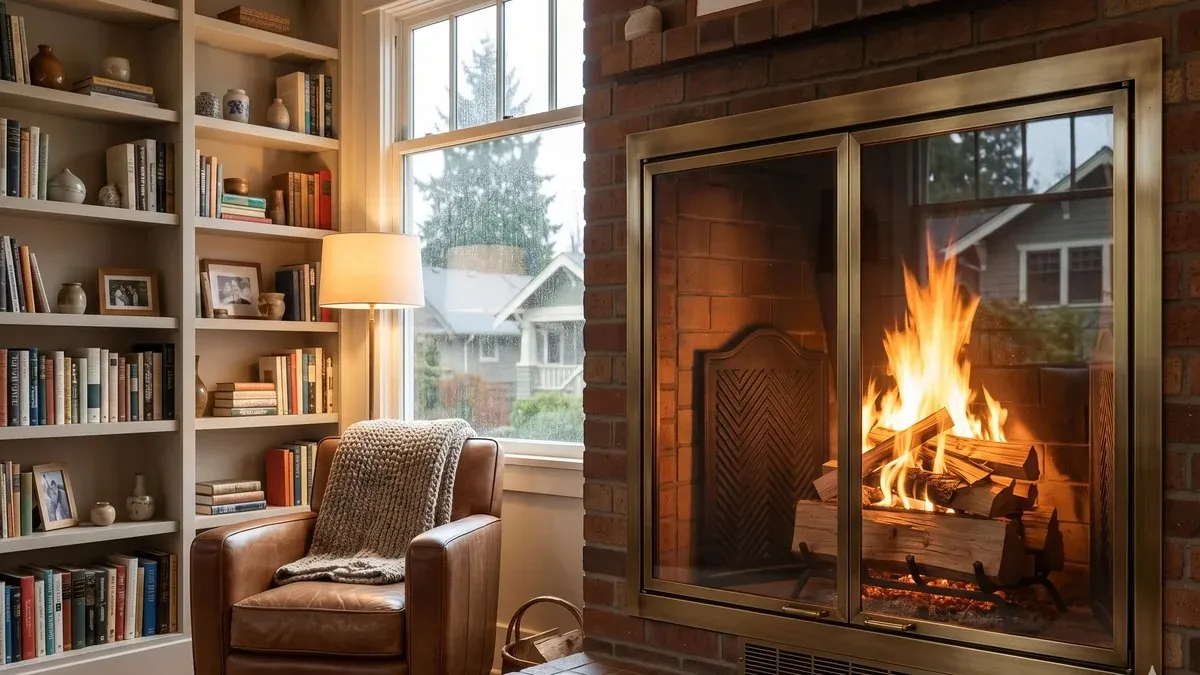
Glass doors ($200–$600 installed) solve the active-fire problem. When the fire is burning, you crack them slightly to allow controlled combustion air in. When the fire dies down to coals at night, you close them fully, sealing the firebox and stopping the chimney from pulling heated room air out for hours after you've gone to bed. The DOE estimates glass doors alone reduce uncontrolled air loss by 20–30%.
What to look for: tempered safety glass (required by code — never plate glass), adjustable air intake vents at the bottom of the frame, bi-fold doors for easy wood loading, and a frame sized precisely to your firebox opening. Measure width and height before ordering.
A top-sealing damper ($200–$400 installed) solves the off-season problem. Your old cast iron throat damper warps over years of heat cycling and never truly seals — in Marcus's case in Fremont, Alex could see daylight around the edges. A top-sealing damper sits at the very top of the flue with a silicone gasket, operated by a cable with a handle inside the firebox. When closed, it forms an airtight seal, stopping cold Puget Sound air from drafting down into your home during the 7–8 months the fireplace sits unused. It also doubles as a rain cap, protecting the flue from Seattle's 38 annual inches of rainfall. Installation takes about 45 minutes and is typically combined with a chimney sweep visit.
What Does a Fireback Do and Is It Worth It?
A fireback is a cast iron plate (typically 20–30 lbs) that stands against the rear wall of the firebox. It absorbs heat from the fire, protects the rear firebrick from spalling, and radiates stored heat forward into the room as infrared warmth rather than letting it soak into the masonry. European fireplaces have used them since the 15th century — the physics haven't changed.
A quality fireback increases room-directed radiant heat by 25–40%. Installation requires zero tools: you lean it against the back wall, optionally propped at a slight angle to direct more heat toward the seating area. Cost: $100–$300 for the unit itself. It pairs particularly well with glass doors, which keep the heat in the room once the fireback radiates it forward.
For maximum effect, combine the fireback with a heat exchanger grate ($150–$400) — hollow steel tubes that loop under and around the logs, heating room air by convection as it passes through the fire zone. Blower-equipped models push efficiency into the 30–40% range on their own. Check that the grate fits your firebox without touching the firebrick walls, and that you have a nearby outlet if you want the electric blower version.
Why Does My Seattle Home Have Draft Problems — And What Fixes Them?
Draft problems in Seattle have a specific cause that the rest of the country doesn't deal with as acutely: Washington State Energy Code mandates one of the tightest building envelopes in the nation. Homes built or remodeled after 2012 are nearly airtight. That's great for insulation — and terrible for fireplaces, which need combustion air.
When your home is sealed tight and the fireplace competes with kitchen range hoods, bathroom exhaust fans, and a dryer vent for available air, the result is negative pressure. Symptoms include smoke rolling into the room when you open the damper, difficulty getting fires started, and — the most alarming one — smoke backdrafting when you turn on the range hood while the fire is burning. In our work across Fremont, Ballard, and Queen Anne, we see this issue in roughly 35% of homes built after 2010.
The fix is an outside air kit ($150–$300 installed): a dedicated 4–6 inch insulated duct from the exterior of the home directly to the firebox. The fire draws combustion air from outside instead of competing with your home's mechanical systems. Installation involves cutting a small penetration through the foundation or exterior wall. It is not a DIY project — it requires proper sealing and insulation — but it permanently solves backdrafting and allows the rest of your efficiency upgrades to work as intended.
If your flue itself is oversized, unlined, or has deteriorating clay tile, an insulated stainless steel liner ($1,500–$4,000) will improve draft consistency, reduce creosote buildup, and allow cleaner, more complete combustion. See our chimney liner replacement guide for a full breakdown of options and costs.
What Should I Do Right Now to Get More Heat From My Fireplace?
If you want to start improving efficiency before any professional work is scheduled, here are the steps you can take today — in order of impact:
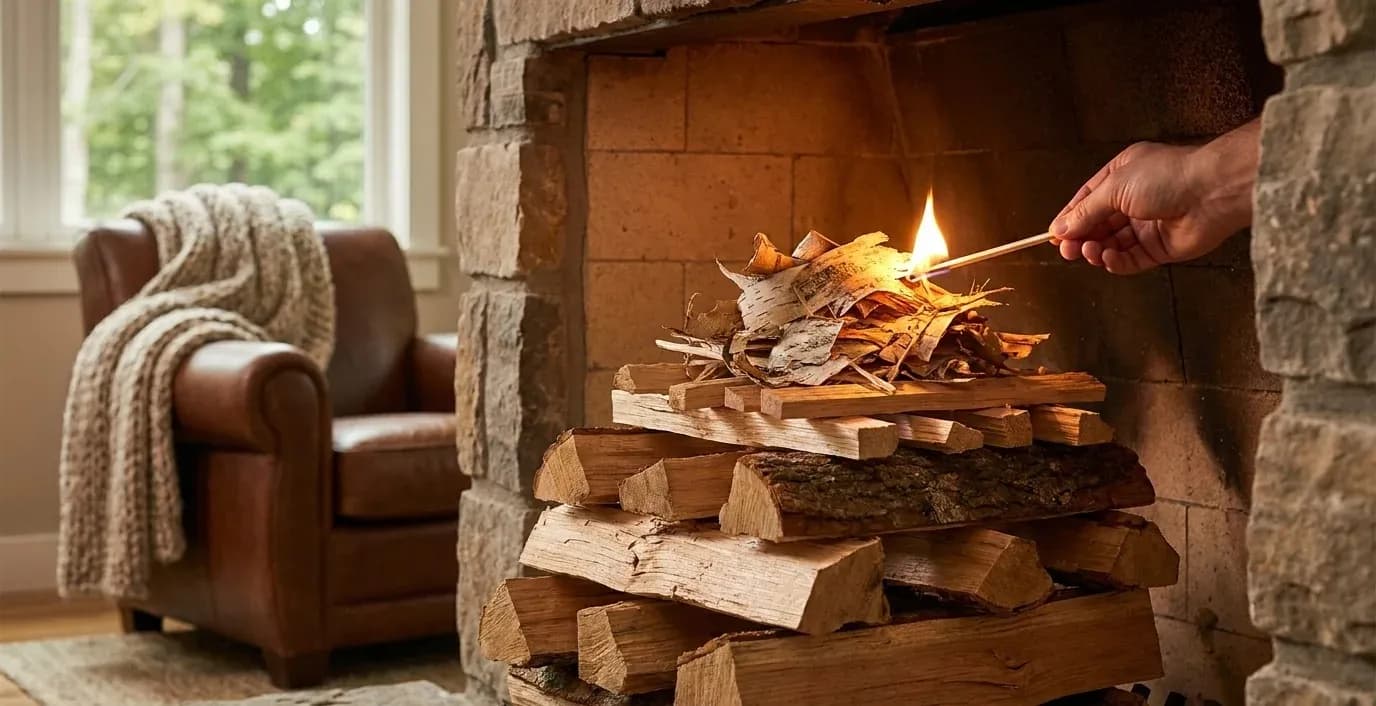
- Switch to the top-down fire method. Stack large logs on the bottom, medium logs in the middle, kindling and a fire starter on top. Light the top. The fire burns downward, establishes a strong draft immediately, produces far less smoke in the first 20 minutes, and uses 15–20% less wood per burn. Zero cost, noticeable difference from the first fire. Full technique in our fire-building guide.
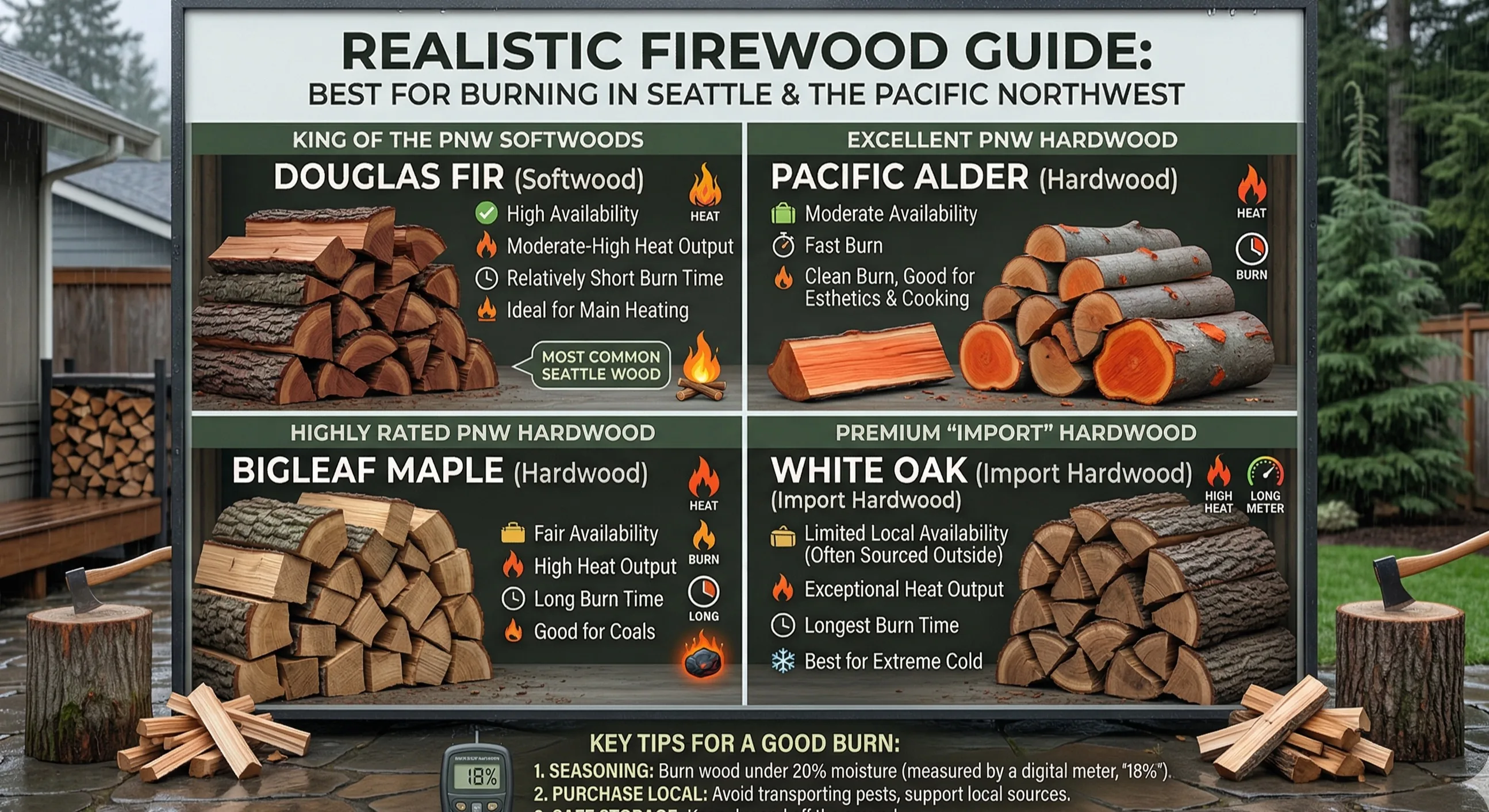
- Check your firewood moisture. Buy a $20 moisture meter (hardware stores carry them). Anything above 20% moisture is burning steam, not wood — you're getting half the heat and double the creosote. Properly seasoned oak or maple at 15–18% moisture produces dramatically more heat. See our Pacific Northwest firewood guide for local sourcing tips.
- Close the damper completely when not in use. Even a warped throat damper is better than leaving it open. If you can feel a draft with the damper 'closed,' that's your sign to prioritize a top-sealing damper replacement.
- Place a cast iron fireback. Order one sized to your firebox — no installation required. It will noticeably increase the radiant heat you feel within the first fire.
- Schedule a sweep and efficiency consultation. Our technicians assess your specific firebox, damper condition, and draft characteristics in about 90 minutes and recommend only the upgrades that will actually move the needle for your setup. Call (206) 278-2924 to book.
When Does a Gas Insert Make More Sense Than Upgrading a Wood Fireplace?
We'd be doing you a disservice if we didn't name the option that outperforms every upgrade on this list: a direct-vent gas insert. A modern unit slides into your existing masonry firebox, vents through your existing chimney with a new liner, and runs at 70–85% efficiency with a remote control. No firewood stacking, no ash cleanup, no annual sweep, no creosote risk, and two to three times the heat output of even a fully upgraded wood-burning fireplace.
Gas inserts are the right answer if your primary goal is heating a room effectively rather than the ritual experience of a wood fire. They range from $3,500–$7,000 installed in the Seattle metro, and many homeowners on our maintenance list have recouped the cost through lower heating bills within 5–8 years. We compared both paths in depth in our gas vs. wood fireplace guide for Seattle homeowners.
If you love the wood fire experience, the combination of glass doors + top-sealing damper + fireback + seasoned hardwood gets you to 40–50% efficiency for roughly $700–$1,200 — a meaningful improvement over the baseline 10–15% without changing the character of your fireplace. Every upgrade stacks with the others, and most pay for themselves within two to three heating seasons in Seattle's 6-month heating climate.
Seattle Chimney Pros has been helping Puget Sound homeowners get real heat from their fireplaces since 2011. Our CSIA-certified technicians serve Fremont, Ballard, and 43 other neighborhoods across the metro. Call us at (206) 278-2924 or schedule a consultation online — we'll tell you exactly which upgrades make sense for your specific setup and budget.
Need professional help?
Our professionally trained team is ready. $99 inspection credited toward repairs, 30-minute response.