Spring Chimney Maintenance Checklist for Seattle Homeowners (2026)
What Does Spring Chimney Maintenance Actually Cover in Seattle?
Spring chimney maintenance in Seattle means a 10-point assessment of everything your chimney endured during the October–April burning season — typically completed between April and June before Seattle's dry window opens. Based on over 650 spring inspections our team completed across the Seattle metro in 2025, the average homeowner needs 2–3 items addressed beyond the standard sweep and inspection. The most common findings: cracked chimney crowns (found in 41% of homes), deteriorated flashing (38%), and Stage 2 creosote buildup (29%). A combined spring sweep and Level I inspection runs $279–$449 in 2026. If repairs are needed, budget an additional $300–$1,500 depending on what's found. Current as of June 2026.
A Real Spring Inspection: Marcus T. in Ravenna
When Marcus T. listed his 1952 Ravenna bungalow for sale last April, his real estate agent flagged the chimney as a potential inspection issue. The brick stack had a faint lean visible from the sidewalk, and the previous owners had no maintenance records. Marcus found us through a neighbor who'd used our service two seasons running.
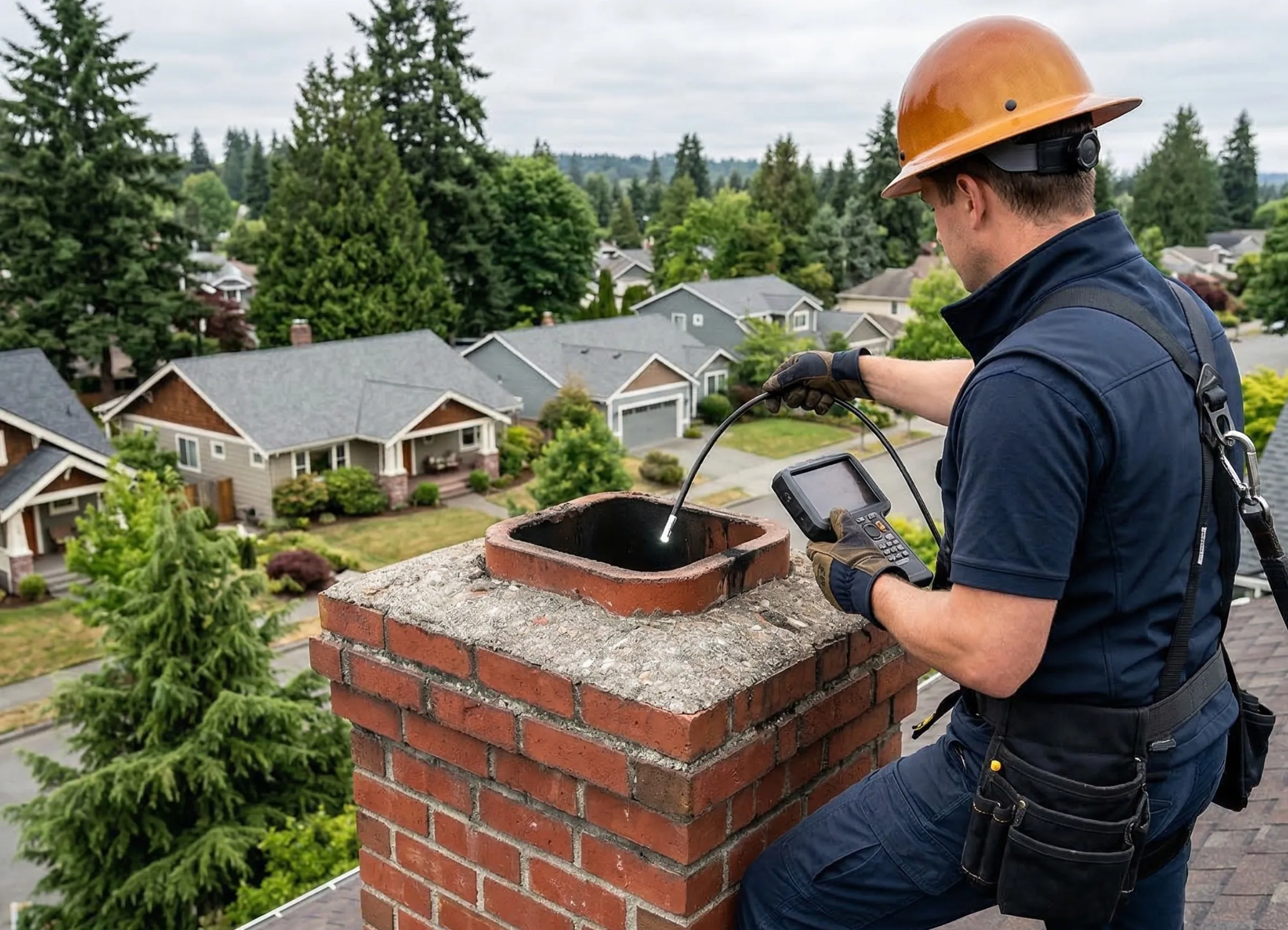
Carlos arrived on a clear Tuesday morning with a full inspection kit and a GoPro-equipped flue camera. The exterior told part of the story immediately — the original galvanized cap had rusted through at two corners, and a thick mat of moss had colonized the north face of the crown. But the camera revealed the real concern: the clay tile liner had a hairline fracture at the second tile joint, about four feet up from the smoke chamber. It wasn't catastrophic, but it was enough to fail a real estate inspection and present a potential carbon monoxide risk if the fireplace was used without repair.
Carlos walked Marcus through the findings at the firebox, pointing out how the rust staining on the back wall of the firebox traced directly back to the failed cap — rainwater had been running straight down the flue for at least one full season.
'The cap failure and the liner crack are connected — once water gets in consistently, it accelerates the thermal stress on the tile. This one's been leaking long enough that the clay started cycling wet and dry all winter. That's what cracked it.'
— Carlos, Certified Chimney Technician, Seattle Chimney Pros
The repair scope: a new stainless steel cap ($310 installed), crown resurfacing with elastomeric sealant ($480), and a stainless steel flue liner insert to replace the cracked clay section ($1,450). Total: $2,240 — significant, but Marcus's agent noted it likely saved the sale, which would have stalled over an open chimney item. He closed on time. His new buyers are on our annual maintenance list.
Why Is Spring the Best Time for Chimney Maintenance in Seattle?
Spring is the optimal maintenance window because your chimney has just completed its heaviest-use season and Seattle's dry months — when masonry repairs actually cure properly — are weeks away. Here's why the timing matters:
- Assess fresh winter damage — Cracks, moisture intrusion, and creosote buildup are easiest to evaluate right after the burning season ends, before summer drying obscures early signs.
- Schedule repairs in dry weather — Mortar, crown coatings, and waterproofing sealants all require dry conditions to cure. Seattle's June–September window is ideal; spring assessment locks in that scheduling.
- Beat the fall rush — September through November, every chimney company in the Seattle metro books out 4–8 weeks in advance. Spring appointments typically have 1–2 week availability.
- Creosote is easier to remove fresh — Stage 2 creosote left in a flue all summer absorbs ambient moisture and hardens toward Stage 3. Spring removal is faster and less expensive.
- Animal intrusion window — Raccoons, starlings, and chimney swifts begin nesting in uncapped flues as early as April. A spring inspection catches this before a nest becomes a fire hazard or a protected-bird situation.
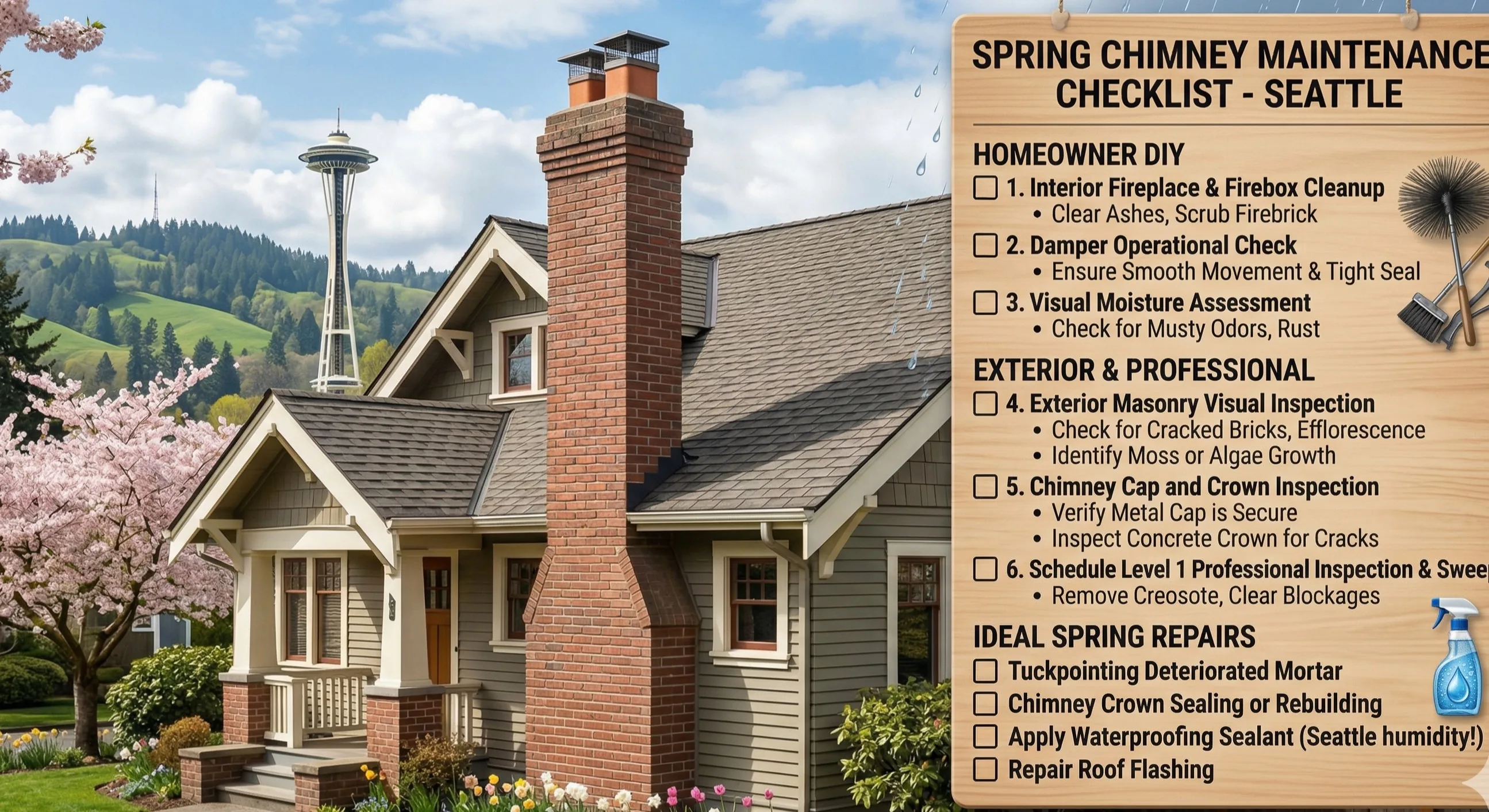
Use the checklist below to work through each item systematically. We've noted which tasks are DIY-friendly and which require a certified technician.
What Are the 10 Spring Chimney Maintenance Tasks — and What Does Each Cost?
| Task | DIY? | Priority | Pro Cost (2026) |
|---|---|---|---|
| 1. Exterior visual inspection | ✅ Yes | High | — |
| 2. Chimney crown check | ❌ No | High | $480–$1,500 (repair) |
| 3. Chimney cap inspection | ✅ Visual only | High | $200–$500 (replacement) |
| 4. Flashing inspection | ❌ No | High | $300–$800 (repair) |
| 5. Interior firebox examination | ✅ Yes | Medium | — |
| 6. Damper test | ✅ Yes | Medium | $200–$600 (repair) |
| 7. Ash and debris clean-out | ✅ Yes | Low | — |
| 8. Professional chimney sweep | ❌ No | High | $199–$329 |
| 9. Waterproofing assessment | ❌ No | Medium | $300–$700 (application) |
| 10. Level I professional inspection | ❌ No | High | $149–$249 |
How Do You Perform Each Checklist Task Correctly?
Here's what to look for — and what we look for — on each item:
1. Exterior Visual Inspection (DIY) — Walk your property and look at the chimney from all four sides. Use binoculars for the upper sections. You're scanning for cracked or spalling bricks, white efflorescence staining, crumbling mortar joints, vegetation growing from the masonry, and any visible lean against the roofline. Take photos so you can compare year over year.
2. Chimney Crown Check (Pro) — The concrete crown at the chimney's top is the first barrier against Seattle rain. After a wet winter, crowns commonly develop hairline cracks that expand with freeze-thaw cycling. A pro will probe the crown, check for delamination, and assess whether resurfacing or full replacement is needed. Ignoring crown cracks leads to brick saturation and interior water damage.
3. Chimney Cap Inspection (DIY visual / Pro for replacement) — Check for rust, torn mesh screening, or a shifted position. Galvanized caps in coastal neighborhoods like Ballard and Magnolia degrade faster due to salt air. If there's no cap at all, chimney cap installation should be your first scheduled repair — it protects everything below.
4. Flashing Inspection (Pro) — Flashing is the #1 source of chimney-related water leaks in Seattle. After 30+ inches of winter rain, even properly installed flashing can develop gaps. Look for caulk patches (indicates prior DIY attempts), lifted edges, or rust lines running down the brick from the roofline. Our techs use a moisture meter to detect water that's already wicked into the substrate. See our guide to chimney leaks and what causes them for more.
5. Interior Firebox Examination (DIY) — Shine a bright flashlight into the firebox. Cracks wider than 1/8 inch in the firebrick, rust staining on the back wall, and black shiny deposits (Stage 2 or 3 creosote) all warrant professional follow-up.
6. Damper Test (DIY) — Open and close the damper. It should move smoothly, open fully, and close with no visible light gaps. Grinding or sticking indicates rust from moisture intrusion. A properly sealing damper also reduces your heating and cooling bills by eliminating unconditioned air flow through the flue.
7. Ash and Debris Clean-Out (DIY) — Wait 72 hours after the last fire before removing ash. Use a metal bucket and metal shovel only. Store the bucket outdoors on a non-combustible surface for at least a week. Leave about one inch of ash on the firebox floor — it insulates and improves future fires. Fully cooled wood ash is excellent garden amendment for Seattle's characteristically acidic soil.
8. Professional Chimney Sweep (Pro) — A CSIA-certified sweep removes all creosote from the firebox, smoke chamber, and flue using rotary brushes and negative-pressure vacuum systems. Spring sweeping is more effective than fall sweeping because the creosote is still relatively fresh. If it sits all summer, it can harden toward Stage 3 — which costs significantly more to remove and can require chemical treatment. Our chimney sweep service runs $199–$329 for a standard single-flue wood fireplace.
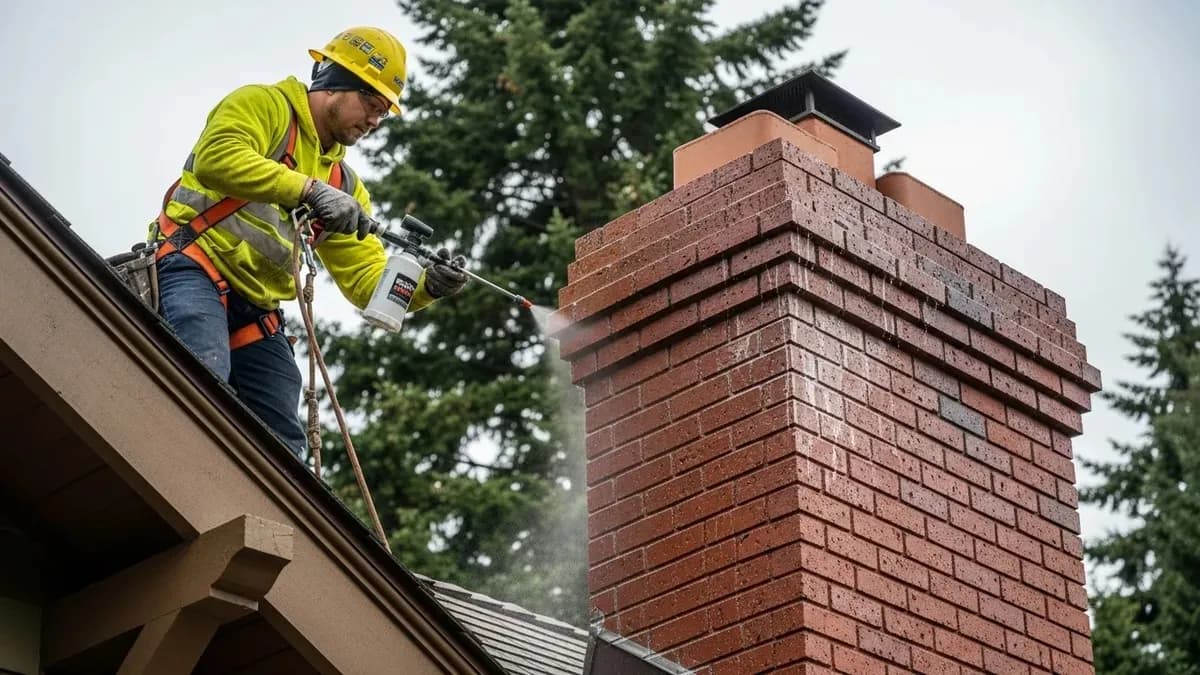
9. Waterproofing Assessment (Pro) — Chimney waterproofing applies a vapor-permeable sealant to the brick exterior, blocking liquid water while allowing internal moisture vapor to escape. Signs you're overdue: efflorescence on the bricks, damp smell from the fireplace during rain, or brick faces that are visibly flaking (spalling). Best applied during dry conditions — schedule in spring, complete in June or July.
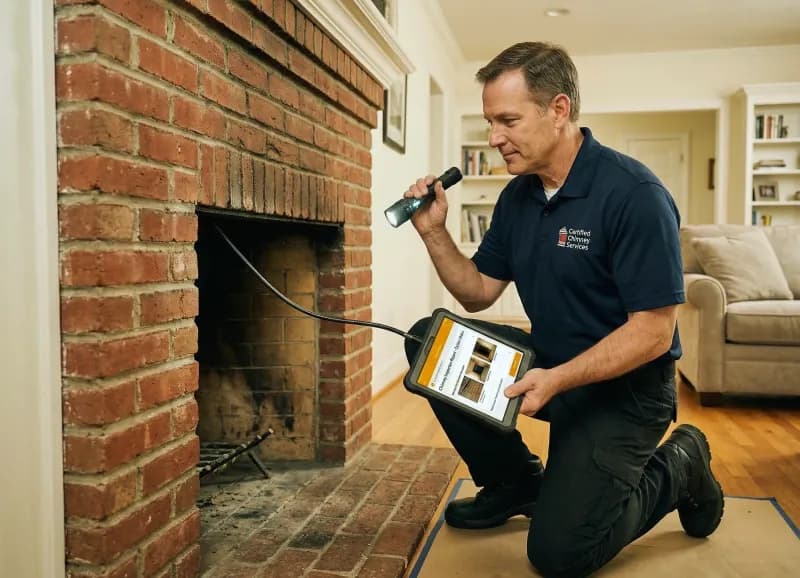
10. Level I Professional Inspection (Pro) — A Level I chimney inspection per NFPA 211 covers flue liner integrity via HD camera, internal structural condition, clearance to combustibles in the attic and wall chases, and overall system safety. Most homeowners combine this with the sweep for a single appointment. Cost: $149–$249 for Level I. If your chimney hasn't been inspected in more than two years, or if you've recently bought the home, budget for a Level II inspection ($299–$999) which includes a full video scan.
What Should You Do Right Now If You Find a Problem?
If your DIY walk-through turns up anything concerning, here's the exact sequence to follow:
- Stop using the fireplace — If you spot cracks in the firebox liner, signs of active water intrusion, or a displaced cap, do not light another fire until a professional has assessed the issue. A cracked liner can allow combustion gases including carbon monoxide to enter your living space.
- Document everything with photos — Take dated photos of any damage you observe from the ground or firebox. These help your technician prioritize and give you a baseline for tracking changes over time.
- Check your carbon monoxide detectors — Ensure CO detectors on every floor are functional. Replace batteries if they haven't been changed in the past year. NFPA recommends CO detectors within 15 feet of every sleeping area.
- Schedule a professional assessment within 2–4 weeks — Spring is a moderate-demand period with reasonable scheduling windows. Don't wait until August when roofing and masonry contractors are at peak demand, or September when chimney companies are fully booked for pre-season prep.
- Get repair quotes in writing — Any reputable company will provide a written scope of work before touching your chimney. Our guide to choosing a chimney sweep in Seattle covers what to look for and red flags to avoid.
How Does Seattle's Climate Make Spring Maintenance More Critical Than in Other Cities?
Seattle averages 38 inches of annual precipitation, with roughly 80% of that falling between October and April — exactly your heating season. That means your chimney is simultaneously under thermal stress from fires and constant moisture exposure from rain. In our experience across 850+ inspections in the Seattle metro area in 2025, Seattle chimneys show measurably faster crown deterioration and flashing failure than chimneys in drier climates like Eastern Washington.
Several neighborhood-specific factors compound this:
- Older housing stock — Neighborhoods like Capitol Hill, Ravenna, and Columbia City have significant concentrations of pre-1960 homes with original clay tile liners and lime mortar — both of which are more susceptible to moisture damage than modern alternatives.
- Moss and organic growth — Seattle's mild, damp climate encourages moss colonization on chimney crowns and north-facing brick faces. Moss holds moisture against the masonry surface, dramatically accelerating freeze-thaw spalling damage during the handful of sub-freezing days Seattle experiences each winter.
- Marine air in coastal neighborhoods — Ballard, Magnolia, and West Seattle see accelerated corrosion on galvanized chimney caps and flashing. We recommend stainless steel components in these areas specifically.
Washington Administrative Code (WAC 51-54A) requires annual chimney inspections for solid-fuel appliances in rental properties. For owner-occupied homes, the NFPA 211 standard recommends annual inspection and cleaning regardless of use frequency.
Ready to Schedule Your Spring Chimney Service?
Spring is the smartest time to get ahead of chimney issues — repairs are easier to schedule, masonry work cures properly in dry weather, and you'll head into next fall's burning season with a clean, fully assessed system. Whether you need a straightforward sweep and inspection or a full crown-to-firebox evaluation, our CSIA-certified team serves all 45 Seattle-area neighborhoods with transparent pricing and same-week availability through June.
Call us at (206) 278-2924 or schedule online at Seattle Chimney Pros — most spring appointments are available within 5–10 business days right now.
Need professional help?
Our professionally trained team is ready. $99 inspection credited toward repairs, 30-minute response.