Masonry vs Prefab Chimney in Seattle: How to Tell Which You Have (2026 Guide)
Masonry vs Prefab Chimney: The Short Answer
In Seattle, masonry chimneys cost $15,000–$30,000+ to build new and last 70–100 years with proper maintenance. Prefab (factory-built) chimneys cost $4,500–$9,000 to install and typically last 20–30 years before needing full replacement. Based on over 1,100 chimney inspections our team completed across the Seattle metro area in 2024–2025, roughly 58% of homes built after 1985 have prefab systems — even when the exterior looks like traditional brick. Current as of July 2026, this guide gives you a 7-point visual checklist to identify your system in under 5 minutes, plus what it means for maintenance, insurance, and your wallet.
A Real Inspection: Marcus T. in Kirkland Finds Out His Chimney Isn't What He Thought
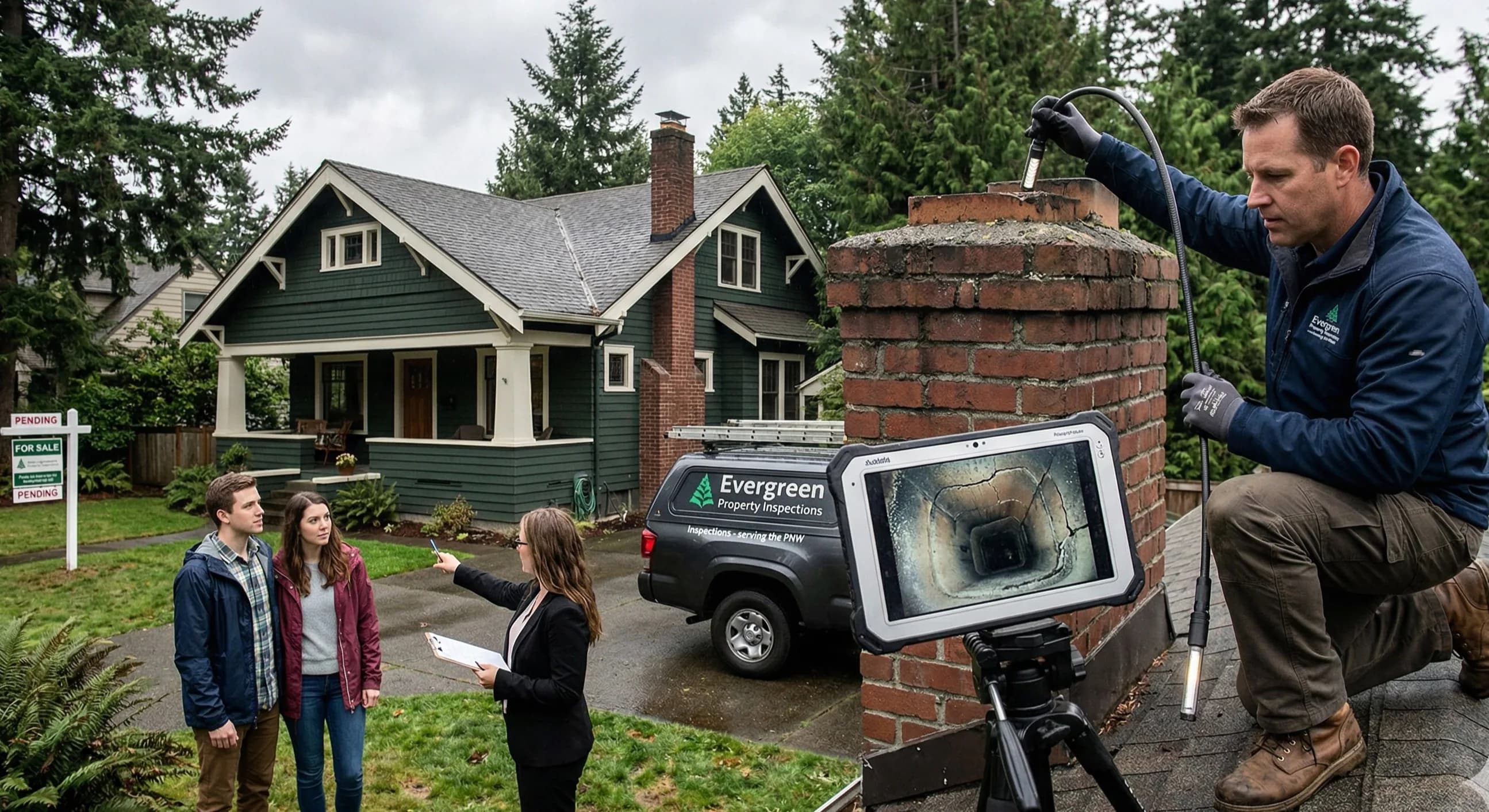
Last September, Marcus T. had owned his 1994 Kirkland colonial for three years before it came up. He was selling — his real estate agent flagged the chimney during a pre-listing walkthrough. 'The inspector is going to ask,' she told him. 'Get it looked at first.' Marcus searched for 'chimney inspection Kirkland' and booked with us that week.
Ryan, one of our senior technicians, arrived on a gray Tuesday morning. The house had a handsome brick-faced chimney on the exterior — tall, well-proportioned, the kind that looks like it belongs on a New England farmhouse. Ryan climbed to the roofline and immediately recognized what he was dealing with.
'The moment I saw the metal rain cap sitting above a wood-framed chase clad in brick veneer, I knew it was prefab. Then I looked inside the firebox and confirmed it — cast refractory panels with visible seams and a Heatilator stamp at the top rear. Classic late-1980s to mid-1990s suburban build. Marcus was surprised, but this is actually the majority of what we see in Kirkland and Redmond homes from that era.'
— Ryan, Lead Technician, Seattle Chimney Pros
The system was a 1994 Heatilator — 31 years old at the time of inspection. Ryan found a corroded chase top actively letting water into the framing cavity, two cracked refractory panels, and gasket failure at the first flue pipe joint. The verdict: individual repairs weren't cost-effective given the system's age and the fact that Heatilator had changed ownership multiple times, making exact-match parts difficult to source.
Marcus opted for a full prefab replacement with a new Majestic system and updated chase cap — total cost: $7,400, including permits and framing repairs inside the chase. He listed the house two weeks later with a fresh inspection report in hand. 'I honestly thought that brick was real,' he told Ryan at the end. 'I had no idea there was a wood frame behind it.' His listing sold above asking, with the chimney documented and clean.
What Is a Masonry Chimney?
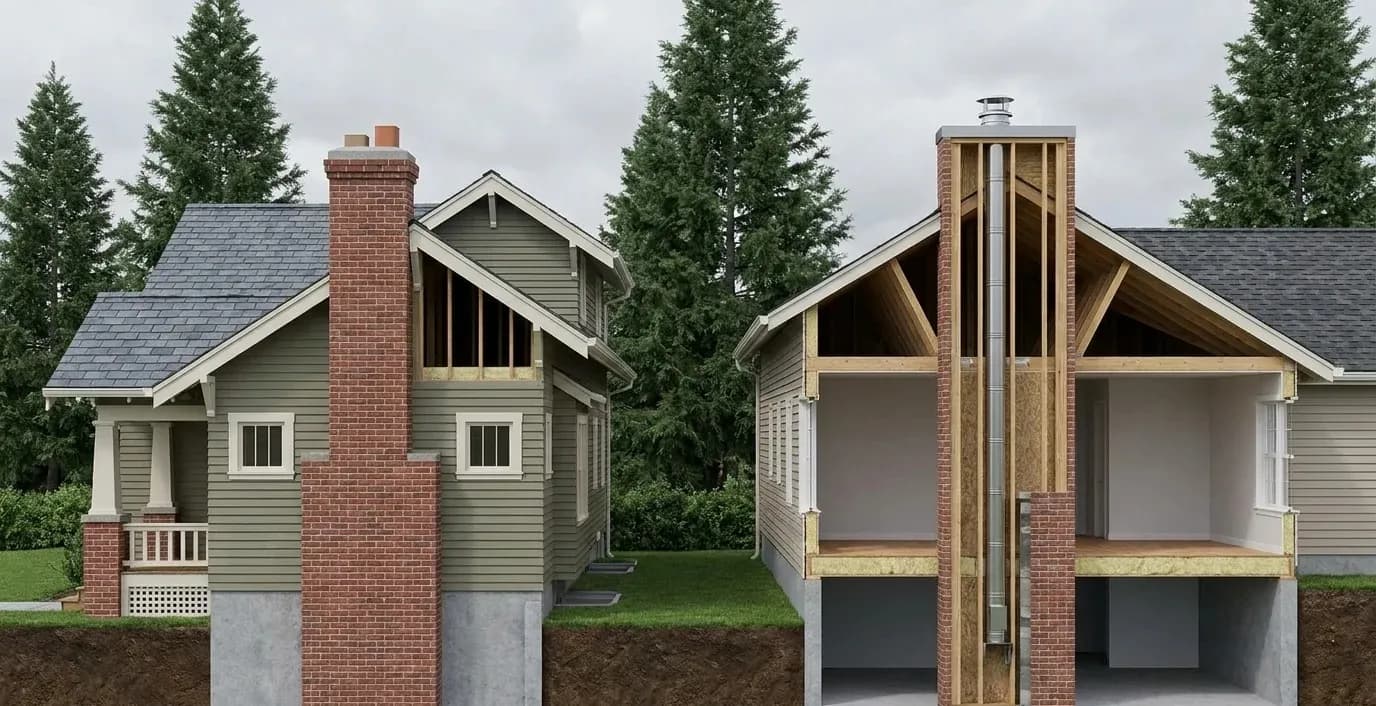
A masonry chimney is built on-site, brick by brick (or stone by stone), from a dedicated concrete footing below grade all the way through the roof. It's a self-supporting structure — often weighing 5 to 20 tons — completely independent of the house frame. Inside the masonry shell is a flue liner: traditionally clay tile, and more recently stainless steel (see our guide to clay vs stainless vs cast-in-place liners).
- Solid brick, stone, or concrete block from top to bottom
- Independent concrete footing below grade — not attached to house framing
- Concrete crown at the top (not a metal rain cap)
- Masonry firebox with real firebrick lining and mortared joints
- Common in Seattle homes built pre-1980: Craftsman, Victorian, Tudor, Colonial styles
- 70–100+ year lifespan with regular maintenance
What Is a Prefab (Factory-Built) Chimney?
A prefab chimney — also called a factory-built chimney, Class A chimney, or zero-clearance system — is manufactured as a kit, shipped to the jobsite, and assembled. It consists of a metal firebox, double- or triple-wall insulated stainless steel flue pipe, and a framed chase built from 2x4 lumber, plywood, and exterior siding or brick veneer. The whole assembly is UL-listed and must be installed per the manufacturer's exact specifications.
This last point matters: each major brand — Majestic, Heatilator, Superior, Lennox, Marco, Martin, Preway — uses proprietary parts. A cracked refractory panel can't be replaced with a generic one. You need the exact model from the original manufacturer, which becomes a real problem when that manufacturer discontinued the model 20 years ago or went out of business entirely.
- Metal firebox with cast refractory panels that mimic firebrick appearance
- Insulated stainless steel flue pipe (round, smooth, shiny)
- Chase framed from wood and attached to the house — no independent footing
- Metal rain cap and spark arrestor visible above the chase top
- Standard in Seattle-area homes built 1980 onward, especially suburbs
- 20–30 year lifespan; year 15 is typically when problems begin
How Do You Tell Which Type of Chimney You Have?
You can usually identify your chimney system in under 5 minutes without any special tools. Work through this checklist in order — the first definitive match usually settles it.
- Check the year your home was built. Pre-1980 in Seattle is almost always masonry. Post-1985 is overwhelmingly prefab. The 1980–1985 window is mixed.
- Look inside the firebox with a flashlight. Real masonry fireboxes have rough firebrick (irregular, porous, individual bricks mortared together). Prefab fireboxes have smooth cast refractory panels — look for visible seams between panels and a brand/model stamp at the rear or top.
- Look up the flue. Masonry flues show clay tile (orange or tan rectangular sections with mortar joints) or a metal liner inside brick. Prefab flues show a smooth, round, shiny stainless steel pipe — no mortar, no tile sections.
- Check the damper mechanism. Masonry chimneys usually have a throat damper — a metal blade just above the firebox, controlled by a handle or lever. Prefab fireplaces often have a simpler damper built into the flue pipe above or a gravity plate at the firebox opening.
- Look at the chimney top from the ground. Masonry chimneys end in a flat concrete crown with a clay flue tile extending through it. Prefab chimneys end in a metal rain cap — often a conical or square metal hood with mesh — sitting above a wooden chase that may be clad in brick veneer or siding.
- Knock on the exterior. Masonry sounds solid and dense. Even a brick-veneered prefab chase sounds hollow in places because it's framed wood with air inside.
- Check the basement or crawlspace. Masonry chimneys pass through with actual brick visible and rest on a concrete footing. Prefab systems show framed wood chase walls and a metal flue pipe with no masonry and no dedicated footing below.
Still unsure? A certified chimney inspection will identify your system definitively in about 15 minutes and document everything with photos for your records.
How Do Masonry and Prefab Chimneys Compare Side by Side?
| Factor | Masonry | Prefab |
|---|---|---|
| Typical lifespan | 70–100+ years | 20–30 years |
| Cost to build new | $15,000–$30,000+ | $4,500–$9,000 |
| Annual maintenance cost | $200–$500 (sweep + inspection) | $200–$400 (sweep + inspection) |
| Common repair cost | $500–$6,000 (crown, flashing, tuckpointing) | $300–$2,500 (cap, gasket, refractory panels) |
| Full replacement cost | $20,000–$40,000+ | $5,000–$12,000 |
| Insurance treatment | Structural — lower depreciation | Appliance — depreciates faster on claims |
| Resale impact | Positive, especially historic homes | Neutral if maintained; liability if aged or damaged |
| Parts availability | Universal (brick, mortar, tile) | Brand- and model-specific; some manufacturers defunct |
| Weight | 5–20 tons | 500–1,500 lbs |
Why Did Seattle's Suburbs Go All-In on Prefab After 1980?
From the late 1970s through the early 2000s, Seattle's suburbs expanded rapidly. Bellevue, Kirkland, Redmond, Renton, Issaquah, Bothell, and Sammamish added tens of thousands of homes. Nearly all of them used prefab chimney systems because they're cheaper to install, lighter (no dedicated footing required), faster to frame up, and arrive pre-engineered and UL-listed — which simplified permitting significantly.
The result: if your home was built in one of these communities between 1985 and 2005, you are statistically very likely to have a prefab chimney — even if the exterior has a brick-veneer chase that looks indistinguishable from traditional masonry. The brick you see is a thin decorative facing applied over wood framing; the chimney inside is metal pipe inside a wood box.
This matters right now in 2026 because many of those original 1985–2000 prefab systems are 21–41 years old — squarely in the zone where failures become common and repair-versus-replace decisions get urgent.
What Are the Most Common Problems with Aging Prefab Chimneys in Seattle?
Seattle's climate — 152 rain days per year, 37+ inches of annual precipitation, and frequent wind-driven rain — accelerates prefab wear faster than in drier regions. Based on our inspections of aging prefab systems across the metro area, here are the failure patterns we see most often after year 15:
- Chase top corrosion: The metal cap covering the wooden chase frame rusts through, allowing water into the chase cavity and the 2x4 framing below — often causing rot that goes undetected for years.
- Refractory panel cracking: The cast refractory panels that line the firebox develop cracks or separations. Most manufacturers specify that cracks wider than 1/16 inch require replacement — and at this age, finding the right panels is a real challenge.
- Gasket and seal failure: Flue pipe seals and gaskets dry out over time, creating draft leaks and potential carbon monoxide pathways into the home.
- Rain cap deterioration: The mesh rusts, the spark arrestor fails, and the compromised cap lets in birds, squirrels, and water. We removed nesting material from 47 prefab caps in the first quarter of 2026 alone.
- Flue pipe corrosion: The inner stainless liner pits and degrades, especially in homes where unseasoned Pacific Northwest wood (high moisture content) was burned regularly.
- Chase framing rot: Once water enters a failing chase top, the framing inside can rot over several seasons. We've opened chase cavities and found framing that crumbles in hand — a structural issue that significantly increases replacement cost.
Proper waterproofing and flashing maintenance extends prefab life, but it cannot eliminate the inevitable replacement at end of system life.
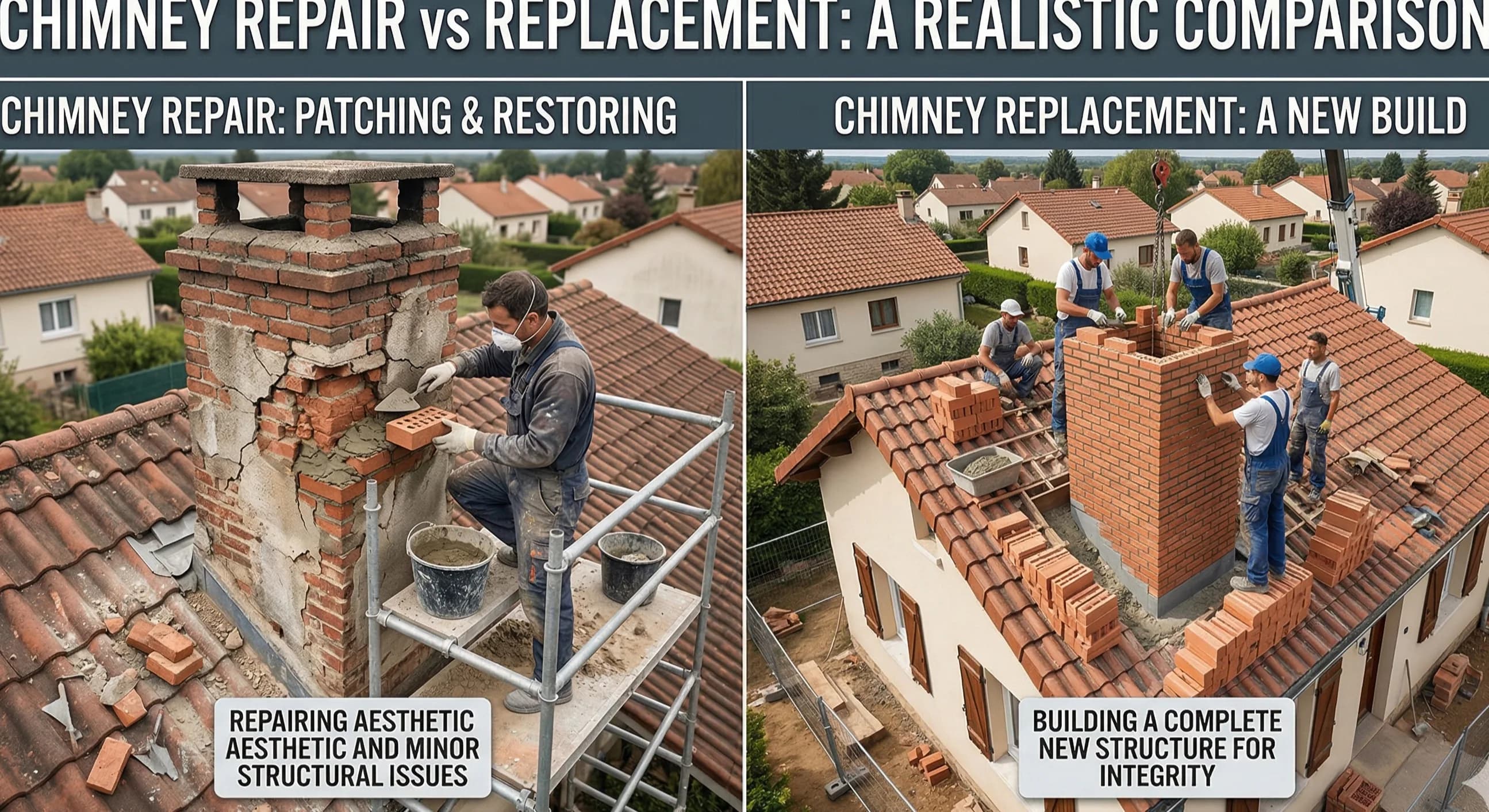
When Should You Replace a Prefab Chimney Instead of Repairing It?
Prefab systems are generally not designed for piecemeal repair past a certain threshold. If any of the following apply to your system, replacement is almost always the more economical and safer path:
- The manufacturer is out of business or your model is discontinued. If exact-match refractory panels or firebox components can't be sourced, the system cannot be legally or safely restored to manufacturer spec.
- The system is 25+ years old with regular use. At this age, multiple components are typically at or past their rated lifespan simultaneously.
- Chase framing rot is present. Once the structure is compromised, you're doing a rebuild anyway — better to do it right with a new system.
- The flue pipe shows corrosion pitting or glazing. Glazed creosote in a metal flue pipe is extremely difficult to remove and can compromise the pipe wall.
- A CSIA-certified inspector has condemned the system under NFPA 211 standards.
Full prefab replacement in the Seattle area typically runs $5,000–$12,000 for a comparable system. Our guide on fireplace insert vs new fireplace walks through the upgrade options, and our chimney repair vs replacement decision guide covers the full cost-benefit framework.
What Are the Main Maintenance Concerns for Masonry Chimneys in Seattle?
A masonry chimney in Seattle faces three persistent threats: rain infiltration, freeze-thaw cycling, and moss and algae growth. In our experience across more than 600 masonry inspections since 2022, these are the failure points we see most frequently:
- Crown cracking: Thermal cycling and freeze-thaw forces split the concrete crown. Left untreated, water enters the masonry core and accelerates internal damage. Fix: crown repair or full crown replacement ($250–$900).
- Flashing failure: The metal flashing at the chimney-roof junction fails from corrosion, movement, or improper original installation. This is the leading cause of attic water damage we trace to chimneys. Fix: chimney flashing repair ($350–$1,200).
- Mortar joint erosion: Seattle's wet winters wear mortar faster than in drier climates. Soft mortar allows water in, which then freezes and expands. Fix: tuckpointing ($600–$3,500 depending on extent).
- Spalling brick: Water-saturated brick face pops off under freeze-thaw. Fix: brick replacement plus chimney waterproofing.
- Flue liner cracks: Especially common after seismic events or chimney fires. Fix: relining with stainless steel ($2,500–$5,500).
With annual inspections, periodic tuckpointing every 8–12 years, and waterproofing applied every 4–6 years, a Seattle masonry chimney will comfortably outlast most owners. See our guide on caring for historic-home chimneys in Seattle for neighborhood-specific advice on Queen Anne, Capitol Hill, and Magnolia homes.
How Does Chimney Type Affect Homeowners Insurance and Resale Value in Washington State?
Washington homeowners insurance generally treats masonry chimneys as part of the home's permanent structure — meaning lower depreciation on claims and coverage aligned with dwelling replacement costs. Prefab chimneys are typically classified as an appliance or built-in equipment, with actuarial depreciation applied. On a 25-year-old prefab system, this depreciation can reduce a claim payout by 50% or more — leaving a significant gap between what insurance pays and what replacement actually costs.
On the resale side, Seattle buyers are increasingly informed and their inspectors are thorough. A well-documented, recently inspected masonry chimney is a selling point — particularly on Craftsman, Tudor, and Colonial homes in Queen Anne, Capitol Hill, and Magnolia. A 28-year-old prefab with deferred maintenance will surface in a Level 2 inspection during escrow and become a negotiation item. In our experience, undisclosed prefab chimney issues cost sellers an average of $3,000–$8,000 in price reductions or repair credits — more than a proactive replacement would have cost.
Ready to Find Out What You Have? We'll Tell You in 15 Minutes.
A CSIA-certified technician from Seattle Chimney Pros can definitively identify your chimney system, document its current condition with photos, and give you a clear maintenance or replacement plan — typically in a single visit. We've completed inspections on more than 2,500 homes across the Puget Sound region since 2011, and we've seen every prefab brand and masonry configuration the Seattle metro has to offer.
Call us at (206) 278-2924 or request your inspection online. We serve Seattle, Bellevue, Kirkland, Redmond, Renton, and 40+ additional communities across the metro area.
Need professional help?
Our professionally trained team is ready. $99 inspection credited toward repairs, 30-minute response.