Washington State Chimney Safety Codes: What Every Homeowner Must Know in 2026
What Are Washington State's Chimney Safety Code Requirements in 2026?
In Washington State in 2026, chimney work is governed by four overlapping frameworks: the International Residential Code (IRC 2021, as adopted by Washington with state amendments), NFPA Standard 211, Washington State Department of Labor and Industries (L&I) contractor licensing requirements, and local permit rules that vary by city and county. Any contractor performing chimney work valued over $500 must hold active L&I registration with proof of bonding and liability insurance. Structural chimney work — including flue liner replacement, partial rebuilds, and new fireplace installation — requires a mechanical or building permit in Seattle, King County, and virtually every other Washington jurisdiction. Based on code-compliance inspections our CSIA-certified technicians have completed across 1,400+ Seattle-area homes since 2019, roughly one in three pre-1970 homes has at least one active IRC violation, most commonly inadequate combustible clearances or a flue that no longer meets the 3-2-10 height rule. Current as of July 2026.
What Happened When a Kirkland Landlord Almost Lost His Rental License Over a Chimney
Marcus T. owns a 1962 split-level rental in Kirkland's Bridle Trails neighborhood — a property he inherited from his parents and has rented continuously for eleven years. When Seattle's RRIO inspection cycle rolled around last spring, he assumed the chimney would be a non-issue. The tenants occasionally used the fireplace, he'd never had a complaint, and the place had passed inspection three years prior.
His tenant called him the morning after the RRIO inspector's visit. The inspector had flagged three chimney items: no carbon monoxide detector on the main floor near the fireplace, visible mortar deterioration at the roofline visible through binoculars from the ground, and a damper that the inspector noted was stuck partially open. Marcus searched 'chimney inspection Kirkland' and booked us the next day.
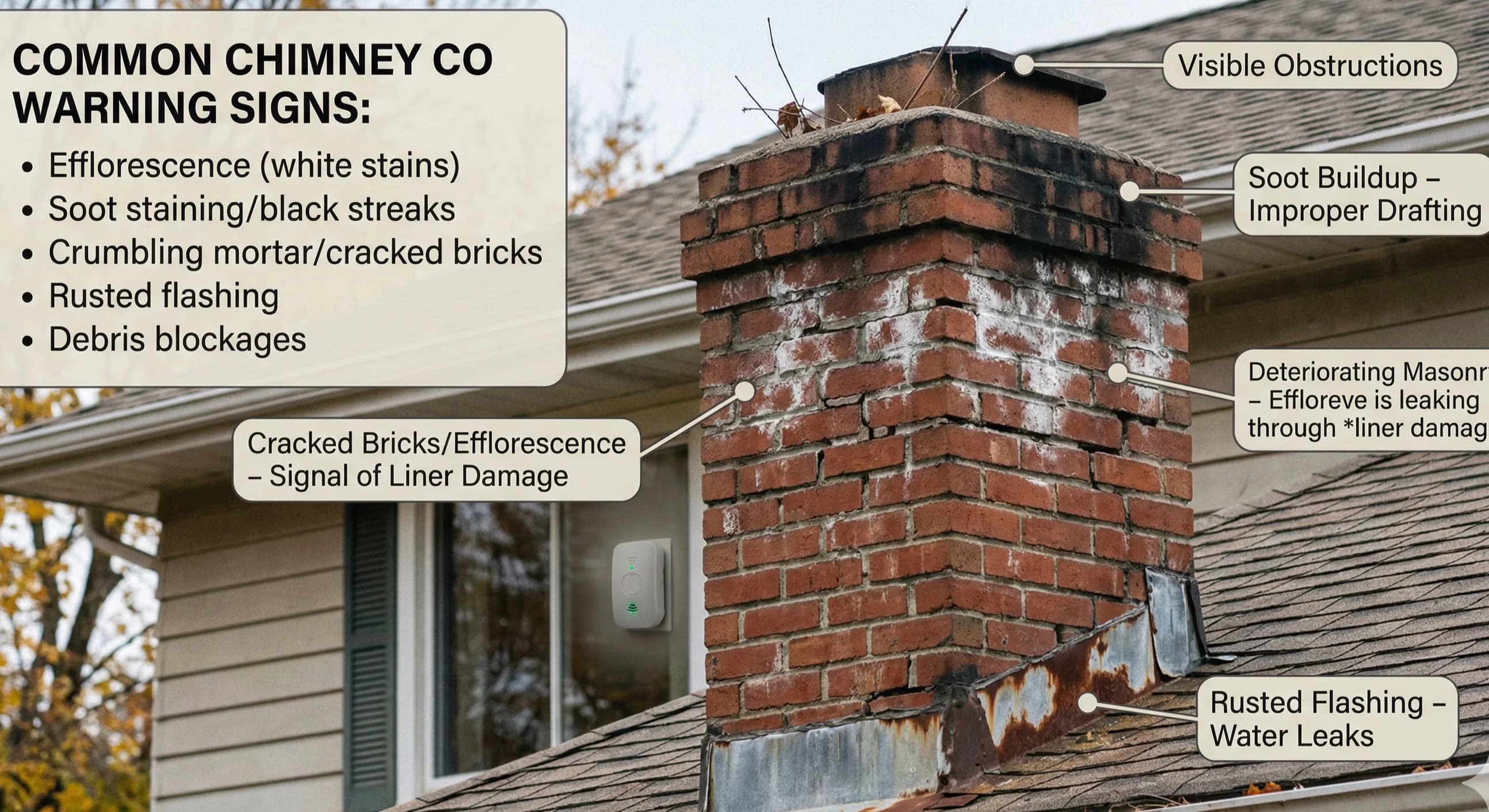
Carlos arrived at the Bridle Trails house on a grey Tuesday morning — the kind of overcast July day that's indistinguishable from November in the Pacific Northwest. He ran a full Level 2 inspection with camera scan. The damper issue turned out to be a warped damper plate that had shifted after years of thermal cycling. The mortar situation was worse than a drive-by suggested: two courses of brick near the crown had spalled badly enough that Carlos could press his thumb into gaps between the joints.
'The spalling up top isn't just cosmetic — those open mortar joints are letting water track straight down inside the flue chase. In another winter or two, you'd be looking at interior masonry damage and a potential liner crack. The RRIO inspector actually saved this landlord from a much bigger bill.'
— Carlos, Lead Technician, Seattle Chimney Pros
Carlos tuckpointed the damaged courses, rebuilt the crown cap with hydraulic cement, and adjusted the damper plate back into alignment. Total cost: $1,140 — substantially less than the re-inspection fee plus tenant relocation costs Marcus would have faced if the rental license had been suspended. A CO detector went in that afternoon for $28 from the hardware store. The reinspection passed without issue.
'I genuinely did not know the chimney could create that kind of liability,' Marcus told us after. 'I thought I was just dealing with a cosmetic thing.' He's now on an annual inspection schedule for both of his rental properties in the Kirkland area.
Why Does Washington State Have So Many Overlapping Chimney Rules?
Chimneys are one of the only residential systems simultaneously regulated by building codes, fire codes, mechanical codes, insurance underwriting standards, and local rental inspection ordinances. Each layer addresses a different risk:
- Building codes (IRC) govern structural integrity and fire separation
- NFPA 211 governs installation standards and inspection methodology
- L&I licensing governs who is legally allowed to perform the work
- Permit requirements govern documentation and inspection of significant repairs
- WAC and RRIO govern ongoing maintenance obligations for rental properties
- HOA rules govern aesthetics and fuel-type restrictions in governed communities
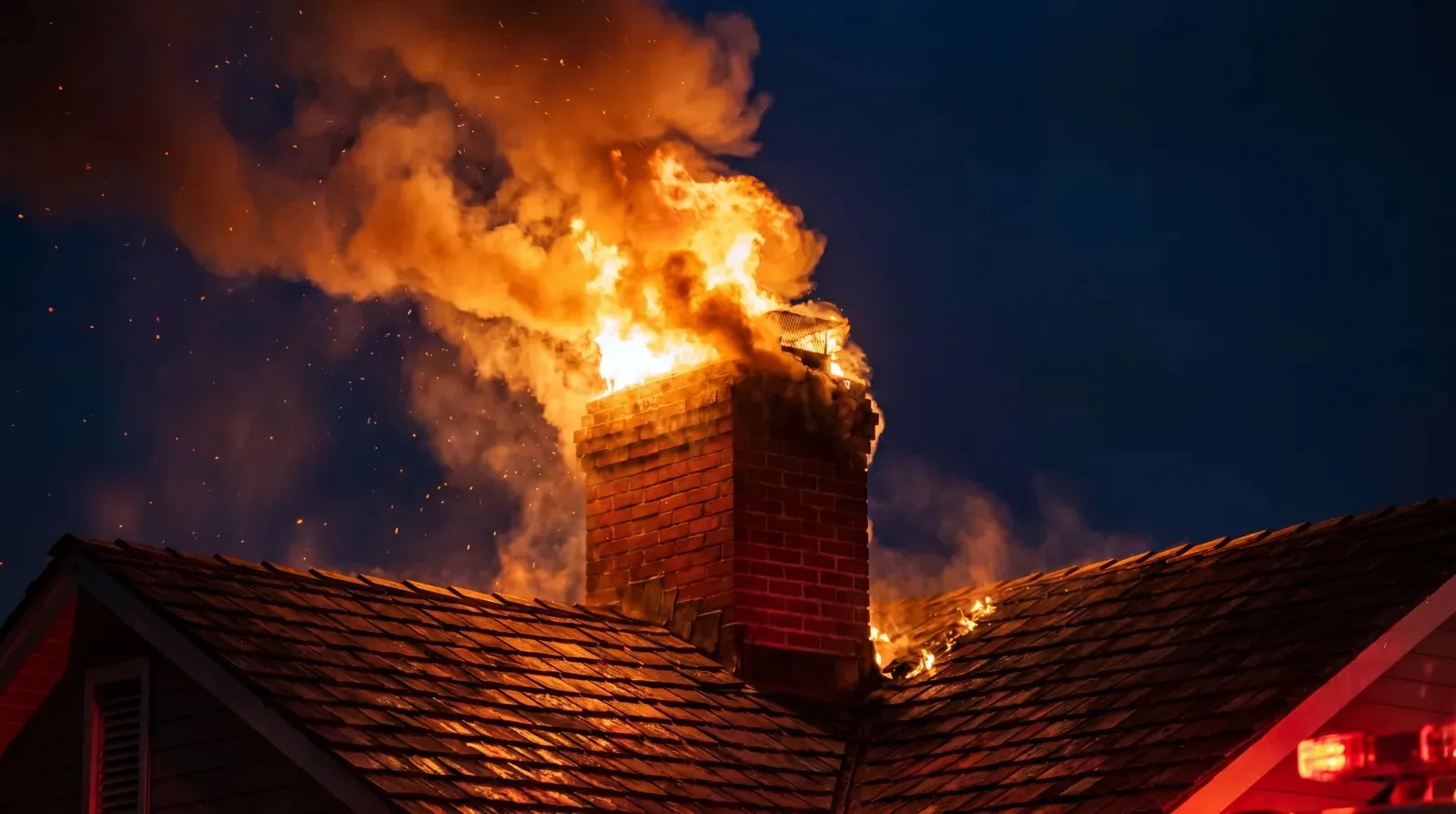
A chimney that fails any one of these layers can void your homeowner insurance, block a home sale during inspection contingency, expose a landlord to rental license suspension, or create personal liability in the event of a chimney fire or carbon monoxide incident. The sections below cover each layer in detail.
What Does L&I Contractor Registration Require for Chimney Work in Washington?
Washington State requires every contractor — including chimney sweeps, masons, and chimney repair companies — performing work valued over $500 in labor and materials to hold active registration with the Washington State Department of Labor and Industries. Registration requires annual renewal and proof of:
- Active surety bond (minimum $6,000 for general contractors)
- General liability insurance (minimum $50,000, most reputable companies carry $1M+)
- Workers' compensation account if they employ workers
- State business registration (UBI number)
Every legitimate Washington chimney contractor has a public L&I profile you can verify at the L&I contractor lookup tool. The profile shows active status, bond details, insurance carrier, and any complaints or disciplinary history. Our detailed guide on how to choose a chimney sweep in Seattle walks through this verification process step by step.
An unlicensed chimney contractor is operating illegally in Washington. If they damage your home or a worker is injured on your property, your homeowner insurance may deny the claim entirely because the work was unpermitted and performed by an unregistered contractor.
How Does NFPA 211 Apply to Seattle Homeowners in 2026?
NFPA Standard 211 — the Standard for Chimneys, Fireplaces, Vents, and Solid Fuel-Burning Appliances — is the nationally recognized technical document that Seattle building inspectors, certified chimney sweeps, and insurance underwriters reference when evaluating chimney safety. Washington's adopted IRC explicitly references NFPA 211, making it effectively enforceable in every Washington jurisdiction.
The most relevant sections for Seattle homeowners are:
- Chapter 12 (Inspection Levels 1, 2, 3): Defines the three inspection tiers. Level 1 covers readily accessible components and is appropriate for annual maintenance. Level 2 adds a video scan of the full flue interior and is required after any major event — chimney fire, earthquake, real estate transaction, or fuel type change. Level 3 involves removing structural components when hidden damage is suspected.
- Chapter 14 (Clearances to Combustibles): Requires minimum 2-inch clearance between masonry chimney exterior and wood framing for interior chimneys, and 1-inch clearance for exterior chimneys. Violations of this rule are among the leading causes of house fires in older Seattle craftsman and Victorian homes.
- Chapter 10 (Chimney Liners): Defines acceptable liner materials — clay tile, stainless steel, and cast-in-place — and the conditions under which relining is required.
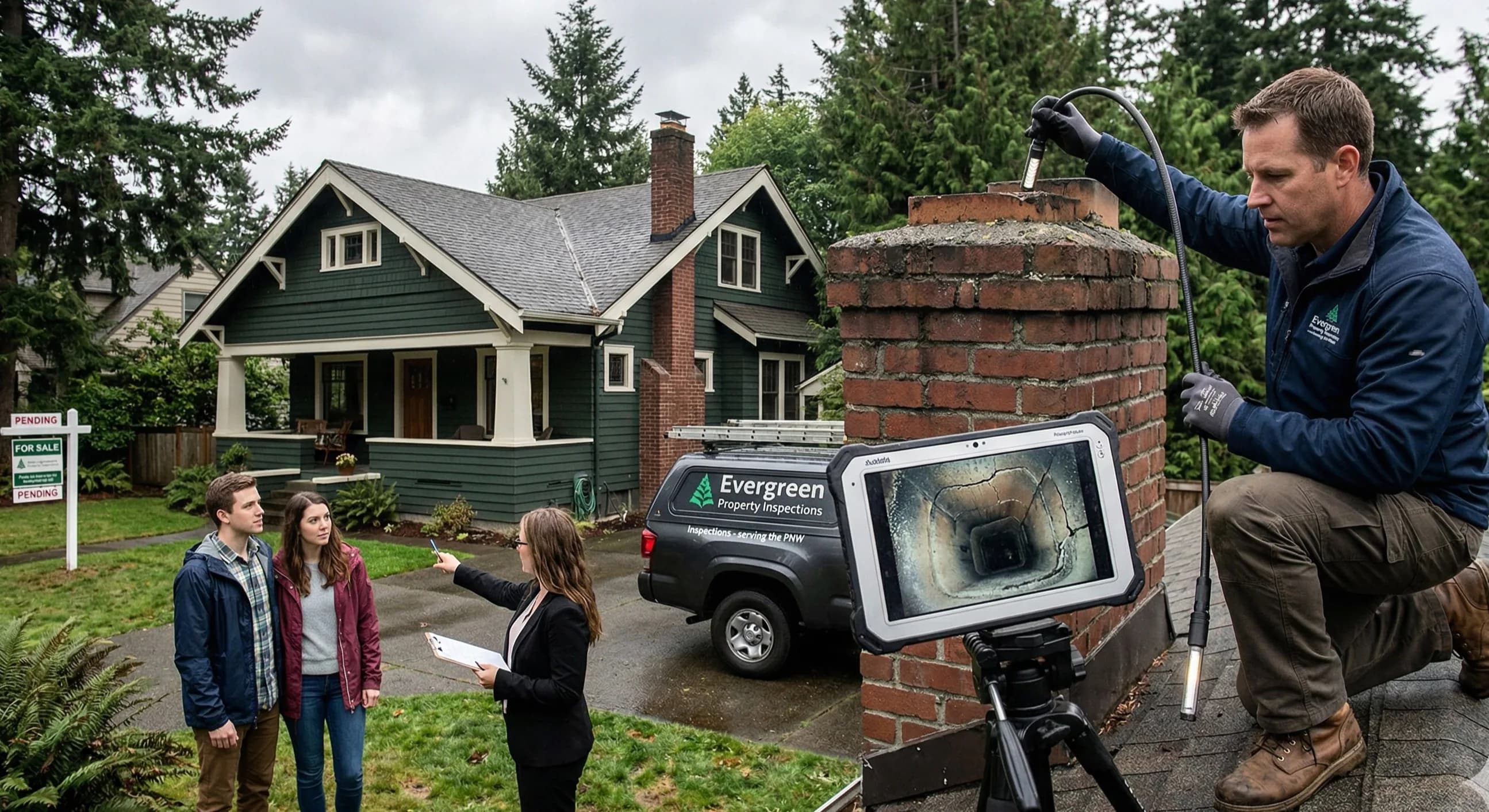
For any real estate transaction in Washington, NFPA 211 Chapter 12 requires a Level 2 inspection — not the cursory Level 1 that most general home inspectors provide. Our explainer on chimney inspection levels breaks down exactly what each level covers and what it costs.
What Are the Key IRC Chimney Requirements in Washington State?
Washington adopts the International Residential Code on a 3-year cycle. The 2021 IRC is currently in effect as of July 2026. IRC Chapter 10 governs masonry chimneys and fireplaces. The four most commonly violated requirements in Seattle-area homes are:
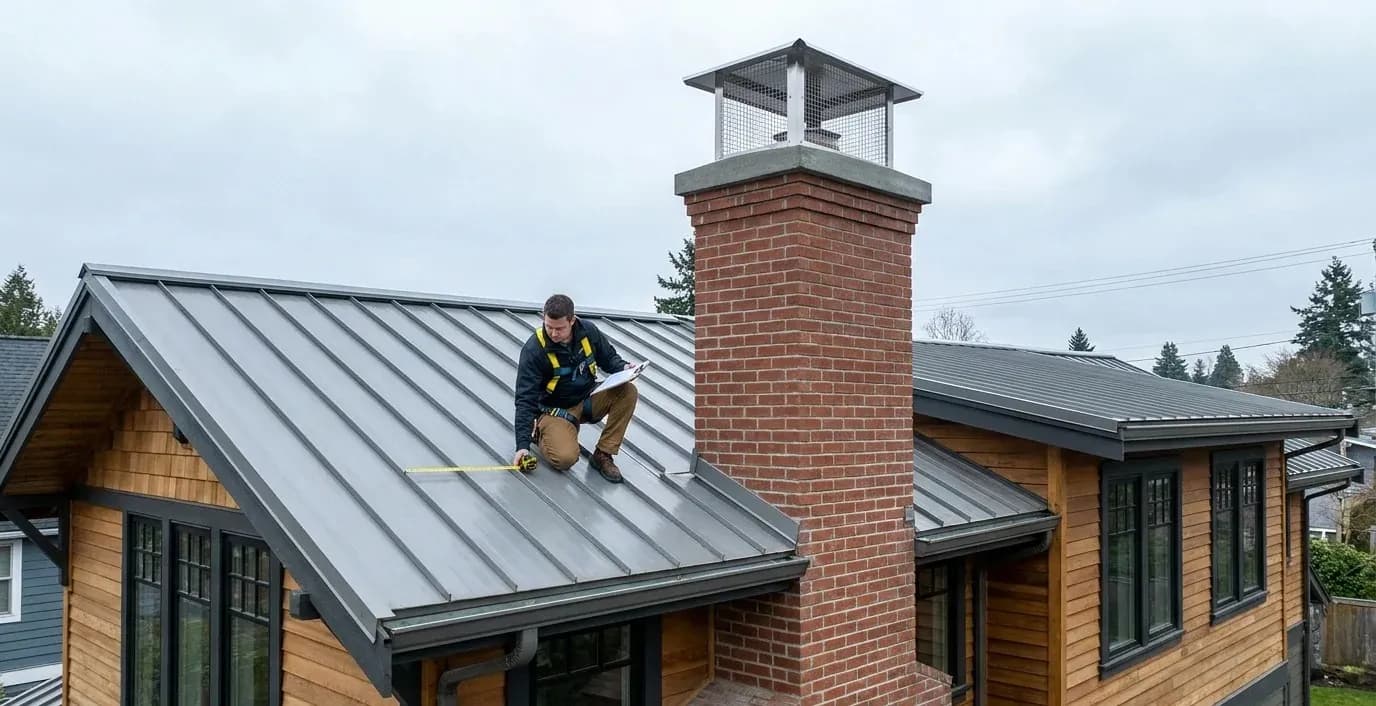
The 3-2-10 Height Rule (IRC R1003.9): Masonry chimneys must extend at least 3 feet above the highest point where they pass through the roofline, and at least 2 feet higher than any portion of the building within 10 horizontal feet. Violations occur frequently in older Seattle homes where additions, dormers, or rooftop decks have brought structures within 10 feet of an existing chimney — resulting in downdraft, poor draw, and smoke infiltration.
Clearances to Combustibles (IRC R1003.18): Masonry chimneys must maintain a 2-inch open airspace between the chimney exterior and any combustible material for interior chimneys (1 inch for exterior chimneys). This airspace cannot be filled with insulation or caulking. In many older Seattle homes, retrofit insulation projects have unknowingly eliminated this clearance.
Flue Sizing (IRC R1003.14): Flue cross-sectional area must equal at least 1/10 of the fireplace opening area for flues under 15 feet, or 1/12 for flues 15 feet and taller. Persistent smoke problems are often a flue sizing mismatch — see our guide on smoke coming back into the house for diagnosis steps.
Hearth Extension (IRC R1001.10): Fireplaces with openings under 6 square feet require a 16-inch hearth extension in front and 8 inches on each side. Openings 6+ square feet require 20 inches front and 12 inches on each side. This is frequently violated when homeowners install hardwood flooring or tile that doesn't maintain minimum hearth distances.
Which Chimney Repairs Require a Permit in Seattle and King County?
Unpermitted chimney work is one of the most common reasons insurance claims are denied and home sales are delayed in the Seattle metro. The table below summarizes typical permit requirements across the most common jurisdictions we serve.
| Chimney Work Type | Seattle | King County Unincorporated | Bellevue / Kirkland |
|---|---|---|---|
| Chimney sweep / cleaning | No permit | No permit | No permit |
| Chimney cap installation | No permit | No permit | No permit |
| Minor mortar / tuckpointing | No permit (under $1,500) | No permit (maintenance) | No permit |
| Flashing repair | Roofing permit may apply | No permit (typical) | No permit |
| Crown repair or rebuild | No permit (repair) | No permit (repair) | No permit |
| Flue liner replacement | Mechanical permit | Mechanical permit | Mechanical permit |
| Partial chimney rebuild | Building permit | Building permit | Building permit |
| Full chimney replacement | Building permit | Building permit | Building permit |
| Gas insert conversion | Mechanical + gas permit | Mechanical + gas permit | Mechanical + gas permit |
| New fireplace installation | Building + mechanical | Building + mechanical | Building + mechanical |
When uncertain, Seattle's Department of Construction and Inspections operates a free Applicant Services Center that advises on whether a specific scope requires permitting. For chimney relining and significant chimney repair, permits are required across essentially every Washington jurisdiction — and pulling them is your contractor's responsibility, not yours.
What Chimney Requirements Apply to Rental Properties Under WAC and RRIO?
Landlords in Washington face an additional layer of chimney-related obligations under the Washington Administrative Code and Seattle's Rental Registration and Inspection Ordinance (RRIO). RRIO, adopted in 2012 and still in full effect as of 2026, requires all Seattle rental properties to pass a physical inspection on a 5-10 year cycle. Chimney and fireplace items inspectors check include:
- Functioning smoke alarms in every bedroom, outside each sleeping area, and on every level (RCW 43.44.110)
- Carbon monoxide detectors on every level of the home (RCW 19.27.530) — especially critical in homes with active fireplaces or gas appliances
- Solid, undamaged hearth extensions meeting IRC R1001.10 minimum dimensions
- No visible signs of active chimney deterioration, water intrusion, or excessive creosote buildup
- Functional damper, or a damper clamp if the fireplace has been gas-converted
- Documentation of recent chimney inspection for actively used fireplaces
Landlords who fail RRIO due to chimney deficiencies face re-inspection fees, potential tenant relocation liability, and in serious cases, rental license suspension. Annual chimney inspections are the simplest way to stay ahead of these requirements and document your due diligence.
Are Older Seattle Homes Grandfathered From Current Chimney Codes?
This is one of the most common misconceptions we encounter. The short answer: original unmodified construction is typically grandfathered, but any new work must meet current code — and no home is grandfathered from genuinely hazardous conditions.
Here's how grandfathering actually works in practice:
- Grandfathered: A 1924 Capitol Hill craftsman with its original, unaltered masonry chimney that met code at time of construction. As long as nothing has been modified, the original construction is legally compliant.
- NOT grandfathered: Any repair, replacement, or modification done after current codes took effect. Rebuild a chimney crown in 2026? The entire crown must meet current IRC and NFPA 211 standards regardless of the home's age.
- Safety overrides grandfathering entirely: A cracked flue tile, inadequate combustible clearance, or active CO hazard must be corrected regardless of the home's age or original permit status. No jurisdiction in Washington will allow a documented safety hazard to remain uncorrected because of grandfathering.
In our experience across 600+ inspections of pre-1950 Seattle homes, the most common non-grandfatherable violations are inadequate combustible clearances (compromised by later insulation retrofits) and chimney height violations created by later additions. Our guide to chimney care for historic Seattle homes covers how to balance preservation goals with current code compliance.
What HOA Rules Govern Chimneys in Bellevue, Kirkland, and Redmond?
HOAs are common in newer developments throughout Bellevue, Kirkland, and Redmond. Before scheduling any exterior chimney work in a governed community, check your CC&Rs and submit for architectural review if required. Common HOA chimney restrictions include:
- Approved chimney cap styles, finishes, and colors
- Wood-burning restrictions (many Puget Sound HOAs limit residents to gas appliances only)
- Required architectural review before any visible exterior chimney modification
- Mandatory annual inspection documentation in some HOAs
- Chimney exterior paint color and finish specifications
Failing to get HOA approval before exterior chimney work can result in fines, mandatory removal, and required rework at your expense. We see this most frequently with decorative chimney cap swaps and crown rebuilds in Bellevue and Sammamish developments.
How Do You Verify a Washington Chimney Contractor's Credentials Before Hiring?
Every fall Seattle sees an influx of door-to-door chimney sweeps offering $79-$99 specials. The majority are unlicensed, out-of-state operators with no L&I registration, no bond, and no certification. Hiring them creates liability exposure that typically far exceeds any savings.
Here is the four-step verification process our team recommends before hiring any Washington chimney contractor:
- Run the L&I contractor lookup: Visit the Washington State L&I contractor verification portal and confirm active registration, bond status, insurance carrier, and complaint history. This takes under two minutes and is the single most important check.
- Request a certificate of insurance (COI): Ask the contractor to email a current COI showing general liability coverage of at least $1 million and workers' compensation if they have employees. A legitimate company sends this without hesitation.
- Confirm CSIA or NFI certification: CSIA Certified Chimney Sweeps and NFI Certified Technicians have passed rigorous technical exams covering NFPA 211, IRC, and installation standards. These certifications are voluntary but demonstrate a level of technical competence that L&I registration alone does not.
- Check local review history: Genuine local contractors have multi-year Google Business profiles, BBB history, and references from homeowners in your area. A company with no Seattle-area reviews and a P.O. box address is a red flag regardless of what they claim.
Seattle Chimney Pros has served over 2,500 homes across the Seattle metro since 2011, maintains full L&I registration and insurance, and provides complete documentation on request. If you want to verify where your chimney stands on code compliance today, schedule a Level 2 inspection or call (206) 278-2924.
What Chimney Code Changes Are Coming in Washington After 2026?
Washington adopts the IRC on a 3-year cycle with state-specific amendments. The 2021 IRC is currently in effect as of July 2026, with the 2024 IRC expected to be adopted statewide later in 2026 or in early 2027. Key changes anticipated with the 2024 edition include updated flue sizing tables, stricter carbon monoxide detector placement requirements, and expanded rules for gas appliance venting in tight construction envelopes — increasingly relevant as Seattle's newer high-efficiency homes create backdraft scenarios with older gas appliances.
The practical implication for homeowners is straightforward: codes trend stricter, not looser. Work completed to current standards today is more likely to remain compliant through future code cycles than work done to minimum standards from older editions. If you're scheduling significant chimney work heading into fall 2026, investing in a properly designed and documented installation now avoids costly corrections when the next code cycle takes effect. Contact us or call (206) 278-2924 to schedule a code-compliance inspection with one of our CSIA-certified technicians.
Need professional help?
Our professionally trained team is ready. $99 inspection credited toward repairs, 30-minute response.