Buying a Home in Seattle? 10 Chimney Red Flags to Check in 2026
The 10 Chimney Red Flags Seattle Home Buyers Must Check Before Closing
A pre-purchase Level 2 chimney inspection in Seattle costs $325 to $595 in 2026 and routinely uncovers repair needs ranging from $400 to $25,000 that no general home inspector is equipped to find. Based on the pre-purchase inspections our team has completed across the Seattle metro area, roughly 6 in 10 chimneys on homes built before 1980 have at least one issue significant enough to warrant a seller concession or price reduction. The 10 red flags below — from leaning masonry to cracked flue liners — are the ones that separate a $500 fix from a $15,000 rebuild. All of them are visible to a qualified chimney technician during the inspection contingency window, and all of them are negotiable before you sign. Current as of July 2026.
What Happened When Marcus T. Almost Closed on a Ravenna Bungalow Without a Chimney Inspection
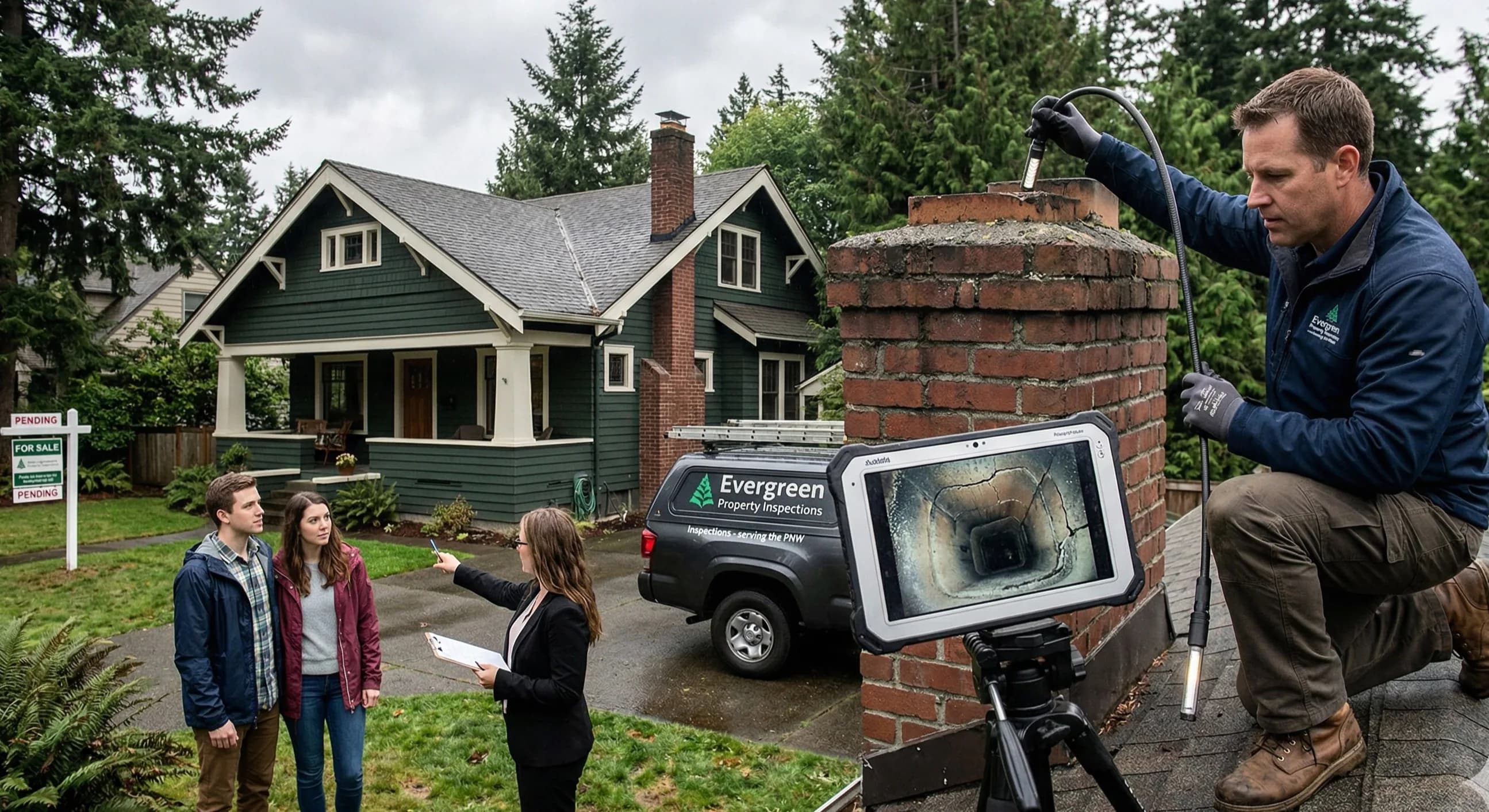
Marcus T. was two days from closing on a 1938 craftsman bungalow in Ravenna last October when his real estate agent mentioned — almost as an afterthought — that she'd seen buyers get burned by chimney repairs on homes this age. Marcus hadn't thought much about the chimney; the general home inspection report had listed it as 'satisfactory from ground level.' But the offhand comment stuck, and he called us that afternoon to ask whether there was time to squeeze in a chimney inspection before closing.
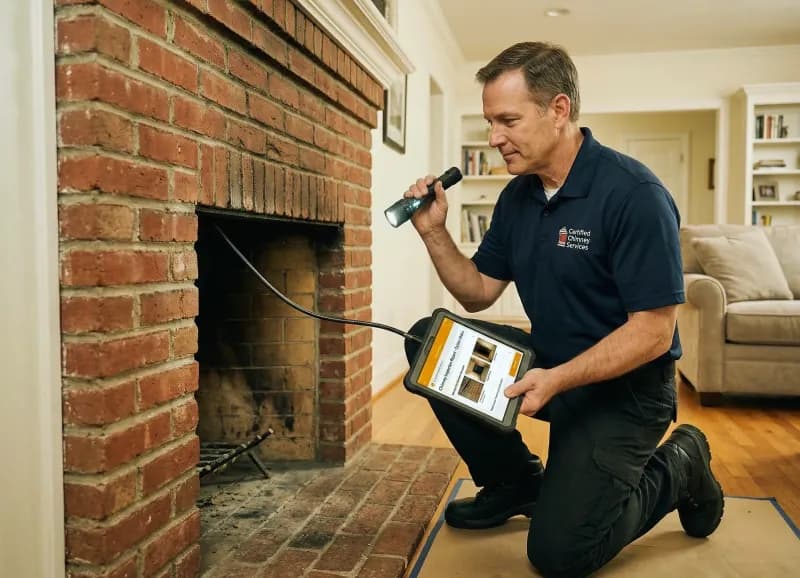
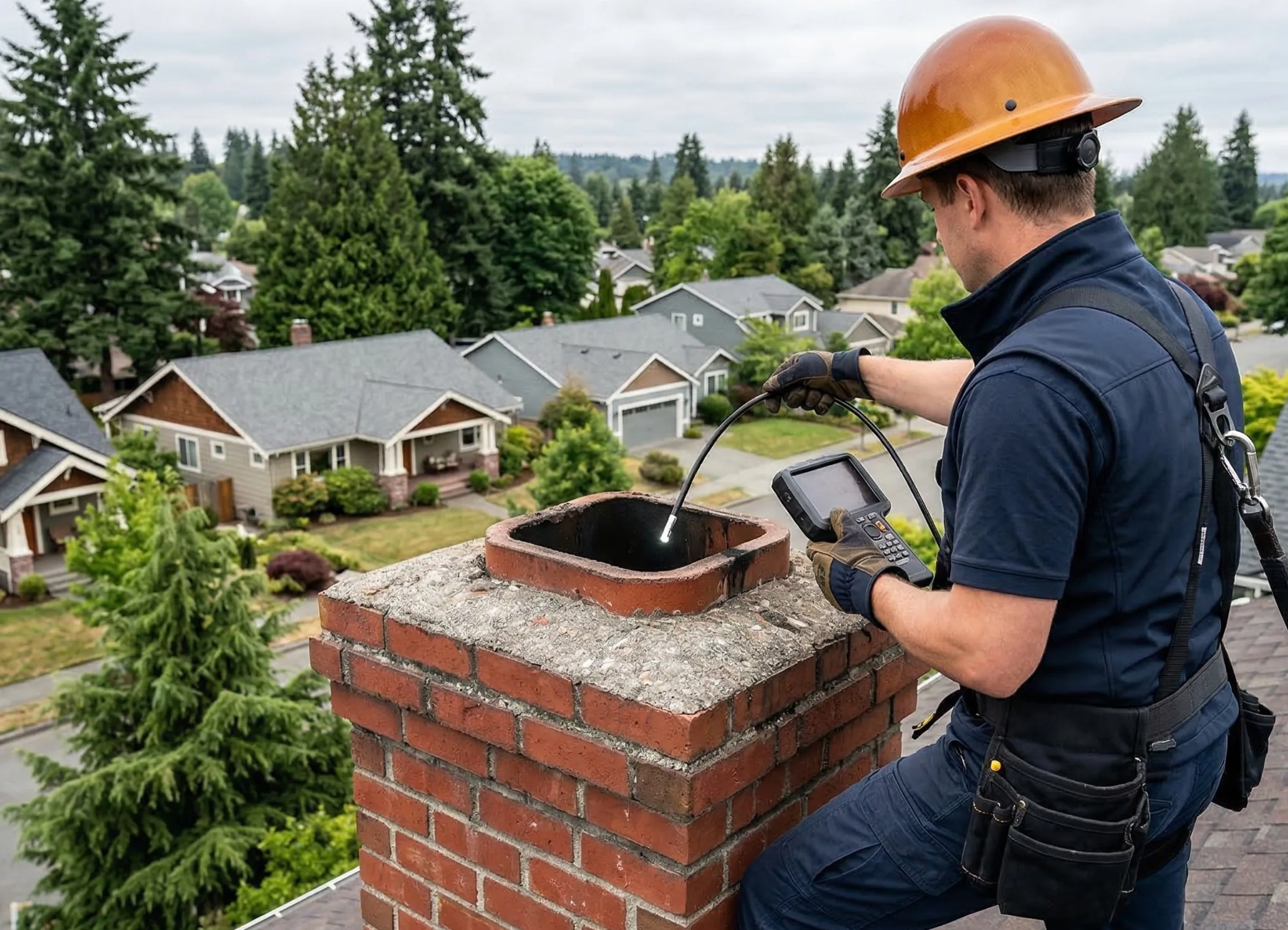
There was. Alex arrived the next morning with a full Level 2 kit — HD flue camera, inspection mirror, flashlight, moisture meter, and rooftop access ladder. The exterior walk-around took about fifteen minutes. What he found before he even pulled the camera out was already telling: white chalky streaks running three courses down from the crown, a chimney cap with a rust-eaten mesh screen, and mortar joints recessed nearly a quarter inch in several spots on the south-facing side. Inside, a flashlight into the firebox showed rust staining on the smoke shelf and a damper plate that was orange with oxidation.
The camera scan confirmed what the exterior suggested. Three clay flue tiles had diagonal cracks — the kind caused by thermal cycling over decades — and the mortar between tiles was eroding at the joints. A small section near the top had a tile pushed slightly inward, likely from the Nisqually earthquake in 2001, creating a gap where combustion gases could contact the framing.
'The exterior told me there'd been chronic water intrusion for years. The camera confirmed it — those diagonal tile cracks combined with the mortar washout between joints meant this liner hadn't been safe to use in a long time. The seller may not have even known.'
— Alex, Lead Technician, Seattle Chimney Pros
Alex's written report came back within 24 hours: liner replacement recommended ($4,200), full crown rebuild ($1,800), flashing repair ($900), and a new cap ($450). Total: $7,350. Marcus's agent submitted the report with a contractor estimate to the seller and requested a $7,000 closing credit. The seller — motivated to close — agreed to $6,500. Marcus used part of it to book us for the liner and crown work the week after he moved in. The inspection cost him $475. The credit saved him $6,500.
Why Do Home Inspectors Miss Chimney Problems?
General home inspectors evaluate 400+ systems in a single 3-4 hour visit. They are not chimney specialists, they don't carry flue cameras, and most state licensing laws explicitly limit their chimney scope to what's visible from ground level or the roof edge. Specifically:
- Home inspectors perform only an NFPA 211 Level 1 inspection — limited to readily accessible areas visible without specialized equipment
- They do not insert a camera into the flue (that's Level 2 territory)
- Many don't access roofs in Pacific Northwest weather conditions
- Most can't distinguish efflorescence from mortar failure at a glance
- Almost none hold CSIA or NFI chimney certifications
NFPA 211 Chapter 12 explicitly recommends a Level 2 inspection for every real estate transaction involving a chimney. The $400-$600 a buyer spends on a specialized inspection is consistently the highest-ROI pre-purchase cost in any Seattle transaction that includes a fireplace. Our chimney inspection levels explained guide breaks down exactly what each level covers and costs.
What Are the 10 Chimney Red Flags Every Seattle Buyer Should Spot?
Here are the warning signs our technicians check on every pre-purchase inspection, in rough order from easiest to spot at a distance to hardest to find without specialized equipment.
1. Leaning or Out-of-Plumb Chimney
Step back 30 feet and sight the chimney against a vertical reference — a door frame, wall corner, or utility pole. Any visible lean points to foundation settlement, chronic mortar failure causing the structure to shift, or seismic damage. Seattle sits on the Cascadia Subduction Zone and took a 6.8 magnitude hit in the 2001 Nisqually earthquake. A leaning chimney is rarely cosmetic — it typically means a $8,000-$25,000 partial or full rebuild. Our article on earthquake chimney damage in Seattle covers how seismic history affects masonry in this region.
2. White Chalky Staining (Efflorescence)
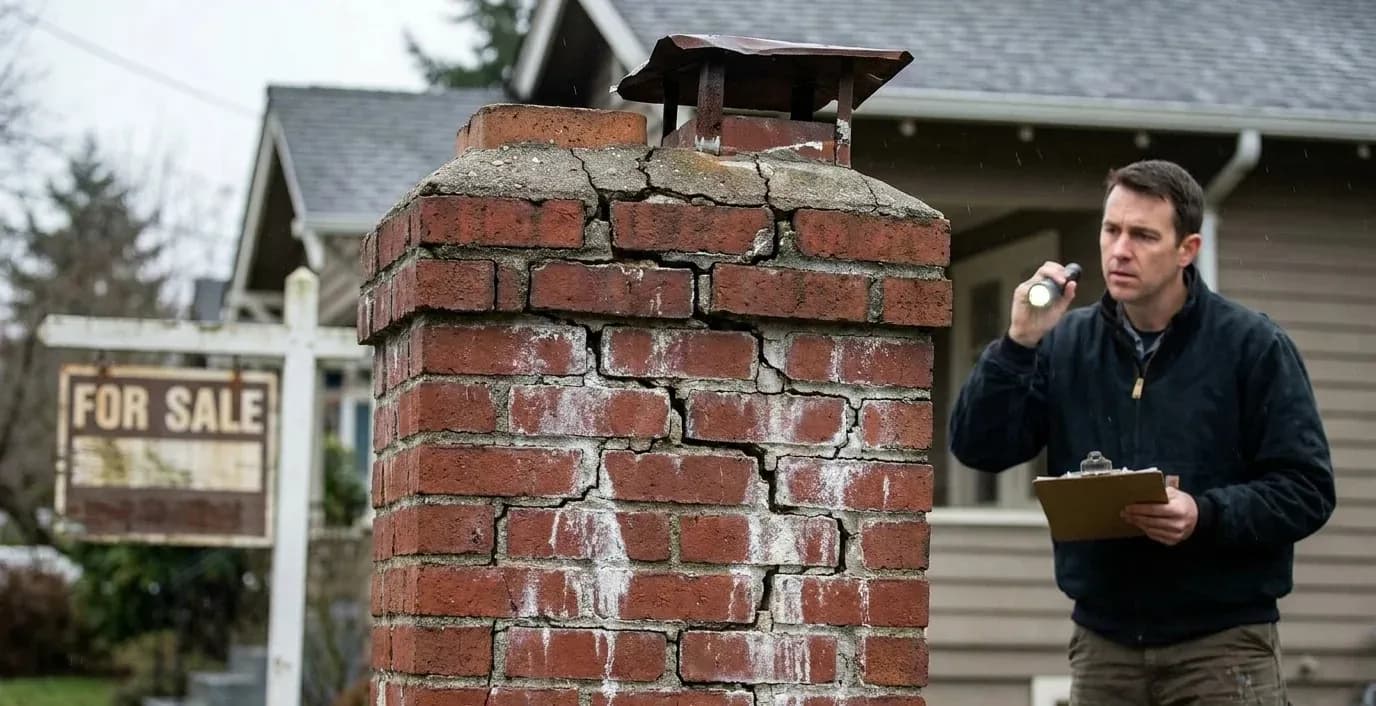
White powdery or crystalline deposits on brick are efflorescence — mineral salts pulled out of the masonry by water migrating through and evaporating at the face. It signals that waterproofing has failed and the brick is being saturated every rainy season. Left untreated, efflorescence leads to mortar failure, spalling (brick face popping off), and eventual structural deterioration. Remediation typically runs $600-$1,200. Our full guide to white stuff on chimney bricks explains the repair process.
3. Crumbling or Recessed Mortar Joints
Healthy mortar sits flush with the brick face, uniform in color, and shows no voids. Problem mortar is recessed more than 1/8 inch, crumbling, discolored, or missing in sections. Tuckpointing to repair failed joints runs $20-$40 per square foot. A full-height chimney repoint on a typical two-story Seattle home costs $3,000-$8,000 and usually indicates 15-20 years of deferred maintenance.
4. Damaged, Missing, or Undersized Chimney Cap
A properly sized stainless steel chimney cap with mesh prevents rain, animals, and debris from entering the flue. Red flags: no cap at all, a cap rusted through its mesh, a cap sized too small for the flue opening, or a DIY 'cap' of brick or stone that blocks draft. A quality chimney cap installation costs $300-$600 — trivial compared to the $2,000-$5,000 in animal remediation or liner damage that follows a missing cap over a few Seattle winters.
5. Cracks in the Chimney Crown
The crown is the concrete cap at the very top of a masonry chimney. It should slope outward with a drip edge and be completely crack-free. A cracked crown is one of the top three causes of chimney water damage we see in Seattle — water enters the cracks, wicks down between the liner and exterior brick, and degrades both from the inside. Crown repairs range from $400 (sealant fill on minor cracks) to $3,000 (full rebuild).
6. Rust on the Damper, Firebox, or Smoke Chamber
Look inside the firebox with a flashlight during the showing — most sellers won't stop you. Rust on the damper plate, smoke shelf, or firebox walls is a direct indicator that water has been entering the chimney. Active rust means active water intrusion, which means active structural decay happening somewhere above that you can't see without a camera.
7. Water Stains on Ceilings or Walls Near the Chimney Chase
Inspect ceilings and walls adjacent to the chimney on every floor, including the attic. Water stains, bubbling paint, warped drywall, or musty odors near the chimney indicate active or recent water intrusion. The three most common culprits are failed flashing at the roof-chimney junction, cracks in the crown, and water entering through porous brick during Seattle's long rain seasons. Interior water damage is almost always worse than visible staining suggests.
8. No Inspection or Sweep Records
Ask your agent to request the last chimney inspection report and any sweep records. Responsible homeowners keep these — they're easy to produce. If the seller 'can't find them' or 'hasn't had it done in years,' that's a red flag in itself. In our experience, unused and uninspected chimneys in Seattle are consistently in worse condition than those used regularly, because they accumulate condensation without the drying effect of periodic fires.
9. Combustible Clearance Violations
IRC R1003.18 requires 2-inch clearance between interior masonry chimneys and combustible framing, and 1-inch clearance for exterior chimneys. In older Seattle craftsman, bungalow, and Victorian homes, retrofit insulation, attic additions, and framing modifications routinely violate these clearances. Violations are a leading cause of house fires and nearly impossible to identify without attic access — which a chimney inspector with proper access will check.
10. Flue Liner Damage (Only Visible with a Level 2 Camera)
This is the red flag no home inspector can find without specialized equipment. The flue liner — whether clay tile, stainless steel, or cast-in-place — is the primary fire barrier between the combustion chamber and the home's structural framing. Cracked or deteriorated liners allow hot gases, sparks, and creosote to contact wood framing, dramatically raising chimney fire risk and violating NFPA 211. Liner replacement runs $2,500-$7,500 depending on height and material. Our chimney liner replacement guide explains all options.
What Does a Level 2 Inspection Reveal That a Home Inspection Doesn't?
A Level 2 chimney inspection per NFPA 211 includes everything in a Level 1 plus a high-definition video camera scan of the entire flue from top to bottom. In our experience across hundreds of pre-purchase inspections in the Seattle metro, here's what the camera regularly finds that no home inspector would catch:
- Cracked or displaced clay flue tiles (extremely common in 1920s-1950s Seattle homes)
- Missing mortar between flue tile joints
- Glazed Stage 2 or Stage 3 creosote deposits — active fire hazard
- Metal liner corrosion, pinhole burns, or separated joints
- Blockages: animal nests, fallen bricks, construction debris from renovations
- Smoke chamber corbel damage and spalling
- Breach points where combustion gases can escape into structural cavities
NFPA 211 Chapter 12 explicitly recommends a Level 2 inspection for every real estate transaction involving a chimney or fireplace. Scheduling a Level 2 chimney inspection during your inspection contingency period is one of the highest-ROI steps any Seattle buyer can take on a home with a fireplace.
What Should You Do If Your Inspector Finds a Red Flag?
Here are the concrete steps to take when a chimney inspection surfaces problems during your inspection contingency period:
- Get a written repair estimate immediately. Ask the chimney inspector or a separate licensed contractor to provide a written estimate for every flagged item. Most inspectors who serve real estate buyers will do this for an additional fee or as part of the inspection package.
- Separate urgent safety issues from maintenance items. Flue liner cracks, combustible clearance violations, and active water intrusion at the firebox are safety issues that affect insurability and occupant safety. A missing cap or minor efflorescence is a maintenance item. Treat these differently in negotiations.
- Submit the inspection report and estimate to the seller through your agent. Vague requests for 'chimney repair' get ignored. A written Level 2 report with photos, video references, and a contractor estimate gets taken seriously.
- Choose your negotiation approach. Seller repairs (completed before closing), a closing credit (you handle the work post-close), or a price reduction — each has trade-offs depending on your timeline and trust in the seller's contractor choices.
- Walk away if the numbers don't work. Leaning chimneys requiring $15,000+ rebuilds or complete flue collapses on older homes may not be financeable or insurable. Know your exit number before you negotiate.
How Much Do Chimney Repairs Cost in Seattle in 2026?
Use this table when preparing your negotiation position. All pricing reflects current Seattle metro market rates as of July 2026, based on jobs our team has completed across the region.
| Issue Found | Typical Cost Range (2026) | Severity | Negotiation Leverage |
|---|---|---|---|
| Missing or damaged chimney cap | $300-$600 | Low | Easy — quick seller fix |
| Efflorescence + waterproofing | $600-$1,200 | Medium | Good — documented water intrusion |
| Minor crown crack / sealant | $400-$800 | Medium | Good |
| Flashing repair or replacement | $600-$1,800 | Medium | Good — ties to interior water damage |
| Partial tuckpointing | $1,500-$4,000 | Medium | Strong with photos |
| Full chimney repoint | $4,000-$8,000 | High | Very strong |
| Crown rebuild | $1,200-$3,000 | Medium-High | Strong |
| Flue liner replacement | $2,500-$7,500 | High | Very strong — safety issue |
| Leaning chimney (partial rebuild) | $6,000-$15,000 | Severe | Deal breaker territory |
| Full chimney demolition and rebuild | $10,000-$25,000+ | Severe | Walk away or major concession |
For a deeper breakdown by service type, see our current guide to chimney repair costs in Seattle.
How Do You Find a Qualified Chimney Inspector for a Real Estate Transaction?
Not every chimney sweep produces written reports suitable for real estate negotiations. When selecting an inspector for a pre-purchase inspection, verify:
- CSIA (Chimney Safety Institute of America) or NFI (National Fireplace Institute) certification — these are the industry standards
- Active Washington State L&I contractor registration and liability insurance
- Provides written Level 2 reports with photos and video references (not just verbal feedback)
- Experience specifically with real estate transactions — some sweeps decline this work
- Ability to provide itemized repair estimates alongside the inspection report
Seattle Chimney Pros performs Level 2 pre-purchase inspections across the entire metro area — including Bellevue, West Seattle, and Kirkland — and delivers written reports with photo and video documentation sized for negotiation use. Our lead technician Alex has completed over 2,000 chimney inspections across Seattle-area homes and has been the report behind hundreds of successful buyer concessions.
Don't Let the Chimney Be the Footnote That Costs You Thousands
A $400-$600 Level 2 chimney inspection during your contingency window is one of the most reliable ways to protect yourself in any Seattle home purchase involving a fireplace or wood-burning appliance. The 10 red flags above can all be caught before closing — and every one of them can be negotiated into a concession, credit, or price reduction when identified with proper documentation. Don't close without it.
To schedule a pre-purchase Level 2 chimney inspection anywhere in the Seattle metro area, call us at (206) 278-2924 or request an inspection online. We typically schedule within 48-72 hours and deliver written reports within 24 hours of the visit — fast enough for any inspection contingency timeline.
Need professional help?
Our professionally trained team is ready. $99 inspection credited toward repairs, 30-minute response.