Common Chimney Repairs in Seattle: A Homeowner's Guide for 2026
What Are the Most Common Chimney Repairs in Seattle in 2026?
The eight most common chimney repairs in Seattle are tuckpointing (mortar joint repair), chimney crown repair, flashing repair, chimney cap replacement, liner repair or relining, firebox refractory repair, damper replacement, and chimney waterproofing. Based on over 900 repair and inspection jobs our team completed across the Seattle metro in the past 12 months, mortar joint deterioration is the single most frequent finding — present in roughly 67% of chimneys on homes built before 1970. Seattle's 152 annual rain days and repeated winter freeze-thaw cycles break down masonry twice as fast as the national average, meaning repairs that last 20 years in a dry climate often require attention in 10-12 years here. Current as of July 2026.
What Happened at Marcus T.'s Fremont Craftsman — and What It Taught Us
Marcus T. reached out to us last April after noticing a rust-colored stain spreading across his living room ceiling near the fireplace. His 1927 Fremont craftsman had been through dozens of Seattle winters, and he assumed the chimney was fine — he'd had a sweep done about four years earlier and hadn't used the fireplace much since. A neighbor mentioned they'd seen our truck on their street and recommended us, so Marcus called and scheduled an inspection for the following week.
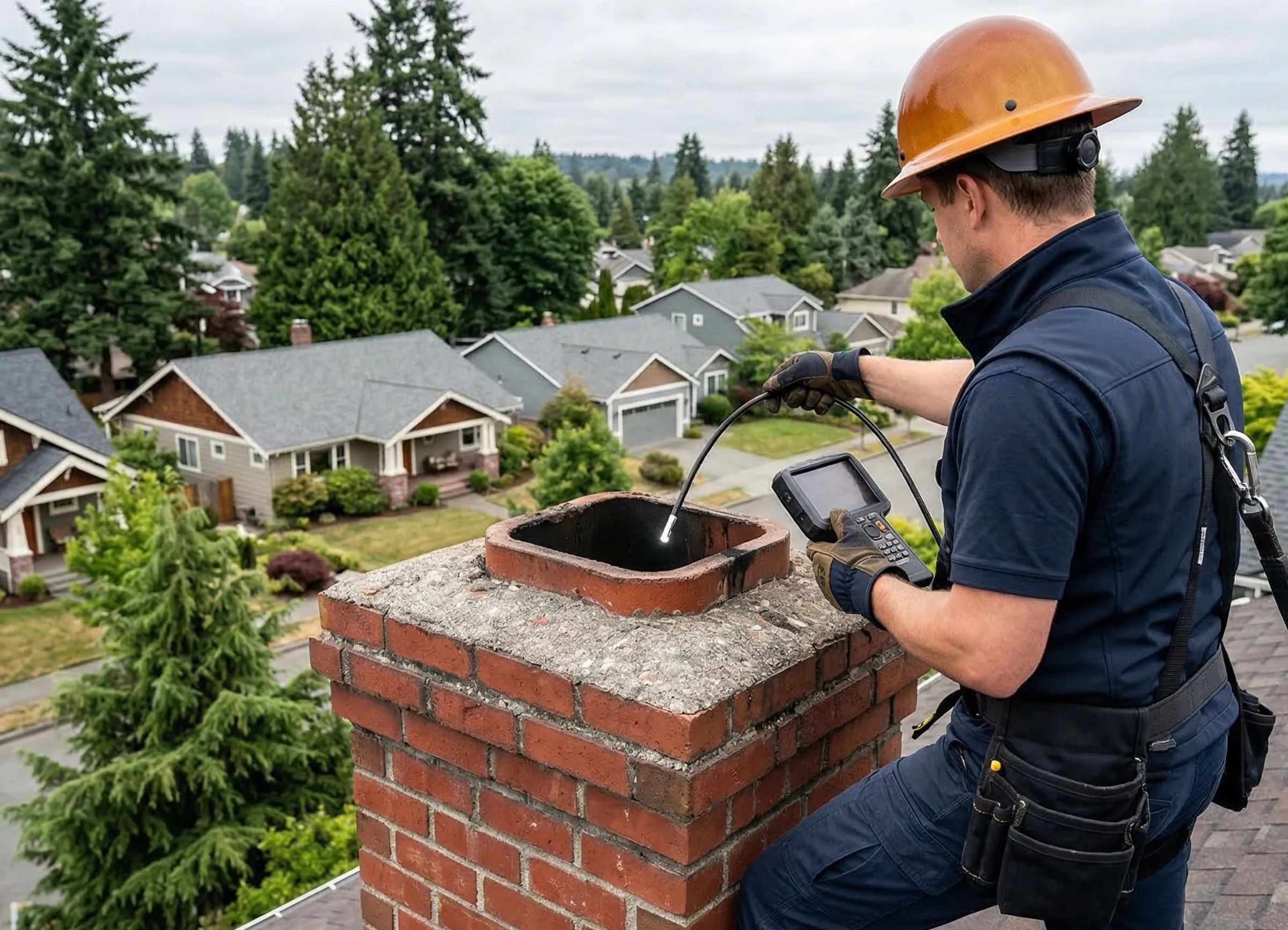
Alex arrived on a cool Tuesday morning with a camera inspection rig and a full repair kit. The exterior told part of the story immediately: the mortar joints on the south-facing chimney face were visibly recessed and crumbling, with a faint white efflorescence stain running down the brick below the crown line. The crown itself had a significant diagonal crack running nearly the full width of the chimney. But it was the flashing that had caused Marcus's ceiling stain — the counter-flashing on the uphill side of the chimney had pulled free from the mortar joint, leaving a gap wide enough to admit a steady stream of water with every Pacific Northwest rain event.
Alex brought Marcus up to speed at the firebox before heading to the roof.
'What you're seeing on that ceiling is the end result of at least two winters of water finding its way in through the flashing gap. The crown crack accelerated it — once water gets into a crown crack, it works down through the masonry and finds every weak mortar joint along the way. You've got three separate problems feeding one symptom.'
— Alex, Lead Technician, Seattle Chimney Pros
The repair scope included full counter-flashing replacement with new aluminum step flashing integrated into the shingles, an elastomeric crown sealant application over the crown crack (the crack was hairline-to-moderate, not structural), and tuckpointing on the south and west faces where mortar had recessed more than 3/4 inch. Total job time: about six hours across two visits. Total cost: $1,640, which covered flashing replacement ($780), crown sealant ($290), and partial-face tuckpointing ($570). Marcus scheduled a follow-up inspection for next spring to monitor the crown crack — if it widens through another winter, a full crown rebuild goes on the agenda for 2027.
'I kept thinking the sweep would have caught this,' Marcus said when we wrapped up. 'Now I understand a sweep and an inspection are two different things.' He's right — and that's a distinction worth understanding before your ceiling gets involved. See our breakdown of chimney sweep vs. inspection for the full picture.
Why Do Seattle Chimneys Deteriorate Faster Than Most?
Seattle's climate creates a compounding set of stress factors that most U.S. cities simply do not experience simultaneously. Understanding them helps explain why the repair intervals are shorter here and why some repair choices that work fine elsewhere — like Portland cement tuckpointing — are actively harmful on Seattle's older masonry.
The core problem is water volume combined with temperature cycling. Seattle records approximately 152 rain days per year — more than twice the national average — and its winters repeatedly oscillate through the 28°F–38°F range that causes the most destructive freeze-thaw cycling in masonry. Water absorbed into porous brick and mortar expands roughly 9% when it freezes, fracturing the material from the inside. This cycle can repeat 30-50 times in a single Seattle winter across neighborhoods like Ballard, Capitol Hill, Queen Anne, and Fremont.
Add to that the moss and lichen growth common on north-facing and shaded chimney faces throughout the Seattle metro. Moss holds moisture against brick and mortar surfaces continuously, extending water contact time from hours to weeks. Seattle's large stock of pre-1940 craftsman and Victorian homes compounds the problem further — these structures were built with soft historic brick and lime mortar that, while appropriate for their era, requires lime-matched repairs. When modern Portland cement (harder, less flexible) is used for repointing on these homes, it does not flex with seasonal thermal movement and accelerates spalling of the surrounding brick face. In 14-plus years working on Seattle chimneys, our team has remediated dozens of cases where well-intentioned but incorrect repointing caused more brick damage than the original mortar failure.
What Are the 8 Most Common Chimney Repairs in Seattle?
Here is a breakdown of every major repair type we perform, in order of frequency across our service area:
1. Tuckpointing (Mortar Joint Repair)
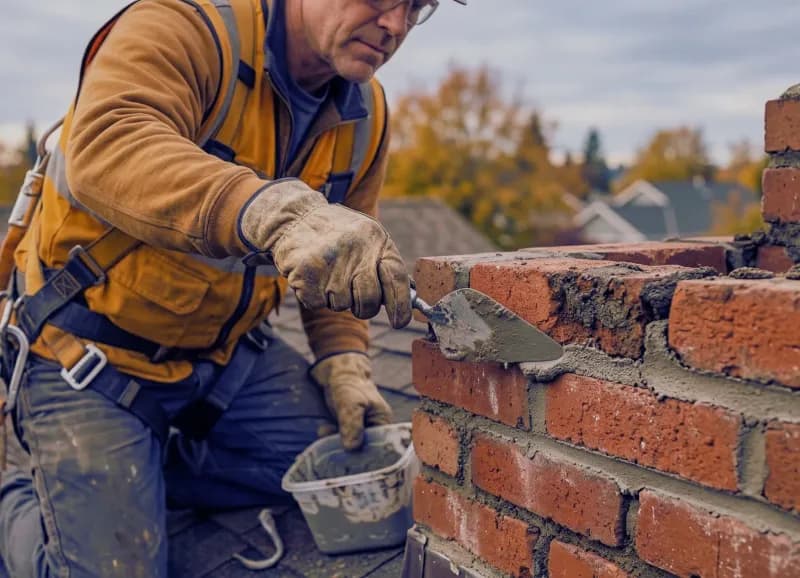
Tuckpointing is the most frequent chimney repair in Seattle by a wide margin. The mortar joints between bricks are the most porous part of any masonry chimney, and in Seattle's climate they deteriorate well before the bricks themselves. A technician removes deteriorated mortar to at least 3/4 inch depth, cleans the joint thoroughly, and packs in new mortar — lime mortar on pre-1940 homes, Type S mortar on newer construction. Full chimney tuckpointing costs $800–$2,500 depending on chimney height and the number of faces requiring repointing.
2. Chimney Crown Repair or Rebuild
The chimney crown seals the gap between the flue liner and the masonry exterior at the top of the chimney. In Seattle, we see cracked or failed crowns on the majority of homes that have not had chimney work in the past decade. Minor hairline cracking is addressed with elastomeric crown sealant ($250–$500 installed). Structural cracking or collapse requires a full crown rebuild ($500–$2,000). A correctly formed crown extends 2–3 inches past the chimney face with a drip edge — many Seattle crowns were poured flush, which accelerates runoff damage to the masonry below.
3. Flashing Repair or Replacement
Flashing is the waterproof metal barrier sealing the chimney-to-roof transition. Failing flashing is the leading cause of interior water damage that homeowners attribute to chimney problems. Counter-flashing must be mechanically embedded in mortar joints — not just surface-caulked — to hold through Seattle rain seasons. Flashing repair or replacement runs $600–$2,000 depending on scope and material choice. See our chimney flashing repair service for details.
4. Chimney Cap Replacement
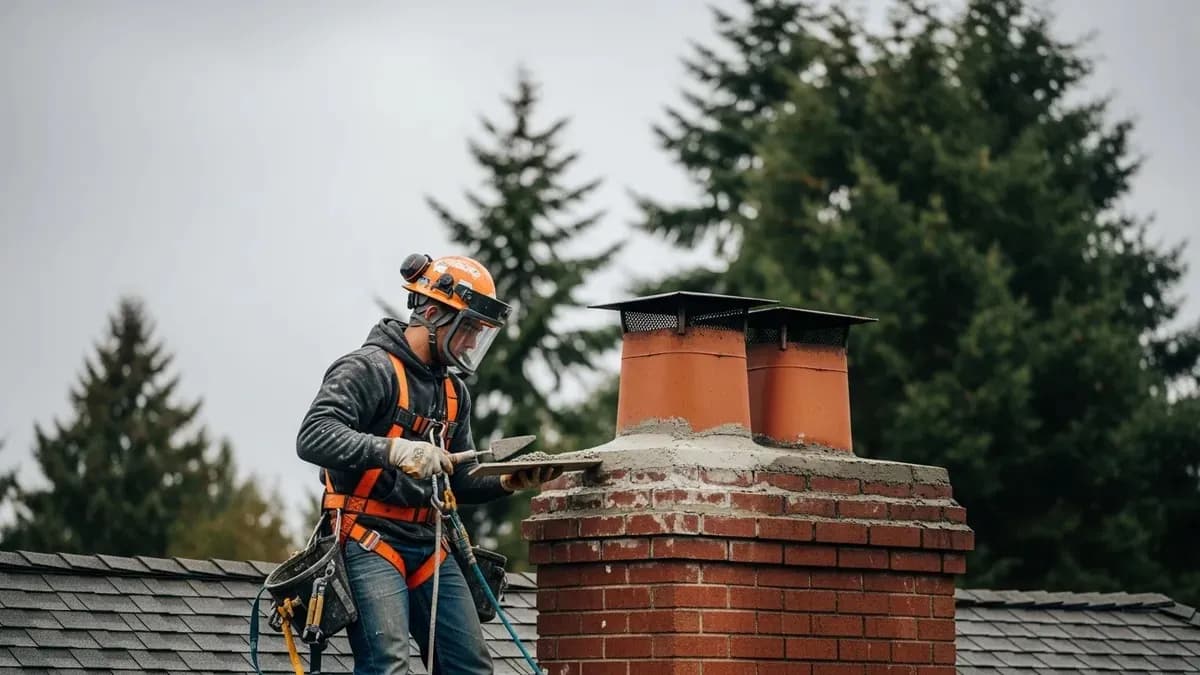
A cap blocks rain from entering the flue directly, prevents wildlife nesting, and reduces downdraft. Missing or damaged caps are a medium-high urgency repair in Seattle — an uncapped flue can admit gallons of water during a single storm. Single-flue stainless steel caps with lifetime warranties cost $200–$400 installed; galvanized caps are $100–$200 but typically last only 5–10 years in Seattle's wet climate. Our chimney cap installation service fits and secures caps to resist wind displacement.
5. Liner Repair or Relining
The flue liner is the most safety-critical chimney component. A compromised liner allows combustion gases including carbon monoxide to transfer into living spaces. Clay tile liners (standard in pre-1970 Seattle homes) crack from thermal cycling; stainless flex liners can develop joint separation over time. Any liner showing cracks wider than 1/8 inch, joint separation, or through-metal corrosion means the fireplace should not be used until repairs are complete. Stainless steel relining in a typical Seattle home runs $2,500–$5,500.
6. Firebox Refractory Repair
Firebox walls and floor are lined with refractory brick and mortar designed for temperatures up to 2,000°F. Refractory mortar joints crack from thermal cycling; spalled panels in prefab fireplaces are replaced as modular units. Refractory mortar joint repairs run $200–$600; a full masonry firebox rebuild is $1,500–$6,000.
7. Damper Repair or Replacement
Throat dampers rust and corrode in Seattle chimneys that have experienced water infiltration. A damper that will not fully close allows conditioned air to escape through Seattle's 7-month heating season — a real energy cost. Top-mounted dampers (installed at the cap level) are a popular replacement option that also adds wildlife exclusion. Replacement runs $150–$500.
8. Chimney Waterproofing
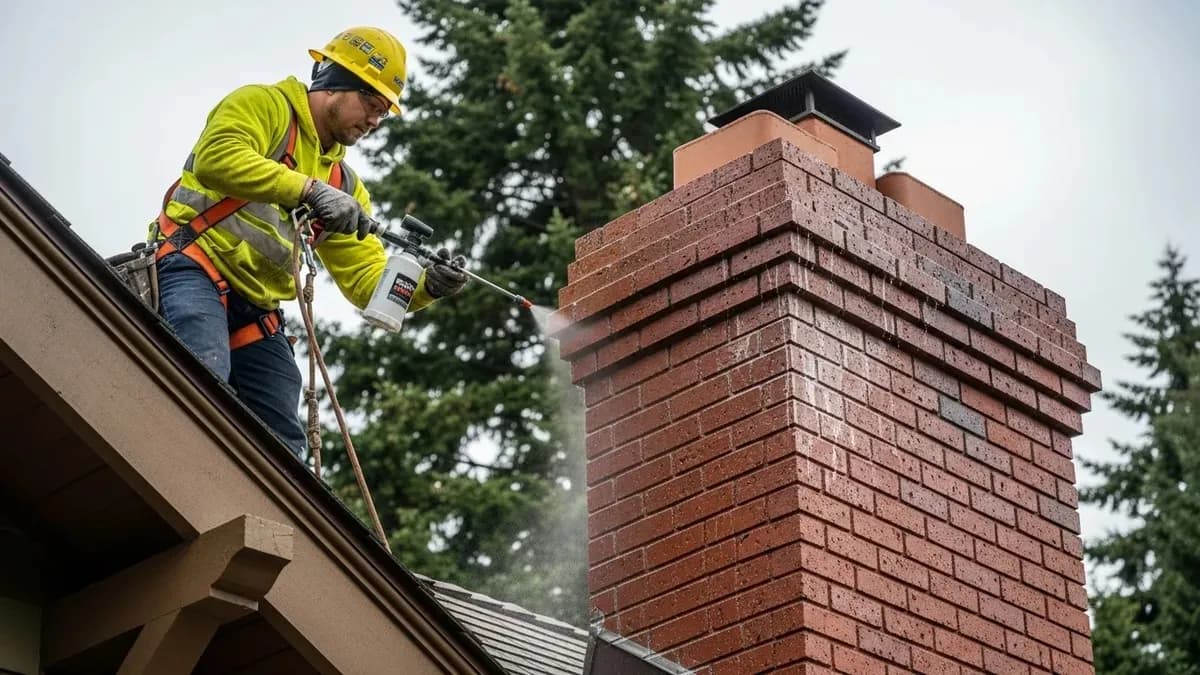
A penetrating silane/siloxane waterproofing treatment seals the masonry surface while allowing water vapor to escape — preventing the paint-trapping effect that causes spalling. Waterproofing a full chimney in Seattle typically runs $250–$600 and is most effective when applied after tuckpointing and crown work are complete, since sealant over failed mortar or a cracked crown will not stop water infiltration. Our chimney waterproofing service includes a surface condition assessment before application.
How Do You Prioritize Chimney Repairs — What Needs to Be Fixed First?
Not every chimney defect requires emergency action, but understanding urgency prevents both unnecessary panic and real safety risks. The table below ranks the eight most common Seattle chimney repairs by urgency and consequence of delay:
| Repair Type | Urgency | Risk of Delay | Typical Seattle Cost |
|---|---|---|---|
| Liner deterioration (cracks, gaps, separation) | High — suspend use now | CO intrusion, structure fire risk | $2,500–$5,500 |
| Active flashing failure with water entry | High — act before next rain | Interior structural water damage accelerates rapidly | $600–$2,000 |
| Crown cracking (moderate to severe) | High — schedule within weeks | Water infiltration damages mortar and liner | $500–$2,000 |
| Missing or damaged chimney cap | Medium-High — before fall rains | Wildlife entry, ongoing water damage | $100–$500 |
| Mortar joint tuckpointing | Medium — within the season | Accelerating masonry deterioration and water infiltration | $500–$2,500 |
| Damper repair or replacement | Medium — before heating season | Energy loss, draft problems, wildlife entry | $150–$500 |
| Crown cracking (minor hairline only) | Low-Medium — within 6 months | Minor water infiltration through a Seattle winter | $250–$500 |
| Refractory mortar joint repairs | Low-Medium — before heavy use | Accelerating firebox wear, eventual heat transfer risk | $200–$600 |
One critical sequencing rule: always complete waterproofing repairs — flashing, crown, cap — before any masonry work. Tuckpointing on a chimney with a failing crown or open flashing gap means the new mortar immediately takes on water through unresolved entry points. Fix the roof first, then fix the walls.
What Steps Should a Seattle Homeowner Take After Getting a Chimney Inspection Report?
If an inspector has handed you a report with repair findings, here is the sequence we recommend to every homeowner we work with across Seattle, Fremont, Ballard, and the broader metro:
- Identify any safety-stop findings first. Look for language like 'liner deterioration,' 'flue obstruction,' 'carbon monoxide risk,' or 'Level 3 inspection required.' These mean do not use the fireplace until resolved. Call for a repair assessment immediately.
- Separate water-entry findings from cosmetic findings. Active flashing leaks, a failed crown, and a missing cap all allow water into the structure right now. These move to the front of the queue regardless of the season.
- Get a written, itemized repair estimate — not a verbal quote. A legitimate chimney contractor will photograph all findings and provide a written scope before starting work. Any contractor who cannot do this is a red flag.
- Ask about repair sequencing. A good contractor will tell you which repairs depend on others being done first (waterproofing before tuckpointing, crown before sealant, etc.).
- Verify mortar type on pre-1940 homes. If your home predates 1940, confirm in writing that lime mortar — not Portland cement — will be used for any tuckpointing or mortar work.
For a broader view of the decision between repairing and replacing altogether, our chimney repair vs. replacement guide walks through when individual repairs stop making financial sense. And if you are heading into a home purchase with a chimney inspection flag on the disclosure, our guide to chimney inspections when buying a house explains how to interpret findings and negotiate repairs. For baseline pricing across all repair types, see our Seattle chimney repair cost guide.
We serve Seattle homeowners across Fremont, Ballard, and 40-plus communities in King, Pierce, and Snohomish counties. Our technicians are CSIA-certified, all repair work carries a written two-year labor warranty, and we photograph every finding and completed repair for your records.
Get a Written Chimney Repair Assessment From Seattle Chimney Pros
Whether you have an inspection report in hand or you have noticed symptoms on your own — rust stains, ceiling water damage, a cracked crown visible from the yard — the next step is a written assessment that identifies exactly what needs to be done, in what order, and at what cost. Seattle Chimney Pros provides itemized repair estimates across all eight of the repair types covered in this guide, with no pressure and no manufactured urgency. If your chimney needs nothing, we tell you.
Call (206) 278-2924 or request an appointment online. Most appointments are available within 3–5 business days, with priority scheduling for active leaks and safety-related inspection findings. We cover Seattle, Bellevue, and 40-plus communities across King, Pierce, and Snohomish counties.
Need professional help?
Our professionally trained team is ready. $99 inspection credited toward repairs, 30-minute response.