Chimney Repair After Winter in Seattle: 2026 Freeze-Thaw Damage Guide
What Winter Does to Seattle Chimneys — and What It Costs to Fix in 2026
Post-winter chimney repair in Seattle typically runs between $250 and $4,000 depending on what the freeze-thaw season damaged. Based on over 420 post-winter inspections our team completed across King, Pierce, and Snohomish counties in early 2026, the most common findings were cracked chimney crowns ($600–$2,200 to repair), deteriorated mortar joints ($500–$2,500 for tuckpointing), and failed chimney flashing ($600–$2,000). Seattle experiences 30–50 freeze-thaw cycles each winter — days where overnight temperatures drop below 32°F and afternoon temperatures climb back above it — and that repeated cycling is what mechanically destroys masonry that was marginal going into fall. Current as of July 2026.
Unlike Minneapolis, where winter temperatures drop and stay frozen for weeks, Seattle spends its entire rainy season oscillating through the narrow band between 27°F and 42°F that does the most structural damage to brick and mortar. Each cycle pushes water deeper into microscopic pores, freezes it (expanding 9% in volume), cracks the surrounding material slightly wider, and repeats. By spring, chimneys that looked borderline in October have visibly failing mortar, fractured crowns, and separated flashing. This guide — built from our 2026 inspection data — tells you what to look for and what to fix first.
Case Study: What We Found on a Queen Anne Craftsman After the 2025–2026 Winter
Marcus T. had lived in his 1928 Queen Anne Craftsman for eleven years without thinking much about the chimney. He burned fires a few times each winter, and the fireplace had always drawn fine. But in late February 2026, he noticed a dark stain spreading across the plaster ceiling just to the left of the fireplace breast — a stain that grew after each rainstorm. A neighbor whose chimney we'd repaired two years earlier gave him our number.
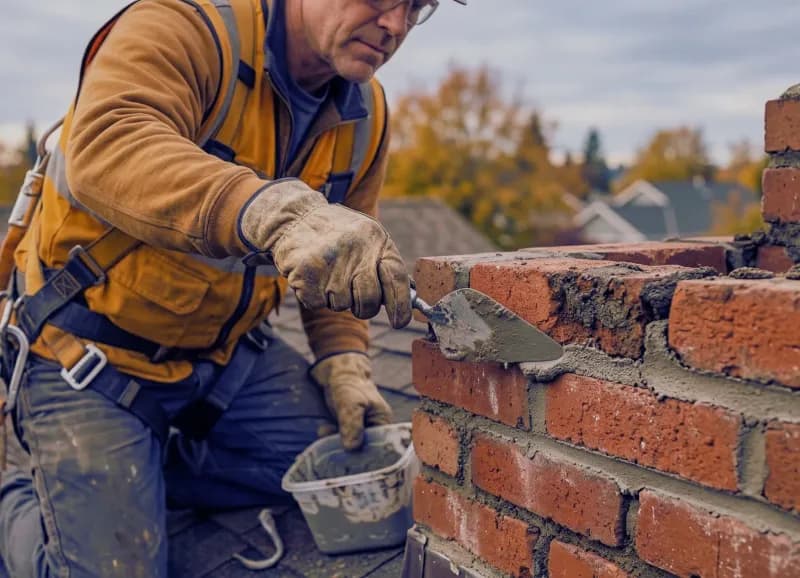
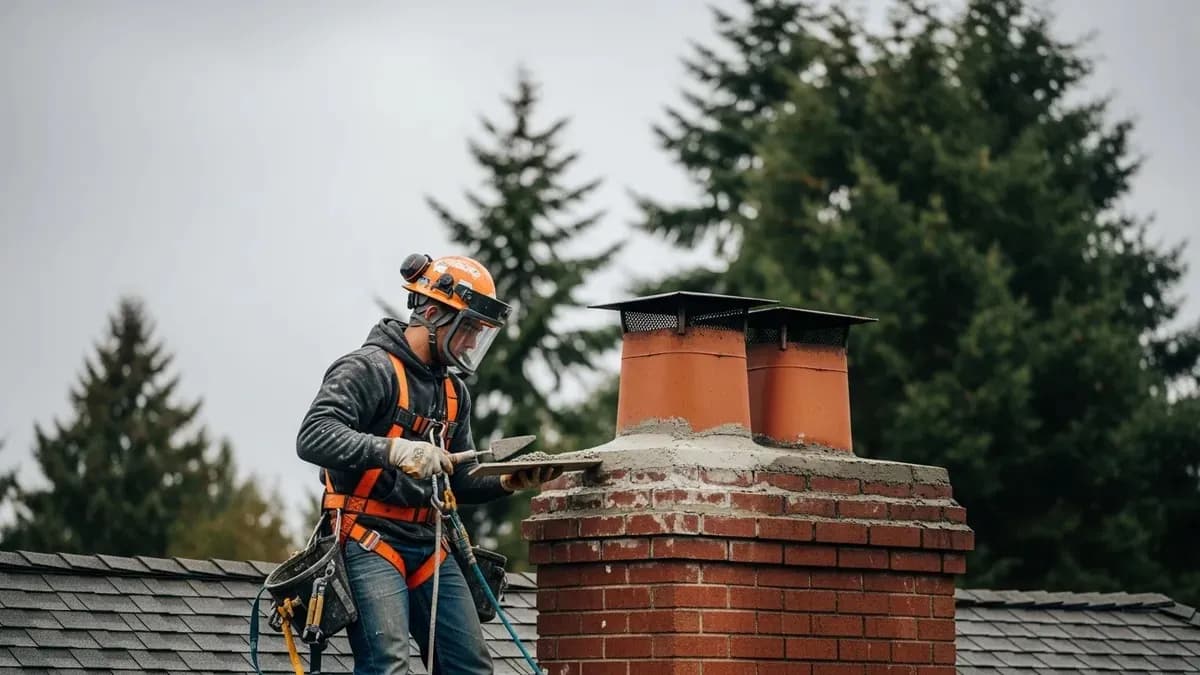
Carlos arrived on a Monday morning with a full inspection kit and a 32-foot ladder. The rooftop told the story immediately. The chimney crown — a flush-poured Portland cement cap that was original to the home's last major renovation in the early 1990s — had two through-depth cracks running from the flue collar to the drip edge. Step flashing along the chimney's north face had separated at three points, with visible daylight between the flashing base and the shingle surface. Moss had colonized the entire north-facing chimney side, holding moisture against the brick face continuously through every freeze event this past winter.
Down in the firebox, Carlos found rust streaking across the damper frame and mineral staining on the firebox walls — both signs that water had been entering through the crown and flashing for more than one season. The mortar joints on the upper two courses of brick were recessed by nearly 3/8 of an inch, well past the threshold where repointing can wait.
'The crown crack and the step flashing separation are working together here — water gets in at the top through the crown, and then again at the roof line through the flashing. By the time it shows up on Marcus's ceiling, it's already traveled through two feet of roof framing. Both entry points need to be closed before we touch the mortar or anything else.'
— Carlos, Lead Technician, Seattle Chimney Pros
We completed the repairs over two visits: crown rebuild and flashing replacement on day one ($1,640 combined), then mortar tuckpointing on the upper courses once the chimney had dried out ($780). Marcus had the ceiling plaster patched by a separate contractor. Total chimney repair cost: $2,420. 'I kept telling myself it could wait until fall,' he said afterward. 'Carlos showed me the photos from the rooftop and I understood immediately why it couldn't.'
Why Does Seattle's Climate Cause So Much Chimney Damage?
Seattle records approximately 152 rain days per year — more than twice the national average — and its winters spend a disproportionate share of time cycling through the 28°F–38°F temperature band that is most destructive to masonry. The physics are straightforward: water expands by 9% when it freezes. Inside a mortar joint or brick pore, that expansion applies outward pressure on the surrounding material. On the first cycle, the resulting crack may be microscopic. By cycle 40, it is structural.
Three Seattle-specific factors make this worse than raw weather data suggests:
- Moss and lichen growth — present on rooftops and chimney surfaces of most homes over ten years old in Capitol Hill, Queen Anne, Ballard, and Bellevue — hold moisture against masonry for weeks, keeping brick and mortar saturated through freeze events when surrounding surfaces have already dried.
- Soft historic brick — Seattle's large inventory of pre-1940 Craftsman bungalows and Victorians was built with more porous brick and lime mortar than modern construction. These materials absorb water more readily and deteriorate faster under freeze-thaw stress.
- Proximity to Puget Sound — marine air keeps temperatures mild enough that Seattle rarely stays frozen for extended periods. The constant oscillation through freezing is far more damaging than a sustained deep freeze.
In our 14+ years performing chimney repair across the Seattle metro, pre-1950 homes consistently show more severe post-winter damage than mid-century or newer construction — but no era of chimney is immune to freeze-thaw deterioration.
What Are the Most Common Post-Winter Chimney Problems in Seattle?
Based on 420+ post-winter inspections completed across the Seattle metro in spring 2026, here are the findings we documented most frequently, in order of prevalence:
- Crown cracking — present in over 55% of chimneys that had not received recent maintenance. The concrete crown sits fully exposed at the chimney top with no protection above it, making it the first component to fail under repeated freeze-thaw stress.
- Mortar joint deterioration — found in approximately 65% of spring inspections across Queen Anne, Capitol Hill, Ballard, and greater King County. Mortar is more porous than brick and acts as the chimney's sacrificial layer, absorbing and releasing water more readily than the brick faces.
- Flashing failure — identified in roughly 38% of inspections, most often at the back pan flashing behind the chimney and at surface-caulked counter-flashing joints that have dried and cracked through successive wet-dry cycles.
- Brick spalling — visible face delamination on one or more bricks, found in about 22% of inspections. By the time spalling appears, freeze-thaw deterioration has been active for multiple seasons.
- Cap damage or absence — missing, cracked, or rusted caps found on 18% of inspected chimneys, typically combined with at least one other finding.
Our guide to signs your chimney needs repair covers all the visual indicators you can assess from the ground before scheduling a professional inspection.
How Do You Spot Crown Damage From the Ground — and When Is It Urgent?
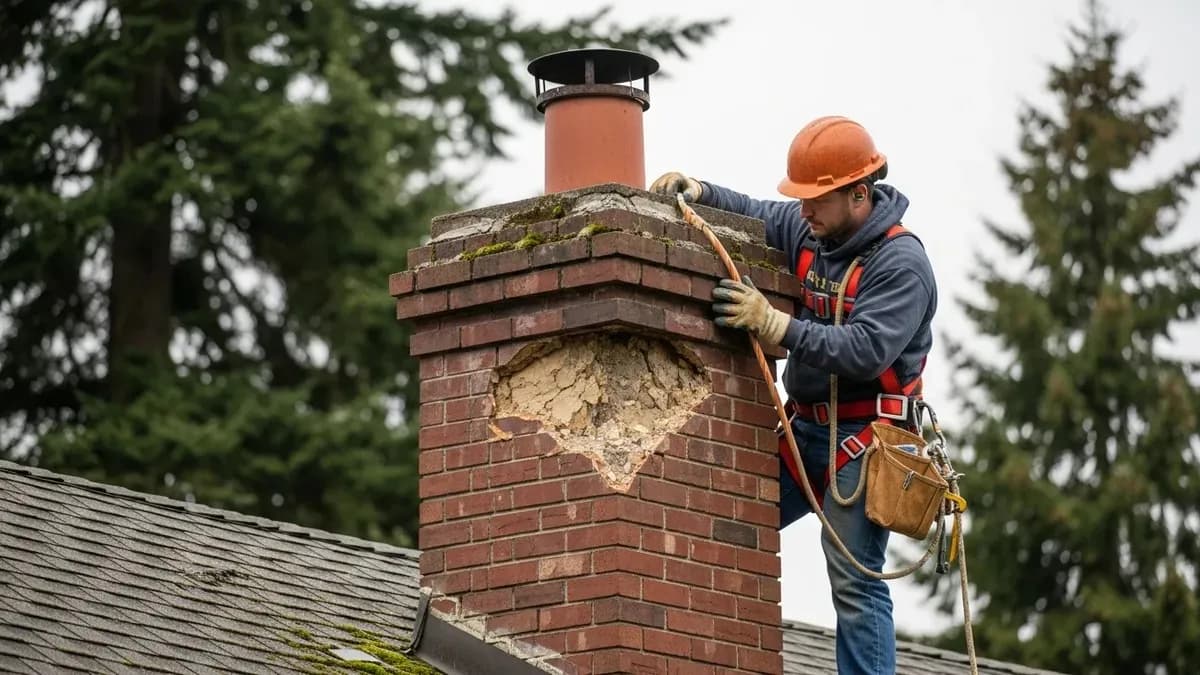
The chimney crown is the concrete or mortar slab sealing the top of the chimney between the flue collar and the outer edge. It bears the full impact of Seattle's rainfall with no protection above it. From the ground with binoculars, you can sometimes see obvious crown fractures or missing sections — but hairline cracks and partial-depth cracking require rooftop access to assess accurately.
Crown damage falls into three categories with different urgency levels:
- Hairline surface cracks — fine cracks radiating from the flue collar or running along the crown face. Require sealing with elastomeric crown sealant. Cost: $250–$500. Urgency: address within the season.
- Structural through-depth cracks — cracks exceeding 1/4 inch width, or cracks with differential movement on either side, indicating the crown is no longer an effective water barrier. Require full rebuild. Cost: $600–$2,200. Urgency: within 2–4 weeks.
- Delamination or collapse — sections physically breaking away from the crown body, exposing masonry below. Immediate repair warranted. Cost: $800–$2,200. Urgency: before the next rain event.
A cracked crown that goes through a second Seattle winter without repair accelerates deterioration in every component below it — mortar joints, liner, damper, and firebox. The repair scope and cost of deferred crown failure almost always exceeds the cost of the crown repair alone. See our Seattle chimney crown repair cost guide for full pricing details.
How Do You Know If Chimney Flashing Failed This Winter?
Flashing failure is the most consequential and most easily missed post-winter damage type. Unlike crown cracking or mortar deterioration, failed flashing produces no obvious visual cue from the ground. The evidence appears on interior ceilings and walls near the fireplace, or in attic sheathing — and by the time interior water damage is visible, the flashing has typically been failing across multiple rainstorms.
In Seattle, the flashing areas most likely to show new failure after a winter include:
- The back pan flashing behind the chimney — where roof runoff concentrates and creates the highest sustained water contact point on the assembly
- Surface-caulked counter-flashing — present on many Seattle homes as the primary seal rather than properly embedded metal. These sealant-only repairs typically last 3–7 years in Seattle's wet climate before cracking and separating.
- Step flashing at the chimney sides — where seasonal shingle movement from moisture cycling creates gaps and separation at the base
An active flashing failure in Seattle is a high-priority repair. Water remediation costs for a flashing failure active through a full rainy season routinely run $3,000–$10,000 in roof framing, wall cavities, and ceiling assemblies. Our chimney flashing repair service includes assessment of adjacent roof components to ensure no secondary entry points are missed. See our chimney flashing repair cost guide for pricing details.
What Should You Repair First? Post-Winter Priority Ranking for Seattle Homeowners
After a Seattle winter, an inspection report may identify multiple issues simultaneously. The following table reflects how our technicians prioritize repair recommendations across 400+ post-winter assessments per year in Seattle and King County. The sequencing rule is critical: water entry repairs must come before masonry repairs. Tuckpointing mortar joints while a failed crown is still admitting water is counterproductive — the new mortar begins taking on water immediately.
| Damage Type | Urgency | Risk If Delayed | Typical Cost (2026) |
|---|---|---|---|
| Active flashing failure with interior water entry | Emergency — before next rain | Ceiling and framing damage compounds with every storm | $600–$2,000 |
| Crown cracking (structural, through-depth) | High — within 2–4 weeks | Unrestricted water reaches mortar, liner, and damper below | $600–$2,200 |
| Missing or significantly damaged chimney cap | High — before nesting season | Wildlife entry plus ongoing flue water damage | $150–$500 |
| Widespread brick spalling | High — assess this season | Structural compromise; repair scope grows significantly | $1,000–$4,000+ |
| Mortar joint tuckpointing (moderate deterioration) | Medium — within this season | Accelerating brick deterioration through next winter | $500–$2,500 |
| Damper corrosion or restricted movement | Medium — before heating season | Energy loss, draft problems, wildlife entry | $200–$600 |
| Crown cracking (hairline surface only) | Medium — within 6 months | Progressive cracking through next winter if unsealed | $250–$500 |
| Isolated brick spalling (1–3 bricks) | Low-Medium — monitor | Cosmetic risk if water entry source is resolved | $200–$600 |
The Correct Repair Sequence
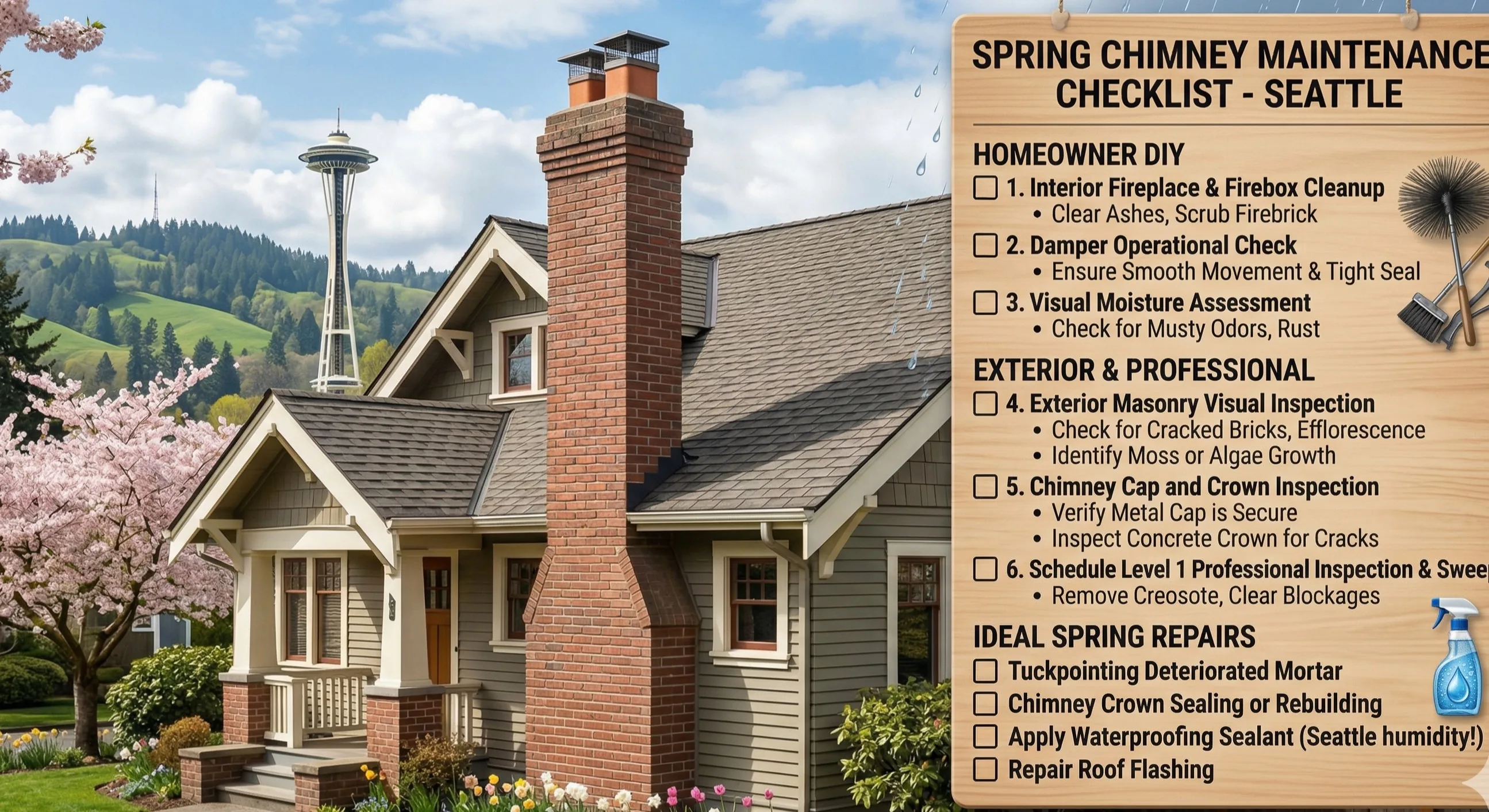
- Stop all water entry first — repair crown, flashing, and cap before touching mortar or brick. Any masonry work done while water is still entering is compromised from day one.
- Address masonry damage — tuckpointing, brick replacement, and refractory repairs once the chimney has had time to dry out.
- Apply waterproofing — a penetrating masonry sealant applied to dry, repaired masonry extends the life of every repair performed in the prior steps and significantly slows future freeze-thaw deterioration.
- Schedule the follow-up — book a Level 1 inspection the following spring to verify no new damage developed and that all repairs held through the subsequent winter.
For full pricing across all repair types, see our Seattle chimney repair cost guide. For the waterproofing step, our chimney waterproofing cost guide explains what the treatment covers and when it makes sense.
What Should You Do Right Now If You Suspect Winter Chimney Damage?
July is an ideal time to address post-winter chimney damage in Seattle. The freeze-thaw season is fully behind us, the dry summer window gives masonry the drying time needed before repairs are made, and scheduling availability is significantly better now than it will be in September and October when fall demand creates 2–3 week waits across every chimney company in the metro. Repairs made in summer on dry masonry also bond more reliably than the same work done in wet fall conditions.
If your chimney showed any signs described in this guide — visible mortar deterioration, crown staining or cracking, interior water marks near the fireplace, a damaged cap, or efflorescence on exterior brick — schedule a professional rooftop assessment now, while the repair is still straightforward. Every Seattle winter that passes without addressing confirmed chimney damage compounds the eventual repair scope. Based on our 2026 inspection data, deferred chimney repairs in Seattle typically cost 30–60% more after one additional winter than they would have if addressed the prior spring.
Seattle Chimney Pros serves 45 communities across King, Pierce, and Snohomish counties, including Queen Anne, Ballard, and surrounding neighborhoods. Every assessment is performed by a CSIA-certified technician who inspects from the rooftop, documents findings with photographs, and provides a written, itemized estimate before any work begins. To schedule your post-winter chimney repair, call (206) 278-2924 or request an appointment online. Most summer appointments are available within 3–5 business days.
Need professional help?
Our professionally trained team is ready. $99 inspection credited toward repairs, 30-minute response.