First-Time Homeowner Chimney Guide for Seattle (2026 Edition)
What Every New Seattle Homeowner Needs to Know About Their Chimney in 2026
As a new Seattle homeowner, your chimney is one of the most expensive systems to neglect — and one of the cheapest to maintain when you catch problems early. A professional Level 2 chimney inspection runs $249–$399 in the Seattle metro, and that single visit either confirms you're safe to use the fireplace or identifies issues before they become multi-thousand-dollar repairs. Based on over 2,500 inspections our team has completed across Seattle neighborhoods since 2011, about 60% of homes purchased in the last two years had at least one deferred maintenance item — most commonly a missing chimney cap, cracked crown, or failed flashing. The good news: none of those are dramatic if you catch them in year one. This guide gives you a complete roadmap for your first year as a chimney owner in Seattle. Current as of July 2026.
A Real First-Year Story: Marcus T. in Greenwood
Marcus T. closed on a 1952 brick Craftsman in Greenwood last October, right as Seattle's fall rains set in. The home inspection report noted the chimney was "functional" with a recommendation to have it serviced — language Marcus assumed meant it was mostly fine. He lit a fire the first cold night and immediately noticed a faint smoky smell drifting into the living room. A Google search for "chimney smoke smell new house Seattle" brought him to our scheduling page.
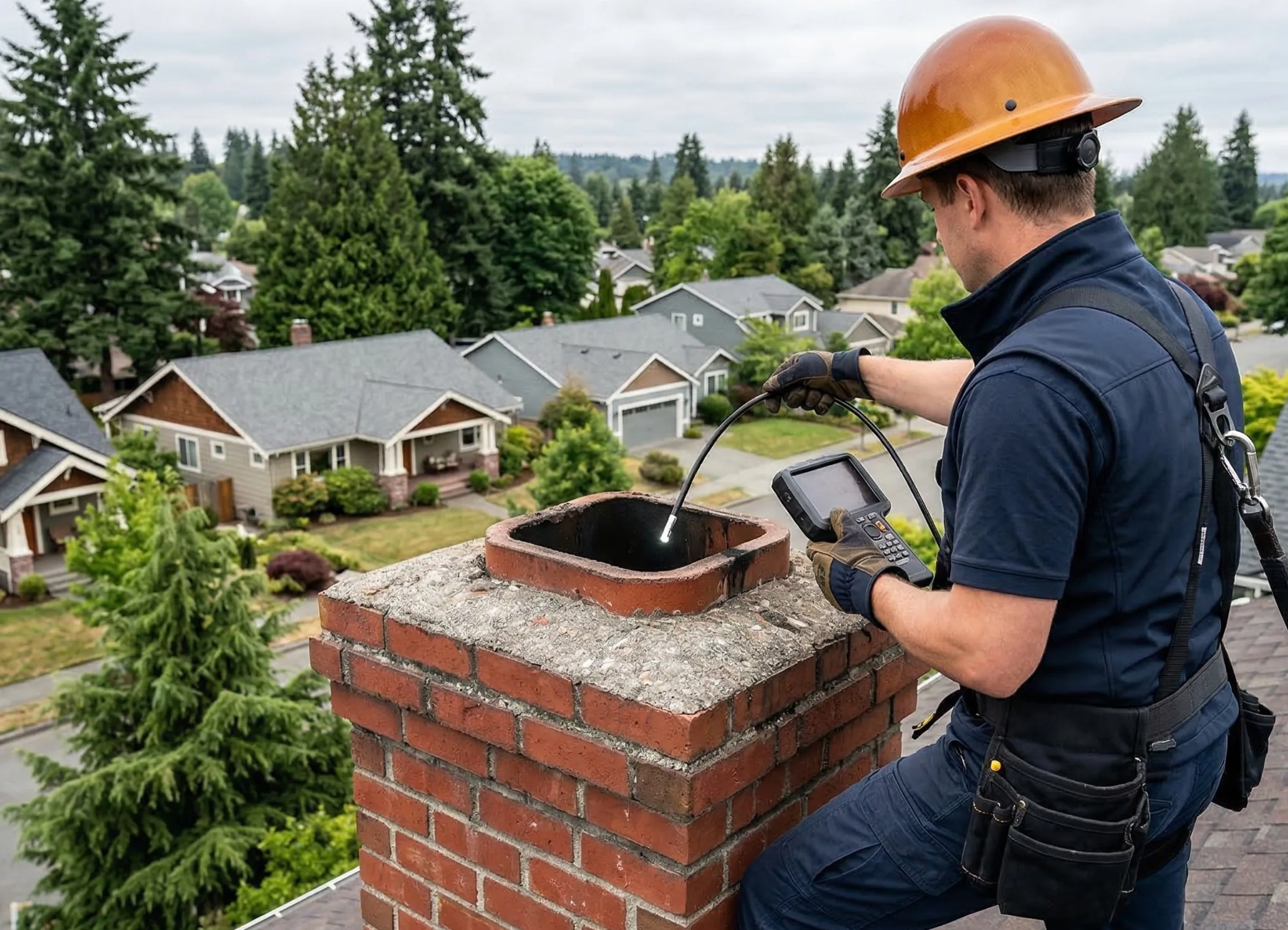
Alex arrived two mornings later with a full Level 2 inspection kit. He started on the roof, where he spotted the first problem within sixty seconds of setting up his ladder: the original clay-and-mortar crown had a diagonal crack running nearly its full width, with a thin strip of moss growing in the gap. Rainwater had been pooling in that crack and wicking down through the brick for at least two or three winters.
The camera scan told the rest of the story. The flue liner — original 1952 clay tile — had a hairline fracture about four feet below the damper, likely from decades of thermal cycling. The smoke smell Marcus noticed wasn't dangerous yet, but it was a warning sign that combustion gases were beginning to bypass the liner.
"That crown crack and the liner fracture are related — water got in through the crown, froze and thawed inside the flue tile, and split it over time. This is exactly the pattern we see in pre-1960 Greenwood and Ballard homes. The crack isn't an emergency today, but light another fifty fires on a fractured liner and you're rolling the dice on carbon monoxide getting into the house."
— Alex, Lead Technician, Seattle Chimney Pros
Alex's recommendation: seal the crown immediately ($375), schedule a stainless steel liner installation before the heating season ($2,100 for a single-flue reline), and add a stainless cap since the existing galvanized one had rusted through at two of its four corners. Total project: $2,850, spread across two visits. Marcus also added our annual maintenance plan so his next inspection and sweep are automatically scheduled for September 2026. "I honestly thought the home inspector's 'looks functional' meant I had years before I needed to worry about it," Marcus told us. "Knowing exactly what was wrong and having a clear fix felt way better than the vague dread I had after moving in."
What Type of Chimney Does Your Seattle Home Have?
Before you schedule anything, identify which of the three main chimney types you have — each has different maintenance needs, lifespans, and common failure points.
Masonry chimney (brick and mortar): Visible brick exterior, clay tile or stainless steel liner inside, concrete crown on top. The most common type in Seattle homes built before 1980 — Capitol Hill, Queen Anne, Ballard, Wallingford, Fremont, Beacon Hill. Lifespan of 50–100+ years with maintenance, but vulnerable to Seattle's rain, freeze-thaw cycles, and seismic activity.
Prefab (factory-built) chimney: Wood-framed chase covered in siding (vinyl, wood, or stucco) with a metal pipe inside rather than brick. Common in homes built 1980–2010, especially in Bellevue, Kirkland, Redmond, Issaquah, and newer King County developments. Manufacturer-rated lifespan of 15–25 years — after which the entire system, not just the pipe, typically needs replacement.
Gas direct-vent: Sealed glass front on the fireplace, vents through a horizontal or short vertical pipe through the wall. No tall chimney structure. Common in condos, townhouses, and post-2000 construction. Lowest maintenance needs, but still requires annual inspection and service.
Not sure which type you have? Your home inspection report should identify it. You can also send us a photo and we'll tell you in minutes. For a deeper comparison, see our guide on masonry vs. prefab chimneys in Seattle.
What Are the 5 Things to Check on Your Chimney Right Now?
Whether you bought a 1920 Craftsman in Ballard or a 2005 Colonial in Bellevue, check these five components before you light your first fire. The exterior checks you can do yourself; the interior ones require a professional.
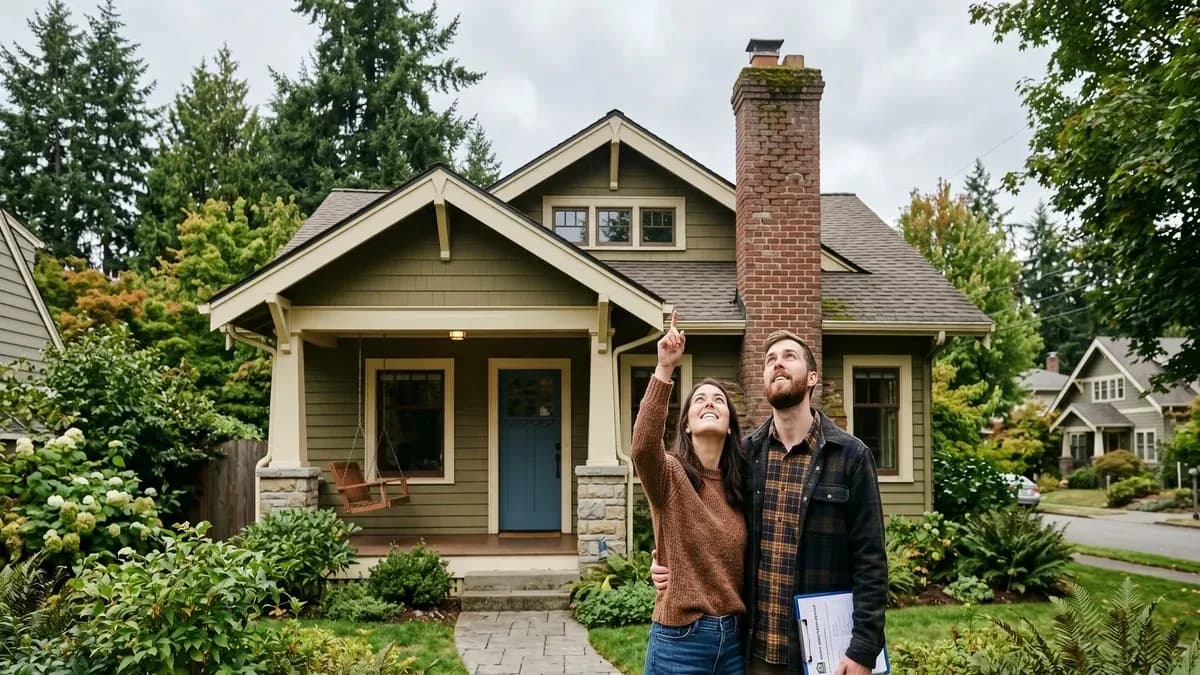
- Chimney cap: Go outside and look up at the top of the chimney. Is there a metal cap with mesh sides? If not, your flue is open to Seattle's 37+ inches of annual rain, plus raccoons, chimney swifts, and debris. A missing cap is the single most common finding on newly purchased homes. A stainless steel chimney cap costs $300–$600 installed and pays for itself within one rainy season.
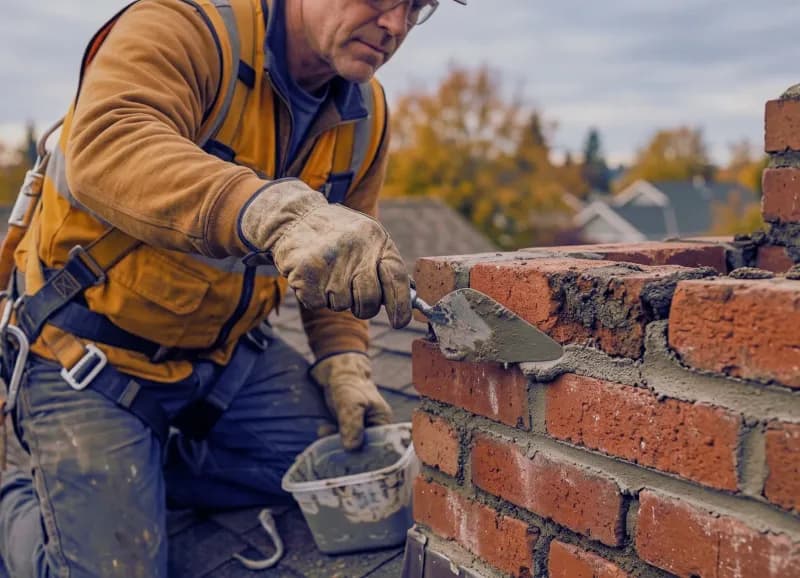
- Chimney crown: The concrete slab on top of the masonry chimney surrounding the flue tiles. Look for cracks, missing chunks, or moss growing in the joints. A cracked crown lets water into the chimney structure — in Seattle's climate, a failing crown deteriorates fast. Small cracks can be sealed for $250–$500; full rebuilds run $1,500–$3,500.
- Flashing: The metal strip where the chimney meets the roof. Look for gaps, rust, lifted edges, or caulk (a sign of a temporary patch, not a real repair). Failed flashing is the number-one cause of chimney leaks in Seattle — and the number-one chimney issue misdiagnosed as a roofing problem. See our flashing repair service page for details.
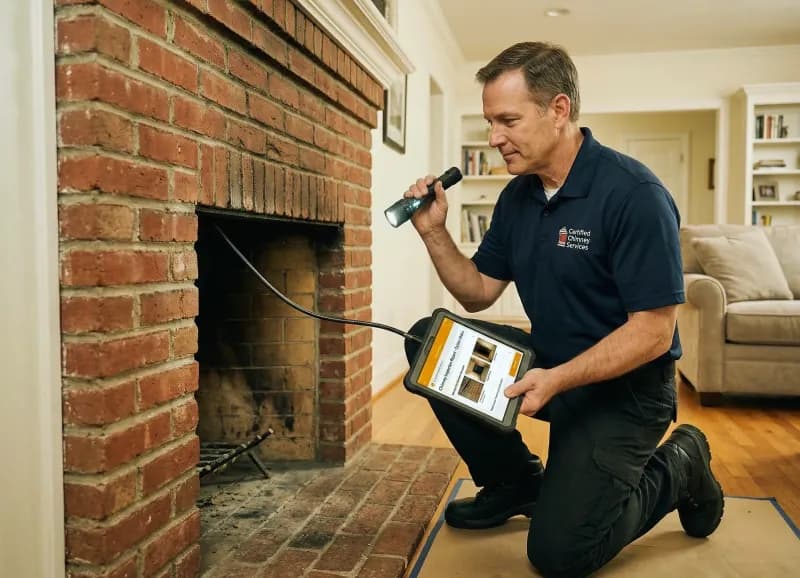
- Flue liner (requires camera): You can't see the liner from outside or by looking up from the firebox. A Level 2 chimney inspection — which NFPA 211 requires after every property transfer — uses an HD camera to scan the interior for cracked tiles, deteriorated mortar, creosote buildup, and obstructions.
- Damper: Open the damper inside the firebox and check that it moves freely and seals tightly when closed. A stuck or missing damper wastes hundreds of dollars in heating energy per winter and can let rain and animals into the flue. Damper repair or replacement runs $150–$600 depending on type.
Why Is a Level 2 Inspection Required When You Buy a Home?
NFPA Standard 211 requires a Level 2 chimney inspection whenever a property changes hands. This is not the same as what your general home inspector did during the sale. Home inspectors look at the chimney from the ground and the inside of the firebox — they don't have chimney cameras, they typically don't access the roof, and they aren't trained as chimney specialists. Passing a general home inspection says almost nothing about flue liner integrity.
A Level 2 inspection includes:
- Rooftop examination of the crown, cap, flashing, and brick or chase condition
- HD video scan of the entire flue interior from top to bottom
- Firebox inspection — refractory panels, damper, smoke chamber
- Accessible attic and crawlspace check for clearance-to-combustibles violations
- Written report with photos, video footage, and a prioritized repair list
Cost in the Seattle metro: $249–$399. That's the best $300 you'll spend as a new homeowner. It either confirms everything is safe — real peace of mind — or identifies problems early when they're cheapest to fix. We perform hundreds of real-estate Level 2 inspections every year across Seattle, Bellevue, Kirkland, Tacoma, and the Eastside. Schedule your inspection here.
How Do You Read a Chimney Inspection Report?
After a Level 2 inspection, your technician will hand you a written report with photos and video. Here's how to interpret it without getting overwhelmed.
| Condition Rating | What It Means | What to Do |
|---|---|---|
| Serviceable | Component is functional and safe | Normal annual maintenance only |
| Serviceable — needs repair | Functional but deteriorating; needs attention within 6–12 months | Schedule repair before next heating season |
| Not serviceable | Component has failed or is unsafe | Do not use the fireplace until repaired |
| Level 3 recommended | Hidden damage suspected behind walls or in concealed areas | Requires invasive inspection — discuss with your technician |
If the report lists multiple issues — common in older Seattle homes — prioritize in this order:
- Priority 1 — safety, fix immediately: Cracked flue liner, missing cap, clearance violations, carbon monoxide risk
- Priority 2 — water damage, fix within 3 months: Failed flashing, cracked crown, actively leaking cap
- Priority 3 — maintenance, fix within 12 months: Minor mortar joint deterioration, damper adjustment, waterproofing
What Does Chimney Maintenance Cost in Seattle in 2026?
One of the biggest anxieties for first-time owners is not knowing what to budget. Here's a realistic cost framework for your first year and beyond, based on jobs we've completed across the Seattle metro.
| Service or Repair | Typical Cost (Seattle 2026) | Frequency |
|---|---|---|
| Level 2 inspection | $249 – $399 | Once at purchase; annually thereafter |
| Chimney sweep (wood-burning) | $179 – $349 | Annually (more if heavy use) |
| Chimney cap installation | $300 – $600 | Once; replace every 15–20 years |
| Crown seal or patch | $250 – $1,500 | Every 5–10 years |
| Flashing repair | $400 – $1,200 | As needed (common in year 1) |
| Tuckpointing (mortar joints) | $500 – $2,500 | Every 10–15 years on older homes |
| Waterproofing | $350 – $700 | Every 5–8 years |
| Chimney relining | $1,500 – $3,500 | Once (lasts 25–50 years) |
A healthy chimney in year one costs $300–$600 (inspection + sweep). A chimney with common deferred maintenance — like Marcus's in Greenwood — typically runs $1,500–$3,500 in the first year to bring it current. Going forward, budget $300–$500/year averaged over time. For detailed pricing, see our complete Seattle chimney repair cost guide and our chimney sweep cost breakdown.
What Makes Seattle Chimneys Different From the Rest of the Country?
Seattle's climate and geography create chimney problems that are more severe — and more common — than in most U.S. cities. Here's what to watch for as a new local homeowner.
Rain damage: With 37+ inches of annual rainfall and over 150 rain days per year, water is the number-one enemy of Seattle chimneys. Water penetrates cracked crowns, failed flashing, deteriorated mortar joints, and porous brick. Once inside, it rusts dampers, cracks liners during freeze-thaw cycles, rots adjacent framing, and stains ceilings. Waterproofing with a breathable siloxane sealant runs $350–$700 and provides 5–8 years of protection — one of the highest-ROI investments for Seattle masonry.
Earthquake vulnerability: Seattle sits on multiple active fault zones. The 2001 Nisqually earthquake damaged thousands of chimneys across the region, and seismologists warn a major Cascadia Subduction Zone event is statistically overdue. Older unreinforced masonry chimneys are among the most earthquake-vulnerable structures in a home. If your chimney shows diagonal cracking, separation from the house wall, or visible lean, get an assessment before using it. See our guide on earthquake chimney damage in Seattle.
Old housing stock: Over 40% of Seattle's homes were built before 1960. Many have original clay liners that are now 65–80+ years old, no chimney caps (builders rarely installed them), and mortar joints that haven't been touched in decades. Homes in Capitol Hill, Queen Anne, Ballard, and Beacon Hill routinely present $1,000–$5,000 of deferred maintenance. The earlier you address it, the cheaper it is. Our guide to chimney care for historic Seattle homes goes deeper on this.
Moss and biological growth: Moss thrives on Seattle chimneys and holds moisture against brick and mortar, accelerating deterioration. Never pressure-wash a chimney — it drives water into the masonry and erodes mortar joints. Gentle brushing, zinc strips on the cap, and periodic mortar maintenance are the right approach.
What Can You Do Yourself vs. When Should You Call a Pro?
Some chimney tasks are safe for homeowners. Others are genuinely dangerous or require specialized equipment. Here's the honest breakdown.
Safe for DIY:
- Visual inspection from the ground (binoculars help for the cap and crown)
- Checking the damper for free movement from inside the firebox
- Cleaning ash out of the firebox
- Replacing smoke and CO detector batteries
- Gentle moss removal from exterior brick with a soft brush — no pressure washer
- Checking for water in the firebox after heavy rain
Call a professional:
- Chimney sweeping — requires specialized rods, brushes, and HEPA vacuum. A bad DIY sweep can push debris into the smoke chamber or damage the liner. (How often should you sweep in Seattle?)
- Chimney inspection — a proper Level 2 requires an HD camera system, roof access, and CSIA-trained technicians. (Book a Level 2 inspection)
- Any work on the roof — falls from roofs are the leading cause of fatal home-improvement injuries. Seattle roofs are steep, often moss-covered, and regularly wet.
- Flashing, crown, or masonry repair — requires proper materials, technique, and fall-protection equipment. (Chimney repair services)
- Liner inspection or replacement — requires a chimney camera and specialized relining equipment
- Anything involving gas lines — Washington State requires a licensed professional for all gas appliance work
A practical rule: if you can do it safely from ground level with basic tools, it's probably fine DIY. If it requires a ladder above the eave, specialized equipment, or involves fire or gas safety, call a pro. For help picking the right company, see our guide on how to choose a chimney sweep in Seattle.
What Are the Red Flags That Need Immediate Attention?
Some chimney issues can wait for a scheduled appointment. These cannot — address them before using the fireplace again:
- Smoke entering the room when the fireplace is in use — indicates a blocked flue, failed liner, or draft problem. Stop using the fireplace immediately. (Why smoke backs up into the house)
- White staining (efflorescence) on interior walls near the chimney — water is entering the chimney structure and migrating into your home. (What efflorescence means)
- Strong odor from the fireplace, especially in summer — often indicates creosote buildup, animal entry, or water damage. (Chimney smell causes and fixes)
- Visible leaning or chimney separation from the house wall — structural failure, possibly seismic. Do not use the fireplace.
- Crumbling mortar or falling brick pieces — active deterioration that worsens with every rain event. (Signs your chimney needs repair)
- CO detector alarming when the fireplace is in use — shut down the fire, open windows, evacuate if levels don't drop. (Carbon monoxide warning signs)
- Water actively dripping into the firebox — the crown, cap, or flashing has failed. Will cause rapid damage through Seattle's rainy season.
- Rust flakes or orange staining inside the firebox — the damper is corroding, which means moisture is consistently reaching internal metal components
Your First-Year Seattle Chimney Checklist and Maintenance Calendar
Here's a month-by-month roadmap for your first year of chimney ownership in Seattle.
Months 1–2 (Right after purchase):
- Identify your chimney type (masonry, prefab, or gas direct-vent)
- Do a ground-level visual check — cap, crown, flashing, and brick
- Open and close the damper to verify it moves freely
- Schedule a Level 2 chimney inspection ($249–$399)
- Address any safety-critical findings before lighting a fire
Spring (March–May): Best time for repairs — contractors have more availability, weather is drying out, and you have months before the next heating season. Schedule a chimney sweep if the inspection found creosote ($179–$349), complete any repair work identified, and consider waterproofing if brick is absorbing moisture. See our full spring maintenance checklist.
Summer (June–August): Ideal for major projects — masonry rebuilds, relining, flashing replacement. Dry weather makes mortar curing more reliable. Also check for animal nesting; chimney swifts nest May through September and are federally protected.
Fall (September–November): Annual pre-season inspection and sweep. Test the damper, check the firebox for cracks, stock firewood (best firewood for Seattle), and verify smoke and CO detectors have fresh batteries. See our fall chimney maintenance checklist.
Winter (December–February): Burn dry hardwood only; never close the damper on an active fire. Watch for warning signs: smoke in the room, white staining on brick, water in the firebox. Know the signs of a chimney fire emergency and what to do.
Going forward, budget $300–$500/year averaged over time — about $25–$40/month. Set it aside like a roof or HVAC reserve. Homeowners who budget proactively spend dramatically less over the life of their chimney than those who defer until something fails.
Ready to Start? Here's How to Get Your Chimney Cleared for Use
Seattle Chimney Pros has been helping new homeowners understand and maintain their chimneys since 2011. Our CSIA-certified technicians have inspected over 2,500 homes across Seattle, Bellevue, Kirkland, Tacoma, and every neighborhood in between. Whether you need your first Level 2 inspection, want a second opinion on a report from another company, or just have questions about what you're looking at on your roof — we're happy to help. Call us at (206) 278-2924 or schedule online. Most new-homeowner inspections are booked within 3–5 business days.
Need professional help?
Our professionally trained team is ready. $99 inspection credited toward repairs, 30-minute response.